
These days, great weather is as unusual and unexpected as anything else that comes along. The last month or so, we’ve been getting rain around weekly, with sun in between. Ignoring the two days of overnight cold snaps, it’s been excellent. Today, after a half day of sun and heat, clouds rolled in on a cool breeze, a good inch (25mm) of rain came down in half an hour…and it was back to clear skies! We haven’t touched the sprinklers in ages. Bonus!
Month: June 2007
Not so sorted at the Market
A bit disorganized at the farmers’ market today, with beet greens and radishes in piles instead of bunches. (The cosmetically challenged flea beetle-bitten bok choi, although tasty and well-received, didn’t help.) The harvest is bigger this year than in the past, and yesterday, even with Conall, and Erin for a few hours, it got a little ahead of us. An afternoon thunderstorm break didn’t help, and the mud splashed up from the rain made for extra rinsing. Because there is no cooler here, everything is straight to market and the Fridays can get crazy, till well after dark (I have to think this no-cooler thing through again—the advantage is, the veggies are absolutely fresh). In any case, we were up at 5:30, rinsing spinach and radishes, and bagging mesclun and spinach at the market at 7:00. I did most of the morning alone, bunching on demand, which is about the slowest way to go. It also probably hurts sales a bit, when everything isn’t neatly prepacked, and there’s little time to keep the veggie presentation neat. In any case, this is still runthrough time. There’s one more weekend to go before the CSA shares start and 25 or so shareholders will be picking up at the market—by then, Friday harvest will really have to be sorted out!
Perfect growing day
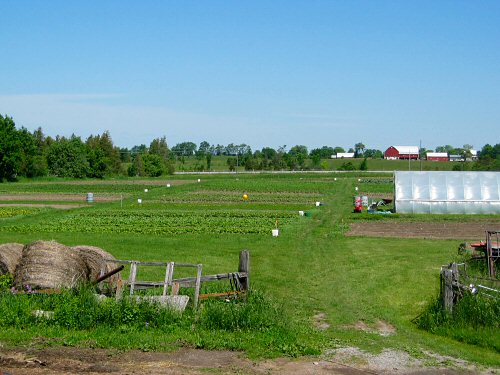
Hot but not a scorcher, a bit of a breeze, full sun in a clear blue sky… Even at a distance, the field is starting to show clear signs of vigorous veggie activity (see one month ago). And, amazingly (although, according to plan!), we’re on top of the weeds. Today was a bit of a semi-day off for me, with only a few hours here and there of hand-weeding, and lots of strolling around thinking about this and that (mostly, about things on the neverending to-do list…). Particularly now, still in spring start-up mode, tiny farming is REALLY full-time, you’ve gotta be into it 100%…so, you’d best love it as well. I’m having fun!
New view
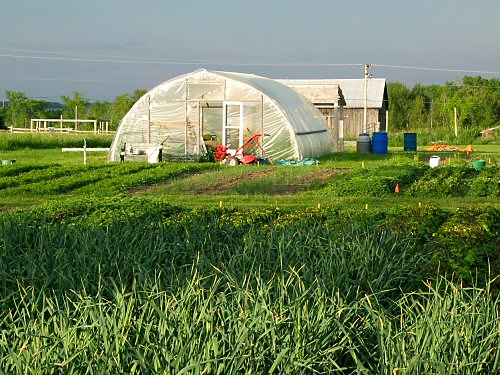
Here’s a view of the lower part of the field, from an angle that I don’t check out too often, looking over the garlic, past mesclun, carrots, green onions, beets, to the greenhouse, and you can see the veggie stand—it’s still roofless—tucked away behind. (Normally, only the mesclun would be in this area, with the root crops at the top of the field, but because the new section wasn’t ready in time for putting in fine seed—too much sod to break up—I’ve had to move things around a bit.) And so, it’s nearing the end of another hot and sunshiny day of weeding, seeding, more weeding…and so forth. We started pruning, staking and caging tomatoes, before they got too far carried away—it’s good to be on time!
Tiny eggplant
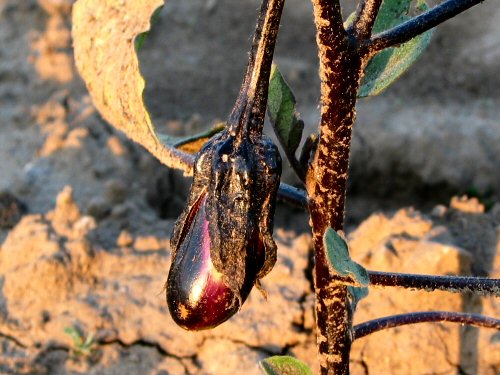
Tiny eggplants—this one’s about 1″ (2.5cm) long—are appearing on a few plants, also, tiny peppers! I’m not sure what this is about, heat stress, maybe, although it hasn’t been that hot. And the seedlings weren’t old, oversized, or root-bound when transplanted—no great STRESS all around (unusually stressful situations seem to make plants, like people, do odd things). As far as I can tell, conditions this year, from seed starting on, haven’t been overall different from in the past, so why all this early, TINY, flowering and fruiting? I’ve seen this when plants were left too long in small pots and…miniaturized, but that wasn’t the case for these guys. It doesn’t worry me so far, but I’ll check into it. Meanwhile, off they come, and then, well, as usual, we’ll see what happens next!
Stakes and cages
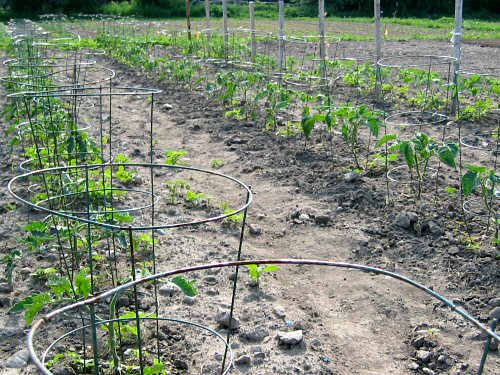
Prune, sucker, stake and cage—there’s a lot of (brutal-sounding!) stuff to do with tomatoes. On the other hand, as I’ve done in past years, simply by not having enough time to support them all, you can let ’em sprawl. I’ve always wanted to have the toms neatly assisted by the basket-weave method. This involves pounding in stakes every second plant (maybe every third would also work), then weaving twine in and out, in front then behind every other plant in one direction, then back again, weaving the opposite way, this done every 12″ or so of growth. This way, each plant is then supported by twine on both sides. You also have to prune and sucker (remove the shoots that grow at the intersection of new branch and stem), so that you have one main stem. This year, we should have several beds set up this way. There are also around 250 home garden-style tomato cages, which are quick, but don’t provide that much support when the plants get heavy. An advantage of caging: you don’t have to be as strict with the suckering. For at least a few plants, I’d also like to try caging with cylinders made of 6″ mesh concrete reinforcing wire, a heavy duty (and fairly expensive) approach… This year’s mix of methods is underway. More as it happens!
Not a pretty picture
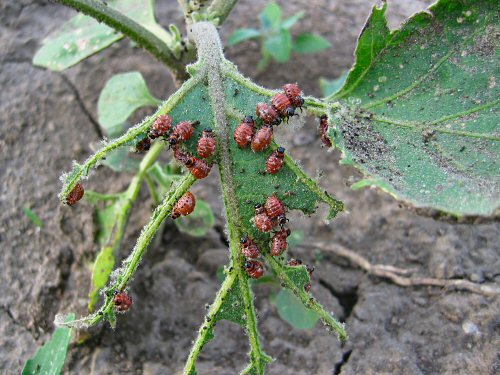
In today’s field photo selection, there was a kinda cool shot of a last-season carrot starting to flower, a freshly hand-weeded onion patch looking quite sharp, or this shiny, slimy cluster of baby Colorado potato beetles, going to town on a Black Beauty eggplant…
Pests and disease have thankfully not been a big problem in this organic field. I like to think that the garden is in some sort of balance, but perhaps it’s just location and luck… In either case, there have been some outbreaks: many tomato hornworms on the…tomatoes in Year 1, same for Colorado potato beetles on potatoes, early blight on tomatoes three years ago when the summer was cool and almost always cloudy and damp, and, of course, the everpresent flea beetles (brassicas) and striped cucumber beetles (cucurbits).
The FBs and CBs are defended against with floating row cover. The rest have recently died down, to the point where I let them do their thing, handpicking a few, but really accepting a small amount of leaf damage (they all eat leaves) and no plant loss.
This year, the CPBs seem to have crossed over to eggplant (another of their natural targets, but one they never really took aim at in the past). They seem to be favoring the Black Beauty eggplant…
The worst of the major damage in the photo happened in probably less than a day, as I’d taken a walk through there just yesterday. Only about four or five of 60+ Black Beauties had a significant presence, with a few loner CPBs on other varieties (and I’d noticed no eggs on the leaves in earlier checks). So, I squished ’em. Vigilance is somewhat increased.