
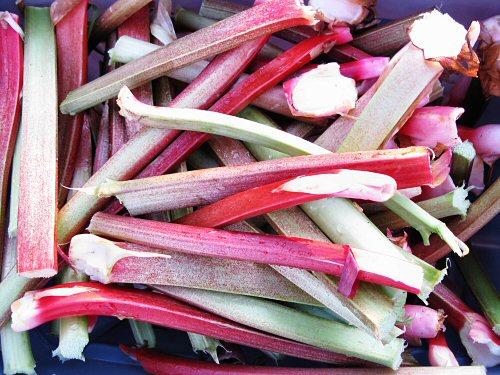
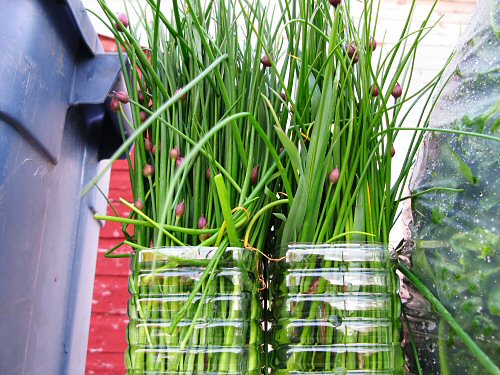
Harvest for the second farmers’ market of the season was OK, but still what I think of as kinda found crops. There’s the first market harvest ever of rhubarb, a binful (20 bundles or so) from the fairly giant patch (about 60 divisions) planted three years ago—kinda stubby, compared to the more sheltered rhubarb behind the farmhouse, but tasty all the same. There’s also 15 lbs (6.8kg) of all-lettuce mesclun from the greenhouse, around 10lbs (4.5kg) of new-growth spinach from a few beds planted last fall, 15 pounds of Jerusalem artichoke, some chives, overwintered and in full return in the herb garden, and a few bags of arugula. Enough to keep our hand in at the market, but I’m really waiting on new stuff from the field…!
Month: May 2008
Farmers’ market: Day 2
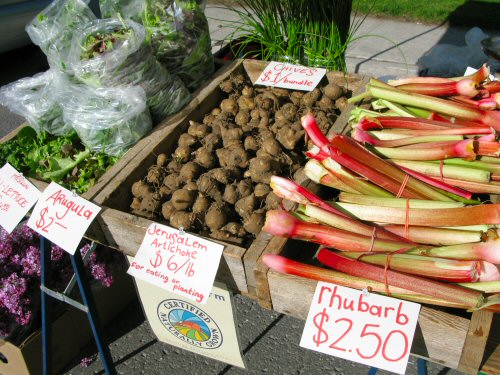
Really fine weather for our second market day of the season: sunshine, warmth, a pleasant breeze…! A bit more variety than last week, with all-lettuce mesclun, spinach, arugula, Jerusalem artichoke, chives and rhubarb, but still not much quantity of anything. We were sold out by around 10 a.m. Hanging below the chokes bin is the “Certified Naturally Grown” sign. It’s a new certification this year, in addition to our “certified organic” status. Naturally Grown is a grassroots, farmer-to-farmer program, started in the USA, and entirely voluntary and at no charge, where farmers’ certify other farmers according to essentially the same production standards as the government-regulated organic program. Instead of a lot of paperwork and fees, it’s simple and straightforward, but of course the legal word “organic” can’t be used, so it’s…”naturally grown” instead. Since there are only a couple of other NG farms in Ontario, and none close by, the inspection for this tiny farm will be done by CSA members. I’m still maintaining regular organic certification, but for what we’re doing, selling local food direct to people, Naturally Grown makes most sense to me…
Where we’re at…
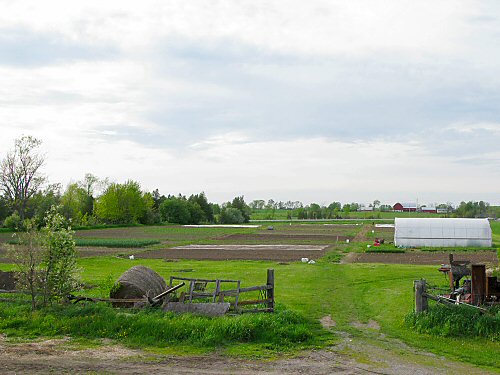
If you can average a month’s weather with one photo, this is pretty well it for the days of May this year, hovering between bright and sunny and gloomy and overcast, veering one way or another for a day or two, or even from one end of the day to the other. The freezing nights have just let up, which is good. We’ve also been getting a nice amount of rain: the month’s average so far is that magic inch-a-week (25mm), the veggie gardening rule of thumb for perfect rainfall. Many hours of dragging around and positioning hoses and sprinklers, and gassing up the irrigation pump, have been SAVED! That’s a big bonus, the total opposite of the last two years. The field is clear and amazingly weed-free (at a distance, at least)—more sun would benefit both the direct-seeded crops and the (kinda evil) pigweed. Less sun and cooler temperatures are also great for transplanting, which is the main thing going on right now. So it’s a toss-up, but I’m slightly more liking the colder, cloudier weather for now than not. As if I had a choice… :)
Row cover everywhere
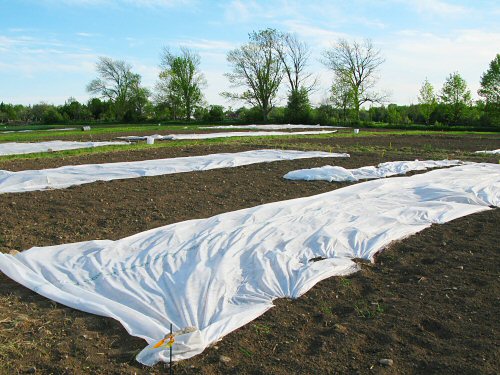
It was impossible to capture all the floating row cover outposts scattered around the feel in just one shot. This pic shows maybe a third of the area under the light, white, spunbond polyester protection. Right now, it’s being used as protection from two separate things: frost and bugs. Let’s see, it’s on all the cucurbits (so far, that’s cucumber, summer and winter squash, and pumpkin) to protect from the cold and striped cucumber beetles, on tomatoes against cold (and coming off in a few days), on the brassicas (broccoli, cauliflower, and the like) against ravaging flea beetles but not the cold (coming off when the plants are fairly big and can withstand the FBs). I’ve used row cover from Year 1, far as I can remember (there are NOTES and even pics…somewhere). Initially, I really didn’t like it, it looked so…unearthy, synthetic,…not part of the garden. BUT, the alternatives, like planting later, ending harvest earlier in fall, temporary wind breaks and cold air channels, trap crops, and all sorts of complex interplanting (so one crop protects another), encouraging beneficial insects, more elaborate timing (basically, closer second guessing of insect cycles and the weather), not to mention a completely adapted, semi-permaculture set-up where everything is at home no matter what, were all way out of what I could handle as I dove into tiny farming with the intention of heading to the farmers’ market in the first season. Floating row cover lets me extend the season by at least a couple of weeks at each and, and I can avoid all pesticides (and there are some killer insecticides allowed even in certified organics) and a lot of bug grief (stemming from lots of LOSS). I still don’t really LIKE row cover, though, the way I like, say, my Sneeboer three-tine cultivator or even the Horse rototiller (I can understand how the Horse is built, get if fixed, or do without). More and more lately, I wonder when FRC will become insanely expensive, or real scarce, or just plain run out… It’s as oil-based as they come, and kind of in a high tech product class of its own. This year, in a small fit of…paranoia (?), I actually ordered a new 1,000’x14′ (300mx4.3m) roll, even though I have enough for this season at least. It’s not much of a stockpile, but, carefully managed, it could get me through 3-4 more years along with what’s on hand, at this tiny farming scale… Oh, well, the more you know, the less you need is what I believe. I’m learning as I go. Keep farming long enough, and I’m sure I’ll get beyond the cover if it doesn’t run out on me first…! :)
Good germination
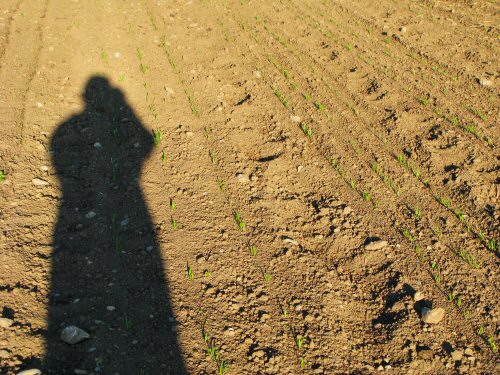
With all the rain, and things finally warming up at night, the evening walkaround was good today, with a fair bit of GROWTH now on display. The third seeding of Spargo spinach (above) is doing very well indeed. Carrots, beets, green onions, chard are all coming along. Most everything is pretty cool… And all of this without irrigation, only some of the mesclun beds were ever watered. This is more like it!
Frey’s vs White Rock
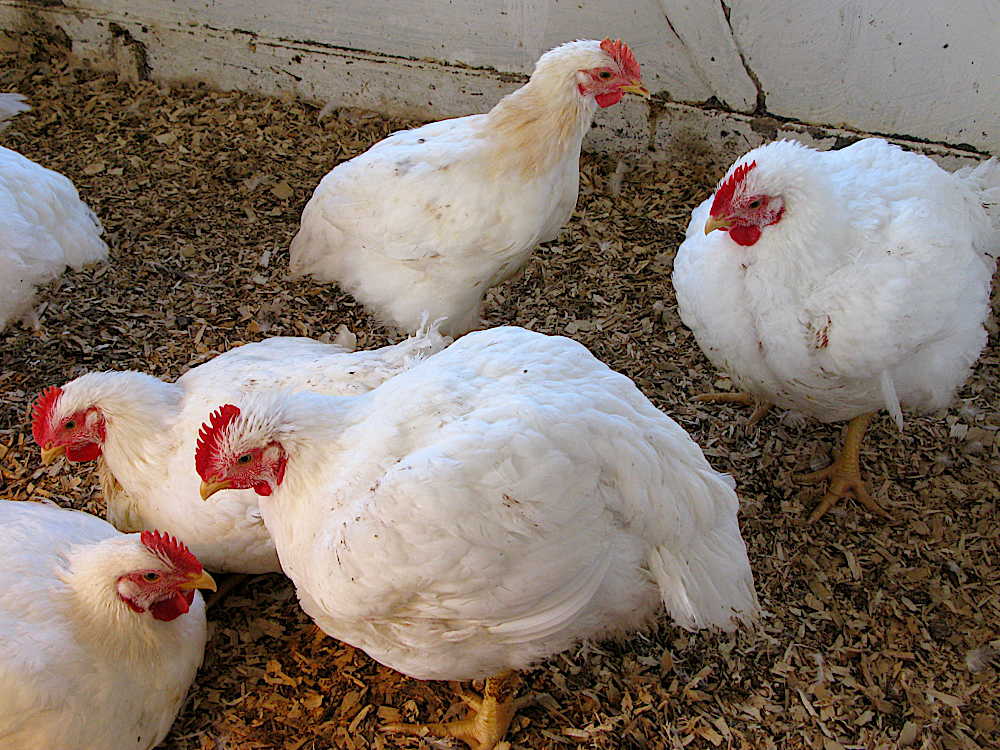
At this point, it’s safe to say that I’m no fan of White Rock Cornish X chickens. Without a doubt, they convert feed to meat incredibly…efficiently—compare the lone Frey’s Special Dual Purpose at the top center of the pic, surrounded by hulking, waddling White Rocks two and three times its size. What they gain in meat, they lose in basic chicken-ness… This first flock of mine are lumbering birds, with no taste for the outdoors, no built-in scratching skills, they’re definitely not up for dust baths or foraging through tall grass. They sit around, eat like crazy, drink, and, here and there, just kinda spontaneously DIE. I’ve learned a lot from this first go-round with meat birds, and I haven’t entirely rejected the White Rocks—I’m saving my final…evaluation for after they’re off to the slaughter in 2-3 weeks. More to follow…
Potting for market
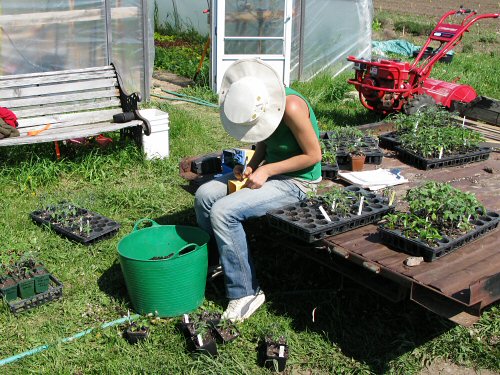
With the recently warming weather, field crops have started to grow more quickly, but nothing but radishes will be ready for this Saturday’s farmers’ market, and the early lettuce in the greenhouse has gotten pretty low after two weeks of harvesting. This is a first: by the end of May, mesclun and usually spinach have been ready in the field. Not this time. Sooo, we decided to fill out the week’s market stand offerings with seedlings. Selling my extra insurance seedlings at the market is something I’ve avoided until now: for the few dollars more, it didn’t seem worth the chance of complaints if anything goes wrong (I’ve heard people blame all kinds of things on the plants they buy)—usually, I’d sell or give only to people I know. There’s always a first time, so Shannon potted up and labeled a couple of dozen spares. We’ll take a walk on the wild side and see what happens… :)