Wed, Jan 02, 2008 · Filed under Building & Fixing, Winter

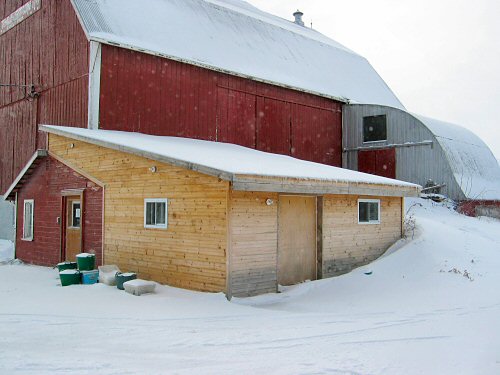
Not a big concern, but part of my rounds is keeping an eye on the snow load on the Milkhouse roof. It’s that shallow angle. This pic makes the potential problem clear: big, steep upper roof, unloading onto not-so-sloped lower roof. Luckily, with the wind and angle, there is seldom upper roof build-up. Although the weather’s been relatively warm recently (it did drop drastically last night), and there’s melt-off, it’s also been snowing in regular spurts, dumping an inch or so at a time. So, I keep an eye out… (If not for apparent global warming—shorter, less snowy winters in general, for whatever reason—we might have gone steeper when building last year. It seems we’re already casually adapting to visions of a freakish weather future, which IS human nature but still…weird!)
Permalink
Mon, Dec 31, 2007 · Filed under Animals, Building & Fixing, The Farm, Winter

As the day faded into New Year’s Eve, I did a little walkaround, checking the goats and visiting Jack the Miniature Donkey, who’s a pretty good barnyard pal. I don’t see him up close that often (I hear him all summer), but we get along. He’s cool. Along with the goats and half-dozen cows, they’re Bob and Karen’s charges. I helped care for the goats daily for a couple of years, winter and summer, watering and feeding twice a day, experienced the goat cycle of life and death (well, birth, and occasionally, off to the slaughter). But my tiny farming career has yet to directly encompass livestock. Another thing to do! I think, this spring, CHICKENS!
Permalink
Sun, Dec 09, 2007 · Filed under Autumn, Building & Fixing, Greenhouse, Tools

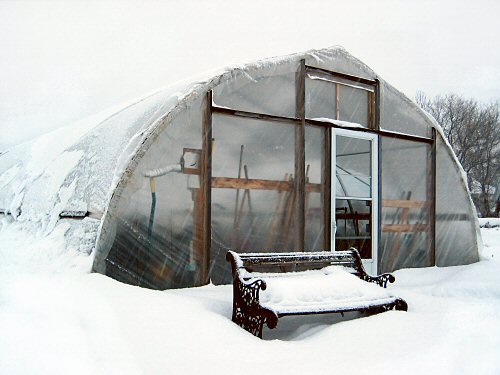
We haven’t gotten a really heavy single dumping of snow so far, but it’s coming down steadily every couple of days and the weather’s staying cold, so there’s build-up. That means increased vigilance on the greenhouse front. The right combination of freezing, a little thawing, and more snow can stick heavy slabs of ice on the hoophouse plastic. It usually slides off, but the weight can build up quick, so I check. If things were to get really weighty, besides removing the ice, I’d have to support the whole thing on the inside by wedging wooden beams under the ridge. I doubt it’ll come to that. And there’s the build-up around the base, some sharp shards of fallen ice could have puncture potential, none so far. AND THEN, this is going into the fifth year for the plastic. The special 6mil hoophouse covering is UV-resistant and rated for four years, so round about now, it’s time to look out for signs of fatigue and disintegration. I haven’t seen this before. I imagine it’ll start tearing at exposed pressure points, the way regular plastic shreds or tears under slight pressure after a while in the sun (well, in the UV, sun or not). I should ask around. The west-facing side, with the door in the picture, is most exposed to really battering winds that occasionally sweep across the fields with not much of a windbreak nearby. (It took me a season to get over being amazed that the hoophouse was still standing after bad storms—I’d actually head out in the howling wind in the middle of the night to check!) So, the usual winter greenhouse watch is on, upped a little. (I should drag that bench inside…)
Permalink
Sat, Dec 01, 2007 · Filed under Autumn, Building & Fixing, Indoors, The Farm

Here’s the Extended Milkhouse, looking pretty much as it did in mid-February last winter, a couple of months ahead of schedule. This time last year, it was still a dreary shell; we didn’t finish up until January. It serves as a seedling room in spring, for overnight harvest storage and CSA pickup for the rest of the growing season, and as the farm office year-round. It may look like a…bunker, but inside, it’s a great, custom-designed small-farming space. Now, I have a little time to do what I haven’t done so far: get it all sorted out!
Permalink
Sun, Nov 25, 2007 · Filed under Autumn, Building & Fixing, Market & Stand, Planning, Storage

The mildly ambitious veggie outpost experiment of earlier this year has returned in pieces. The stand came back today, courtesy of Conall, who took it apart and dropped it off (you can’t help but notice, he’s pretty thorough when it comes to taking things apart…). In any case, a nearby coffee shop wanted to sell a small, choice selection of organic veggies. They were buying upfront at normal prices and marking them up a bit. Our part was to harvest once or twice a week, and deliver (only 12 miles)—building the stand was basically a last-minute favor… Why it didn’t work came down to that simple consideration that supermarkets are built on: SHELF LIFE. The coffee shop couldn’t get a handle on how to keep the veggies perky and fresh. I heard about an attempt to revive baby eggplants, shriveling after a day in the sun, by misting them like salad greens. Yikes. I would’ve helped if I could’ve, but I have zero experience with storage in a store-type situation. I’d kinda assumed that, since they prepare and sell food, they were equipped to figure it out. Not so. At the farmers’ market, I start in the cool early morning, it’s only six hours, and the veggies move quickly, so it’s all fine, without refrigeration or cooling, even on the hottest summer days. But keeping displayed veggies perfectly presentable for even a couple of days is a whole other specialized thing. Anyhow, after six weeks or so, we stopped. There was no ill will or anything, and we continued to supply mesclun for their salads for the rest of the season. The bottom line is a lesson I learned long ago, but failed to act on in this case: when you’re involved in something NEW, if there’s no plan that clearly deals with the DETAILS, chances are there will be…TROUBLE. I look forward to tackling this particular puzzle—how to handle daily fresh veggie sales—next year, when we FINALLY open the farm stand. ;)
Permalink
Sun, Nov 11, 2007 · Filed under Autumn, Building & Fixing, Tools

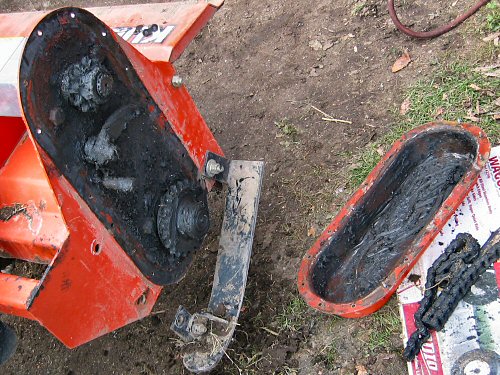
Like machinery everywhere, gear on the farm tends to break down just when you need it. This may be obvious, but it’s no less annoying for it!! Some breakdowns you know are coming sooner or later, like when you decide to let it wear out rather than fix it at the first signs of trouble. This you can avoid with regular maintenance including INSPECTION—checking things out for looseness and wear always eventually pays off—but often I, uh, don’t get around to it (as with, recently, the riding mower). Most breakdowns are, at least on the surface, sudden failures, like today, when in the midst of tilling with the 48″ rototiller on the back of the Kubota compact tractor, the tines suddenly stopped turning. This had happened once before, so the diagnosis was easy: broken chain. And that’s a good one. Every time something breaks and we fix it, I stock up on extras of whatever was used in the repair—DIY repair and a good selection of spare parts go hand in hand on the tiny farm! So, for the chain, there are parts: full links, offset links, master links. A replacement chain is also quite cheap and a good thing to have on hand. This particular repair job is dirty but extremely simple and straightforward, same as for a bicycle chain. Pop off the chain guard, scrape off the excess grease, bang out the rivets on the broken links and add new ones, or decide to replace the whole thing, put the chain back on…it’s about as simple as that, and you’re back in the saddle again!
Permalink