Tiny farming: Farm lab (research!)

Tea and fungi

Making chamomile tea

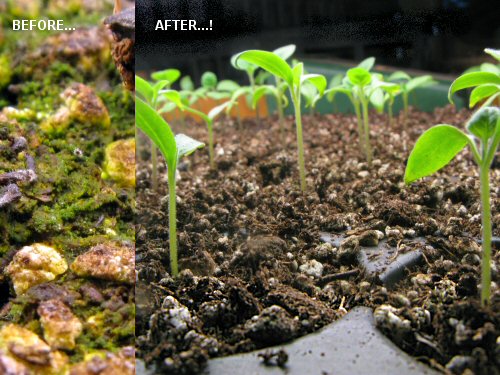
Chamomile tea prevents damping off—I’m a believer! It’s one of those natural but-do-they-really-work remedies, used where more product-minded folks would fork over a few bucks for a bottle of No-Damp fungicide… I brew up a batch of tea, dilute it by eye to a pale gold,  and apply every couple of days with a fine-misting spray bottle. I’m pretty casual about the recipe, and keep spraying until the seedlings are established (there are more precise instructions around as well).

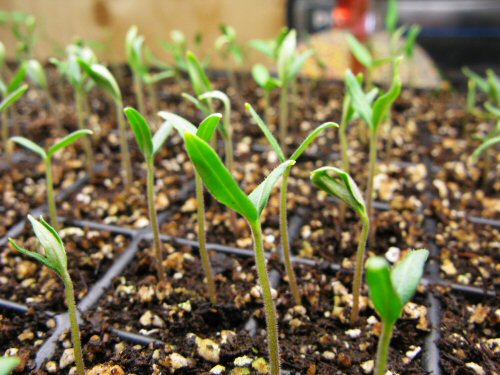
Damping-off is the name for a bunch of different fungal infections that can hit seedlings in trays with similar effect. Typically, they attack right below the soil line, strangling the stem just out of sight. Dig up a stricken seedling and there’s a small section of the stem, all pale and shriveling to nothing, while above and below, all looks well. It’s pretty shocking to see in action. One minute, your seedlings are looking all perky, and then you touch one…and it topples over! Whooaa!

Up to a couple of years back, I’d lose a few seedlings, usually PEPPERS for some reason, never anything major, parts of a tray or two, but enough to be scary. I seed-start in soilless mix (so it should be disease free), trays and tools are given a good disinfection at the beginning of the season, there’s always plenty of air circulation, and I make sure the soil surface doesn’t stay wet—all the things these soil-borne fungi don’t like. Still, damping off was sneaking in, until chamomile tea spray came along… Coincidence?

Comments (22)

Welcome to KeroWorld

Kerosene heater for the greenhouse

What an odd thought, what image comes to mind: the world of kerosene… And now I’m in it! Purchased new today, at a healthy 35% discount, this small, rather inexpensive, KeroWorld-brand indoor kerosene heater is the core technology in the extended-spring greenhouse plan. The idea is to turn the unheated hoophouse into a barely heated one, by warming it at night so that it stays above 38°F (4°C). That way, I can put out seedlings weeks early, instead of crowding them under scarce indoor lighting until it warms up in April. It should also give the earlier-than-ever lettuce, going into the ground in the greenhouse, a smoother start. This heater is low-powered—10,000 BTU, recommended for 420 sq ft, it’s 640 sq ft out there—but only a wee bit of heat is required. I think. Last year’s propane space heater was quite efficient, but burned too much gas for every-night use, it often went out by itself, and it required lots of ventilation. Plus, I don’t really like relying on pressurized tanks. This heater will hopefully burn low and steady, and it’s pour-to-fill! Aided by a fan to keep the air moving, and row cover on the coldest nights, it should get the job done. This all reminds me of Patrick of Bifurcated Carrots’ comment a while ago about the line between good and bad technology. It seems a personal decision as much as anything. Why don’t I dream about full-blown winter greenhouses, with high-intensity lighting and industrial-strength heating and ventilation, I wonder? Dunno. I just don’t. But an extra growing month in the strengthening sun, and a little less reliance on indoor lights, traded off against some kerosene, well, THAT would be cool!

Comments (18)

Exploring down below…

Lettuce root system

These technical drawings of a lettuce root system are from Root Development of Vegetable Crops*, first published in 1927 and now in the public domain. This is an incredible book that I just discovered. The text is like a complete gardening course delivered from underground. The drawings record direct observation, the result of years of root excavation. Over 30 (North American) common garden veggies are covered, a chapter each. I can hardly describe how satisfying and…enlightening it is to simply look at page after page of painstakingly drawn root systems! Here, the top two pictures are lettuce at two months and then at three months and flowering. Each square in the grid is one foot. The little side-by-side illustratation shows 3-week-old seedlings, grown on the left in loose soil (nearly 2′ down!!), on the right in compacted soil (and to think, I have 3-week seedlings in tiny plug sheet cells, 2-1/2″ deep!). One look at this and your mind expands!
*I downloaded it from the fantastic Soil & Health Holistic Agriculture Library, an online repository for dozens of excellent books, mostly from 1910-1960, and all entirely free—there are many organic farming classics, tons of great, practical stuff!

Comments (6)

Seedling treatment

Fanning seedlings

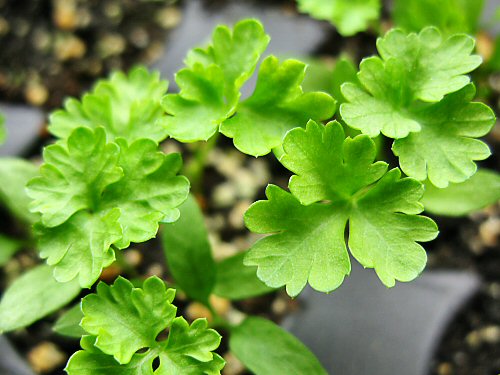
The fan is oscillating and the grow racks are slowly filling up. Parsley—curly and flat-leaf—are underway, and there’s more lettuce and some herbs…

Fanning the seedlings is particularly satisfying because it does a lot for such a simple thing. I forget where I heard about it, probably from a book, and I’ve been doing it since Year 1 or 2.

The idea is that plants develop differently when they have to deal with wind, or rain, or otherwise being pushed about. Seedlings raised indoors lead an extremely sheltered life; providing a bit of a breeze toughens them up, and this sort of mechanical stimulation (brushing is another approach) also encourages stockier growth instead of stretching.

It makes sense to me—seedlings definitely wouldn’t be so coddled growing out in the field! There’s even a term for this: thigmomorphogenesis! While hunting down the word, I found an interesting article about mechanical stimulation of seedlings as well.

I don’t follow a particular schedule, just give ‘em at least an hour or two a day, sometimes more, turn the fan on and move it around every once in a while (I also make sure the seedlings are properly watered, since wind is great for drying out plants).

All in all, it’s easy, sounds good, hasn’t hurt! The fanning also dries the soil surface, which helps prevent damping-off, so you can’t lose!

Comments (8)

Books! Seed! Orders arrive…

Seeds and books

Better than Christmas! The first half of the first big seed order, and my first book order in months, both arrived today.

Seed every year comes almost entirely from three companies: William Dam, Veseys and Terra Edibles. The first two are both bigger, family run companies, one definitely slicker and more marketing-oriented, with a series of color catalogs through the year in addition to their main one, all kinds of enticing special offers involving free shipping, a call center with almost no waits, y’know, the works. The other is definitely more…”indie”, with a single annual catalog, a written commitment to untreated seed only, and a busy signal more likely than not right through the order season: keep calling till you get through. The third is a tiny company specializing in heirloom seed, grown in-house or directly sourced from small growers.

The cool thing about all three is that you’re actually dealing wtih the owners, right to the top. Even in the case of the slickest one, when a seed potato order was a WEEK late last year, the prez himself called to apologize. And I’ve had great, informative chats with various people from all. It’s another small satisfaction, knowing to a degree from where and whom your seed arrives.

The book situation is a little different: Amazon.com (Amazon.ca, in my case). It seems like a sprawling, faceless, digital megacorporation, and I long ago stopped keeping track of who bought out who, but as far as I know, it’s still…OK (like, not like Facebook). And it’s downright depressing/futile to browse a small-town bookstore if you’re looking for specific titles (of course, they can always order in, so I do it myself instead).

Anyhow, the few titles (selected from a long list of must-reads): The Complete Vegetable & Herb Gardener: A Guide to Growing Your Garden Organically (based on a recommendation), The Omnivore’s Dilemma: A Natural History of Four Meals (finally…eek! :), The Art of Simple Food: Notes, Lessons, and Recipes from a Delicious Revolution (hmm, high hopes for this one, based largely on a Charlie Rose PBS (US public TV) interview with author Alice Waters; I WILL cook more, but we’ll see if this helps…), Micro Eco-Farming: Prospering from Backyard to Small Acreage in Partnership with the Earth (I have NO IDEA how this came to the long list, I forget, but I did mark it with a bunch of stars…). And then there’s the Linux Pocket Guide, ’cause with blogs and web sites, like tiny farms, it’s usually best to know your way around the territory…

Off to start some rosemary really late, and read!

Comments (10)

The joy of decay…

Winter squash decays

During the growing season, decay is the last thing you want to see, let alone watch. This time of year, what with culling veggies from cool storage, I’m a little more thoughtful about…decomposition. This miniature butternut caught my eye as it slowly returns to its essence in the Milkhouse. I’ve watched it instead of tossing it out. I like it! It’s soft, but seems to be drying faster than it’s rotting… Those little amber crystals, the product of ooze, are interesting: hard, transparent, sort of brittle, almost tasteless… I wonder what they are? I’m sure chemistry and biology would give me great, detailed explanations of the entire process of winter squash decay. But is that…good? Is that what I want? I used to think that understanding how EVERYTHING worked was kinda the goal, you’d learn and learn and learn stuff and become…better. But tiny farming doesn’t seem to lead that way. You watch and you do learn lots of things when they’re useful, but simply tearing everything apart into little chunks of measurement and description, just for the sake of it, isn’t as appealing as it once seemed to be. I think I want to know LESS. Demand simplicity! Let the squash rot in peace… (Of course, things don’t really work that way, do they…) More »

Comments (8)

TFB & the Web

Locations of visitors to this page

Free PageRank Checker

website uptime

Best Green Blogs

Home and Garden Blogs - Blog Catalog Blog Directory

Download Firefox