
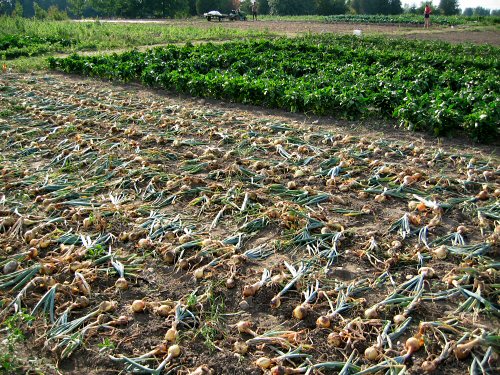
Started the full onion harvest today. This is about half the crop, pulled and layed out to dry (although, with NO RAIN, drying is hardly an issue). Above, it’s peppers and eggplant; at the top left, an almost depleted section of Yukon Gold potatoes with a scraggly weed cover that needs to be tilled in. The onions will be topped, put around half deep in the old style wooden bushel baskets (lots of air, no sweating), and set in the barn to cure. Once again, this year I took the easy way with onion sets, which limits my selection and also seems to produce flatter rather than rounder bulbs. Here it’s the usual two: Stuttgarter yellow cooking and Spanish Yellow (that’s apparently the variety name). Next year, it’s gotta finally be onions from seed! For now, nothing fancy: strong, flavorful onions that bring tears to your eyes!
Fieldwork
Crops for Fall
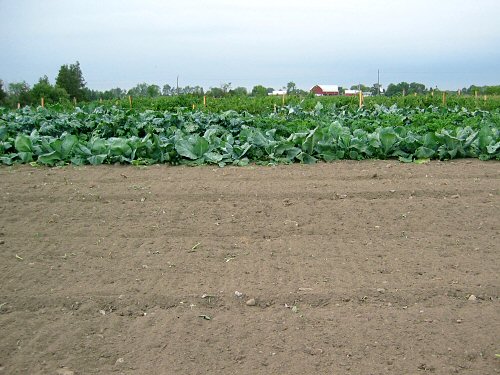
Newly released from row cover, five new beds of brassicas (cabbage, broccoli, cauliflower, kale) get ready for Fall. Beyond, tomatoes (and beyond that, the farm across the road, they gather honey). In front, a vacated section that contained the season’s first planting of peas seeded way back in April, and is now awaiting a mid-August green manure cover crop of…oats! And still, no rain…
Anti-raccoon measures
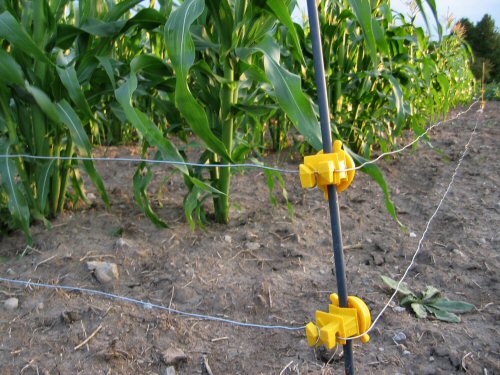
Finally strung up the electric fence to protect the corn from raccoons. Powering the short, hopefully sharp shocks is a solar-charged controller. The lower wire is place about 6″ (15cm) from the ground, with a second strand about 10″ (25cm) above it. The perimeter has to be kept clear of weeds that might ground the fence, which would reduce or eliminate the shocks. In theory, this is a totally effective, non-lethal, physically harmless method, but coons are clever. Already, there’s been some pre-fence eating activity. We shall see what comes next!
Farmer in field
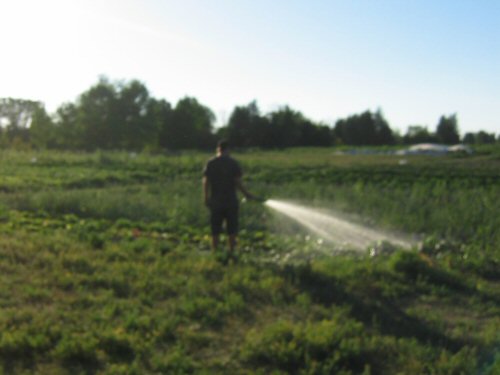
Conall watering in mesclun in the late afternoon. Even on busy harvest Friday, plants need water if they’ve had no rain. Guest photo by Erin, with a different than usual, no less…realistic, view of the field. There’s nothing like being there to see for yourself! I cropped the photo to fit the format, but it’s the original that just catches a certain tiny farm feeling…
More on the carrot-burlap method
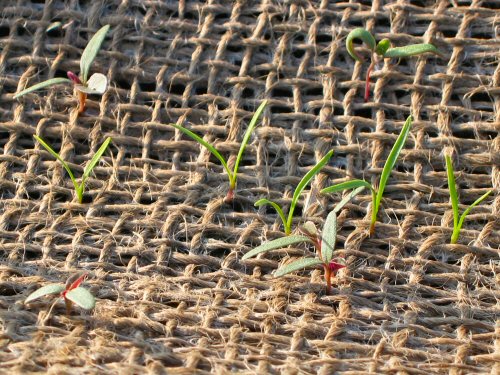
From the last carrot planting of the year, a new development in the burlap method! The variety is Nelson, and germination in less than a week was so vigorous, the seedlings came right up through the fabric, where in all previous seedings, they remained scrunched under. I’m not sure whether the burlap wearing down and loosening up helped this effect, or that there may have been less of a gap between burlap and soil due to a shallower seed furrow. In any case, it’s working better than ever! Rolling up the burlap, the seedlings slip through with ease, while most of the little pigweed emerging alongside get yanked by their aggressive leaf growth. Perfect!! (Clearly, I have carrots and pigweed on my mind…)
Supporting tomatoes
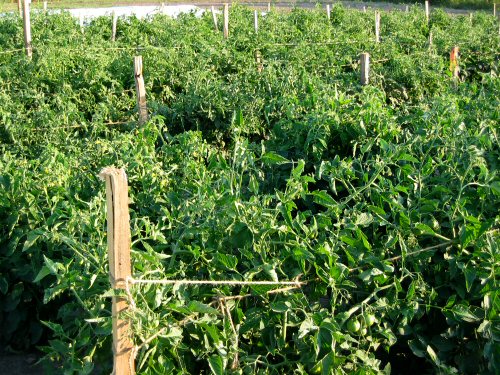
Time is tearing by, and there’s still lots more tomato-supporting work to be done, but it’s coming along. The good thing about my for-now semi-sprawl method is that it can be done reasonably effectively quite far along. The toms are indeed starting to really sprawl, but we still have a week or so when pulling them up is fairly easy and it will keep the paths clear and the fruit off the ground. Off course, stringing them together from both sides does make for a dense mass of tomato plant, but a bit of quick pruning and it’s better all around than without! We’ll see for sure over the next few weeks of tomato harvest…
Risk crop
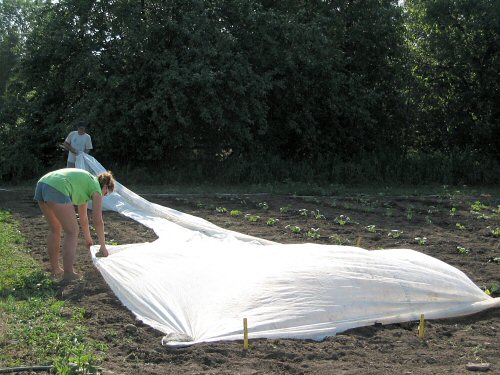
Protecting a final planting of the season, Jo and Conall lay row cover over a selection of summer squash. Also transplanted today from the squash family, more cucumber, an extra early muskmelon, and a couple of early maturity winter squash because there’s space. All of these are pretty much risk crops, with 50-65 day maturity up against our average first frost of around Sep. 20. They could have gone in a week or two earlier, but I’m gambling on another warm fall, with only a mild frost or two to get in the way (against which, row cover once again!), and MAYBE a harvest through October. Of course, the weather can be relied on less than ever, BUT, warm autumns seem to be a good bet. If this pays off, I’ll have some interesting veggies after the standard, safe season for ’em is over. Nothing ventured… You take your chances!