
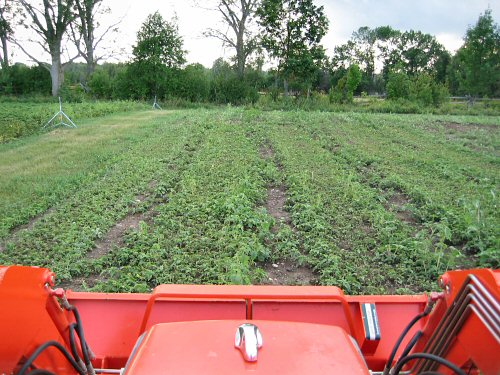
There’s no exaggerating the amount of pigweed in some sections of the field. Here, where the last seedings of spinach and peas failed—really poor germination in the heat—pigweed happily took over in no time. I mowed it down, and now I’m going in with the 48″ rototiller, prepping for fall spinach. Ideally, I’d keep the rototilling and any heavy gear off the garden beds, but this is practically an emergency. I apply the in-moderation rule here… It’s growing on me that round about next year, much of the pigweed seed, deposited three years ago in two-year-old manure, is due to expire… Right now, though, the seed seems pretty healthy to me.
Fieldwork
Freshly dug garlic
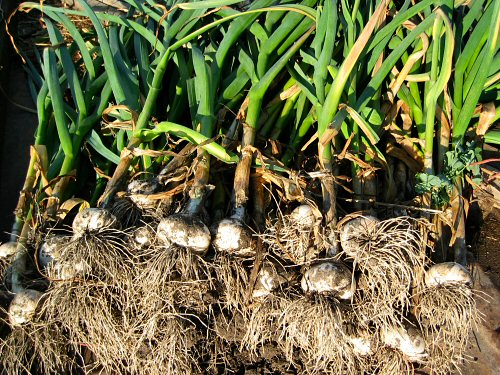
To add variety to this week’s CSA shares, I dug up 50 garlic a little ahead of the main harvest in a week or two. It’s looking great. Uncured garlic doesn’t store as well, but how long are you gonna let a single bulb of garlic hang around?! Really, there’s no such thing as too much garlic!
Pounding stakes
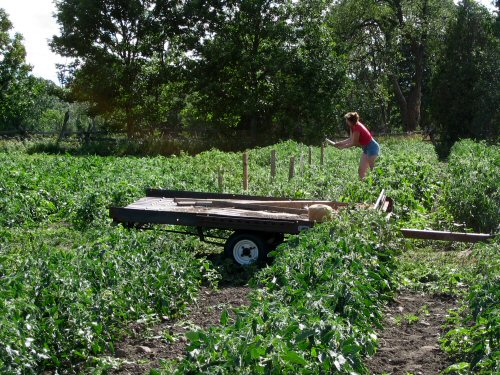
Jo pounds in wooden stakes for a somewhat catch-up version of tomato staking. I think of it as the Modified Sprawl. There are about 600 plants, with maybe 250 in home-style tomato cages. The rest are so far on their own. The cages work great, until a mighty wind comes along and blows a bunch over—they’re not really rugged field gear. It’s too late for proper basket weaving support, so it’s on to my previously tried and OK version, pulling the plants up with twine on both sides, to stakes set every three plants apart, with a bit of pruning and suckering as we go…
This is the point in the season where we start playing catch-up as a million different things need handling. It can get a little frantic, depending greatly on how it went earlier in the year. To add to the…decision-making puzzle, it’s last call, and even very iffy last call, for planting many crops (60 day maturity and under), with day length shortening and frost risk building to a significant consideration just 6-8 weeks down the road. So, thin here, or weed or seed there, or water elsewhere, you can’t do everything at once! It’s all in the timing, with much of the schedule in the hands of Ma Nature (where’s that RAIN!?!). Gambling, yes! Still and all, quite FUN.
Burlap method strikes again!
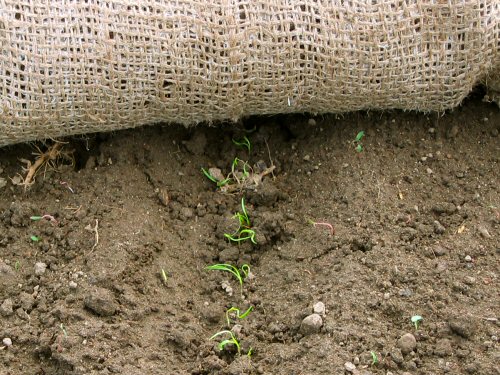
The carrots-under-burlap germination method is now 3 for 4, with this fine performance: solid rows and almost no weeds! The third attempt failed miserably with three different varieties, mainly due to underwatering (the extra drying effect of a very windy week wasn’t given proper respect) combined with using the Earthway seeder’s light carrot plate, which puts down much less seed (what a bad idea, I fall for the allure of little or no thinning every few plantings…). Anyhow, it was back to the regular seed plate and proper checking and watering, and now, a new 800′ of Nelson and Touchon is on its way (although, something’s been munching on carrot seedlings lately). Never dull! :)
Water work
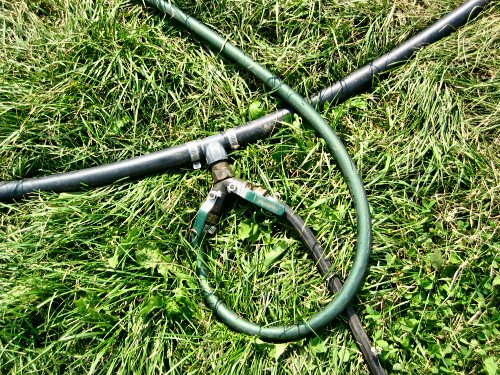
We’ve been watering heavily (well, as heavily as our gear allows) for what seems like weeks. Rain has been teasing us, 5mm a few days ago after an impressive, all-day cloud build-up; last night, 2mm following a brilliant extended lightning show and promising bit of a shower that soon faded away. It’s terrible. Conall has been honing his newly acquired hose rigging and sprinkler positioning skills. For heavier watering, the set-up begins at the pond and continues along a 1″ pipe (a little small, but it’s what I have from Year 1, intended for the much lower capacity barn well) that runs the length of the field. Water arrives through a series of shutoff Y-valves and from the valve of the moment snakes through up to 500′ of 5/8″ garden hose. (Fluid dynamics is something I should apparently be studying, to get a grip on the water-reducing effects of our often convoluted hose, valve and quick coupler combinations.) The hose leads to sprinklers (never too efficient, and quite a waste with anything above a hint of a breeze) and soaker hoses (MUCH better, but a pain to run up and down beds and then move again). The pump can deliver only so much, so it’s a multi-day rotation of gear to get around the entire field. The golden upside: WATER to the crops!! It’s amazing how much energy half an hour of heavy rain can save…!
Extreme makeover
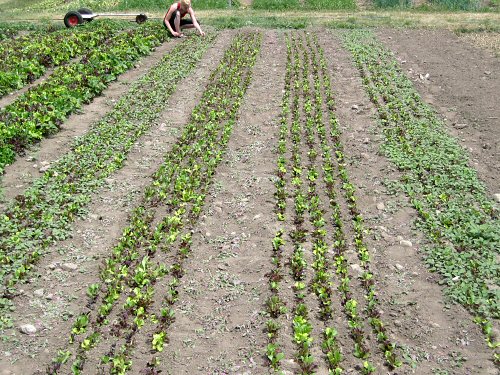
The one dark secret of this organic field, something you couldn’t really tell from selected photos, is the prevalence of pigweed (amaranth, mostly or all Amaranthus retroflexus if I’m ID-ing correctly). About two-thirds of the garden seems to be completely saturated with pigweed seed. Weeding two or three times for all-new outbreaks is common. In some spots, it’s literally as if some phantom planter is broadcasting new seed, thickly, every couple of weeks. And when it’s a closely space crop like the all-lettuce salad mix in the pic, this means painstaking fingertip weeding.
Here, Andrea and I spent about two and half hours clearing 200′ of 5-row beds, the entire latest succession planting. Luckily, conversation made the time transparent (thinking about all of the extra labor devoted just to de-pigweeding is a little painful). As best as I can figure, the pigweed came along with the two-year-old, not-fully-composted cow manure that we spread in the fall of Year 2 (three years ago). We put down I’m not sure how many, but many, tons on just over an acre—the ground was positively springy!—which was great. Except for the pigweed seed. Eventually, the vast store will be depleted (the seed is apparently viable for five years). Until then, it’s a lot of extra work… The pop quiz question: “What have those cows been eating?!”
Pond and pump
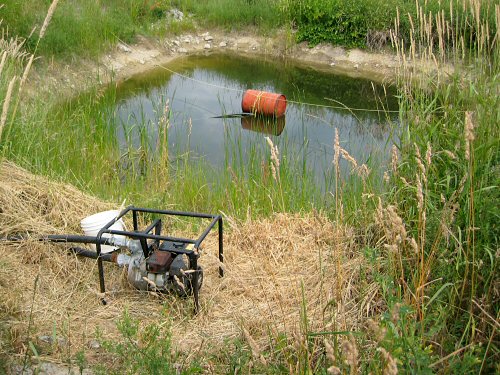
With only a little over an inch (25mm) of rain for most of June, and a near constant breeze on top of sun and heat to help dry things out quicker, we’ve had to hit the pond. Full irrigation here is a time-consuming process, involving dragging around and repositioning a network of hoses, soaker hoses, and sprinklers, and making trips every couple of hours to refill the pump set-up by the pond (see also “Pond and barrel”). The pond was dug out a couple of years ago, is ground-fed, drops level at an alarming rate (it starts the season full to the top of the photo), and replenishes slowly. If you look closely at the perimeter, the darker strip just above the water shows the level drop just for today. Still, it was used quite heavily last year and I’ve yet to see bottom! Meanwhile, I’m visualizing RAIN!