
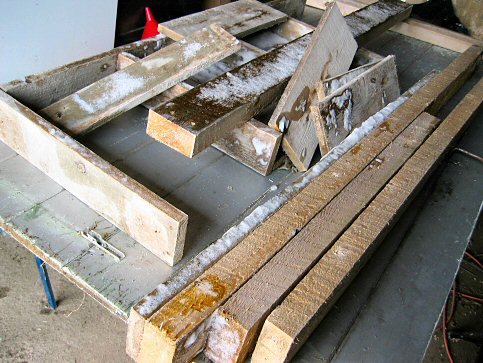
The mildly ambitious veggie outpost experiment of earlier this year has returned in pieces. The stand came back today, courtesy of Conall, who took it apart and dropped it off (you can’t help but notice, he’s pretty thorough when it comes to taking things apart…). In any case, a nearby coffee shop wanted to sell a small, choice selection of organic veggies. They were buying upfront at normal prices and marking them up a bit. Our part was to harvest once or twice a week, and deliver (only 12 miles)—building the stand was basically a last-minute favor… Why it didn’t work came down to that simple consideration that supermarkets are built on: SHELF LIFE. The coffee shop couldn’t get a handle on how to keep the veggies perky and fresh. I heard about an attempt to revive baby eggplants, shriveling after a day in the sun, by misting them like salad greens. Yikes. I would’ve helped if I could’ve, but I have zero experience with storage in a store-type situation. I’d kinda assumed that, since they prepare and sell food, they were equipped to figure it out. Not so. At the farmers’ market, I start in the cool early morning, it’s only six hours, and the veggies move quickly, so it’s all fine, without refrigeration or cooling, even on the hottest summer days. But keeping displayed veggies perfectly presentable for even a couple of days is a whole other specialized thing. Anyhow, after six weeks or so, we stopped. There was no ill will or anything, and we continued to supply mesclun for their salads for the rest of the season. The bottom line is a lesson I learned long ago, but failed to act on in this case: when you’re involved in something NEW, if there’s no plan that clearly deals with the DETAILS, chances are there will be…TROUBLE. I look forward to tackling this particular puzzle—how to handle daily fresh veggie sales—next year, when we FINALLY open the farm stand. ;)
Market & Stand
Au revoir to the farmers’ market!
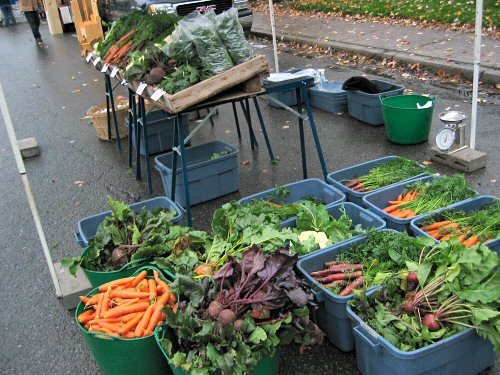
A great last day at the market! We were packing in the rain at 6am, drove in through a drizzle, and by the time I was set up just after 7, the rain had stopped! Despite the dreariness, it was quite warm. So far, so good. I didn’t particularly expect a big turnout, and was happy to find two and three people waiting at a time for a good deal of the peak fall hours, from 9:30-11:30. In the pic, it’s around 8:30, few people around as the weather sorts itself out, time to drink coffee and wander around a bit to chat. Soon, a steady stream of mostly regulars. It’s hard to explain the pleasure I get from this part of the people equation, so at this point I won’t even try. Growing food for people and delivering it directly is simply…great! The stand set-up didn’t change over the season as intended, it’s pretty barebones as it’s been from the start. I’m already renewing plans for a new and improved version for next year. On we go!
Pumpkins on the stand
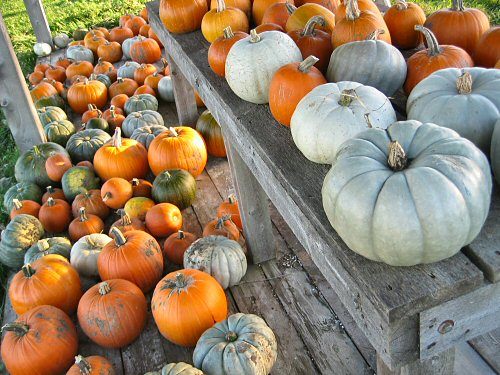
This year’s pumpkins eventually made it to the newly roofed farm stand. It makes a nice autumn scene, especially on a fine, balmy fall day like today. I suppose this coming together of pumpkin and stand is a fitting progression and a good sign, since both are works in progress. For the last couple of seasons, I’ve PLANNED to open the stand full-time for at least a day or two a week, but various things got in the way. And pumpkins have been too bulky to take in quantity to the market so far (we absolutely pack a pick-up truck; a roomy, custom-fitted trailer is on the big-purchases-when- I’m-able list). At least, the pumpkins are now on the stand! Several CSA shareholders have picked some up, and I’ve given away a few, so it’s working, kinda. The greenish-gray ones are Jamboree, the white ones are Lumina…
Seasonal eating
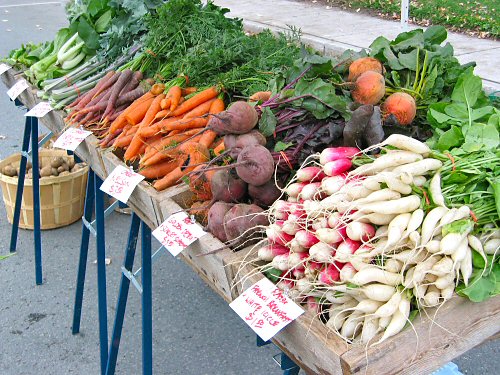
The veggie selection changes over the season, but it’s not necessarily reflected too dramatically on the stand at the farmers’ market this year. Compared to mid-August, the absence of snap beans and tomatoes is clear (with the mild weather, some vendors did have standard field tomatoes today). As for early June, well, more variety now is to be expected. Still, most of the cool-season crops for around here, like broccoli, cauliflower, and collards, also, winter squash, I have only enough of for CSA. On the stand, two types of radish (White Icicle, French Breakfast), three types of beet (Golden Detroit, Scarlet Supreme, Bull’s Blood, in smaller sizes here), two types of carrot (Nelson, Purple Haze), Red Russian kale, two types of bok choi (Mei Quing, Joi) and mesclun, plus Yukon Gold potatoes, Music garlic and Stuttgarter onions in baskets. The stand could be a lot bigger, offering more display space, and the harvest could be expanded (there are still herbs, summer squash, sweet and hot peppers, tomatillos, Brussels sprouts,…) but the marginal sales for many “secondary” veggies at this slowing down time of year don’t make it worthwhile. I’m still working on the balance between production planning, labor, harvest selection, post-harvest prep, and presentation… Sounds complicated, but it’s just…work! ;)
Off to market…
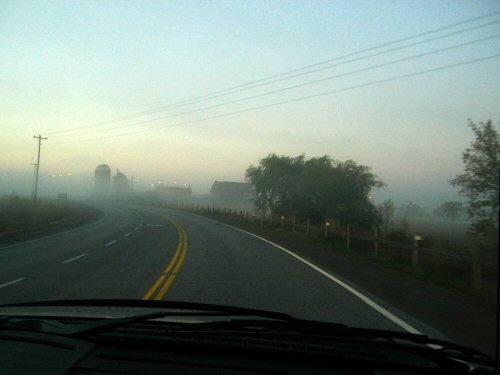
Early Saturday from May through October, just before 7 a.m., I’m heading down the road with Bob, making the quick 12 mile (19 km) hop to the farmers’ market in the center of town. Up at 5:30 after only three or four hours sleep, I’m generally a little groggy, and the drive is a pleasantly dreamy trip through peaceful farm country. Once in a while, though, a sharper awareness breaks through. We pass a farm that’d been turned into a seniors retirement home as a way to survive. We travel through a rapidly increasing number of adjoining farms, thousands of acres of them, bought out in the last couple of years by the Mennonite community—the continued farming is great, the seemingly monolithic takeover somewhat unsettling because it’s to me an unknown. The last farm on the way in to town is owned by the municipality and waiting for demolition. You can see the silos and buildings outlined in the fog ahead, right beside the lights of the new, low profile, high tech superprison that’s probably a bigger full-time employer and overall economic force than all of the farms on the drive put together. In the wrong frame of mind, I can really feel the decline-of-farming statistics I read about, and everything seems totally out of balance and more than a little surreal… Luckily, the farmers’ market is always fun!
Little bundles for market
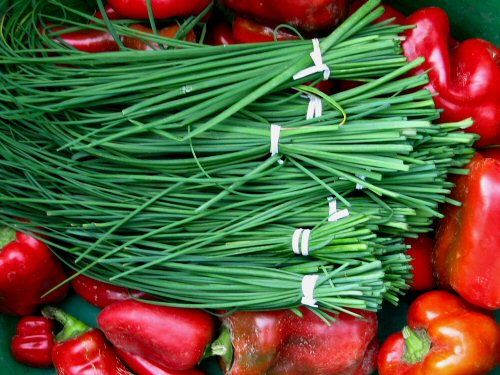
As things slow down in the garden and crops finish for the year, there is more time for really tiny harvests of this and that. Fifteen bundles of chives, a couple dozen small but tasty red peppers—little hauls like these add variety and incremental sales at the farmers’ market stand. I imagine you can afford to spend time on this kind of thing only on a really small, hand-cultivated farm. The veggie line-up for today’s market: carrot, mesclun, potato, onion, garlic, beet, summer squash, tomato, green onion, parsley, a few eggplant, peppers, cabbage and cauliflower, a little spinach and chives…
Roofing the stand

Finally got around to putting the roof on the farm stand. We recycled the old galvanized steel roofing that was replaced during the Milkhouse extension last fall. In the end, a quick job, three hours or so of matching pieces, handing them up one by one (watch the wind), and screwing ’em down. Luckily, there was very little cutting to do, sheets of old metal can be a real nightmare for slicing and gashing (working without gloves, I nicked a finger only once—every so often, it’s good to see a little bit of your own blood running red and true :). In the pic, I’m screwing things down while Bob selects sections. The farm stand is definitely not on course for the ambitious plans of earlier this season, but in good tiny farming fashion, it’s moving along! (Guest photo by Mami.)