Sun, Jul 15, 2007 · Filed under Fieldwork, Pests & Disease, Summer

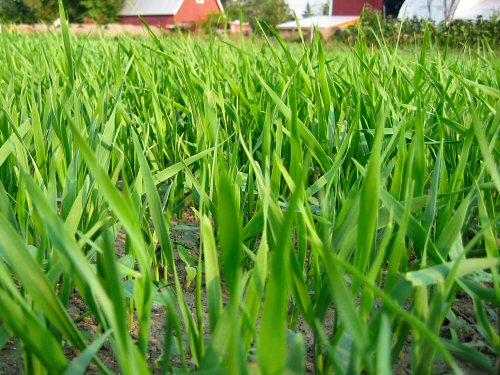
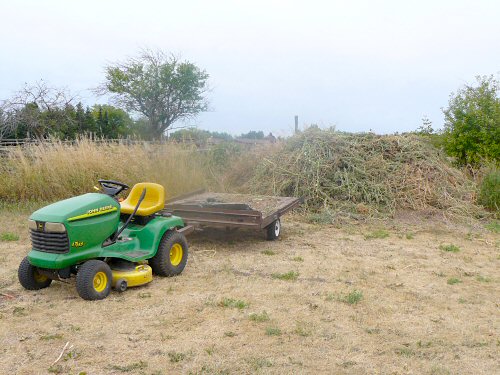
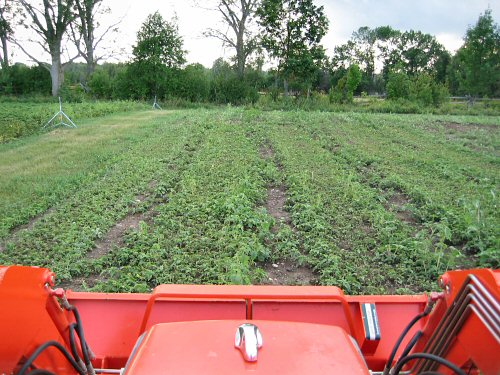
There’s no exaggerating the amount of pigweed in some sections of the field. Here, where the last seedings of spinach and peas failed—really poor germination in the heat—pigweed happily took over in no time. I mowed it down, and now I’m going in with the 48″ rototiller, prepping for fall spinach. Ideally, I’d keep the rototilling and any heavy gear off the garden beds, but this is practically an emergency. I apply the in-moderation rule here… It’s growing on me that round about next year, much of the pigweed seed, deposited three years ago in two-year-old manure, is due to expire… Right now, though, the seed seems pretty healthy to me.
Permalink
Tue, Jul 03, 2007 · Filed under Fieldwork, People, Pests & Disease, Summer, Veggies

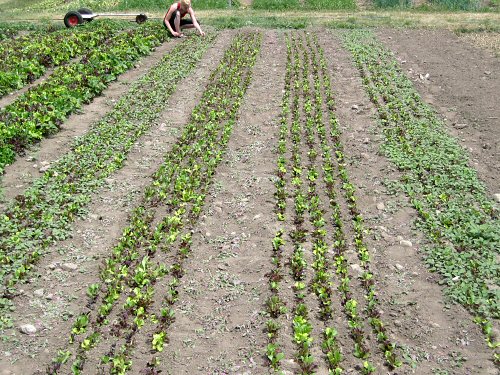
The one dark secret of this organic field, something you couldn’t really tell from selected photos, is the prevalence of pigweed (amaranth, mostly or all Amaranthus retroflexus). About two-thirds of the garden seems to be completely saturated with pigweed seed. Weeding two or three times for all-new outbreaks is common. In some spots, it’s literally as if some kind soul is broadcasting new seed, thickly, every couple of weeks. And when it’s a closely space crop like the all-lettuce mesclun mix in the pic, this means painstaking fingertip weeding. Here, Andrea and I spent about two and half hours clearing 200′ of 5-row beds, the entire latest succession planting. Luckily, conversation made the time transparent (thinking about all of the extra labor devoted just to de-pigweeding is a little painful). As best as I can figure, the pigweed came along with the two-year-old, not-fully-composted cow manure that we spread in the fall of Year 2 (three years ago). We put down around 100 tons on just over an acre—the ground was positively springy!—which was great. Except for the pigweed seed. Eventually, the vast store will be depleted (the seed is viable for five years). Until then, it’s a lot of extra work… The question I’d now ask: “What has that cow been eating?!”
Permalink
Thu, Jun 14, 2007 · Filed under Fieldwork, Pests & Disease, Spring, Veggies

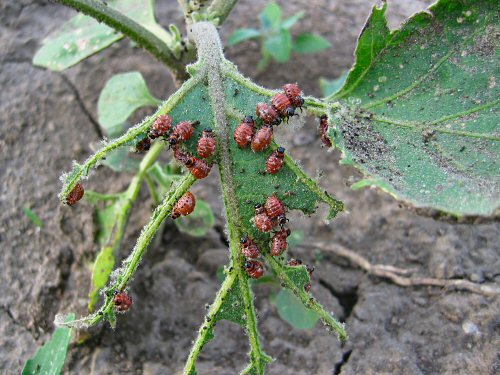
In today’s field photo selection, there was a kinda cool shot of a last-season carrot starting to flower, a freshly hand-weeded onion patch looking quite sharp, or this shiny, slimy cluster of baby Colorado potato beetles, going to town on a Black Beauty eggplant…
Pests and disease have thankfully not been a big problem in this organic field. I like to think that the garden is in some sort of balance, but perhaps it’s just location and luck… In either case, there have been some outbreaks: many tomato hornworms on the…tomatoes in Year 1, same for Colorado potato beetles on potatoes, early blight on tomatoes three years ago when the summer was cool and almost always cloudy and damp, and, of course, the everpresent flea beetles (brassicas) and striped cucumber beetles (cucurbits).
The FBs and CBs are defended against with floating row cover. The rest have recently died down, to the point where I let them do their thing, handpicking a few, but really accepting a small amount of leaf damage (they all eat leaves) and no plant loss.
This year, the CPBs seem to have crossed over to eggplant (another of their natural targets, but one they never really took aim at in the past). They seem to be favoring the Black Beauty eggplant…
The worst of the major damage in the photo happened in probably less than a day, as I’d taken a walk through there just yesterday. Only about four or five of 60+ Black Beauties had a significant presence, with a few loner CPBs on other varieties (and I’d noticed no eggs on the leaves in earlier checks). So, I squished ‘em. Vigilance is somewhat increased.
Permalink
Mon, Apr 09, 2007 · Filed under Indoors, Pests & Disease, Spring, Veggies

Day Two of lettuce under siege. The enterprising field mice were back overnight, munching down another half dozen seedlings (by the angled bite where the stems were severed I’m pretty sure it’s mice). I stuck in white markers yesterday to mark the spots, so it would be easy to see if they’d come back for more. This time, instead of eating them or dragging them off, they just left ‘em lying there. That’s plain rude. Anyhow, they’ve had their tithe, a tenth of the early lettuce. I’m all for live and let live, but if it’s them or the lettuce killed for sport, well, it’s out with the peanut butter and mouse trap surprise. (The little emerging seedlings scattered around are from some of last year’s early lettuce left to go to seed…the crop becomes its own weed!)
Permalink
Fri, Apr 28, 2006 · Filed under Pests & Disease, Spring, Tools

The Scare-Eyes ball seems to work on birds and, from what I’ve seen, cows. I use it for beans, a favorite bird target. A lot of scientific-sounding info comes with each ball. The shapes and mylar circles are supposed to look like predatory birds to other birds. They come in three colors, which you’re supposed to rotate every three weeks, with six balls minimum to an acre. There’s been only the one yellow one for the last couple of years, but this year, I got three more: yellow, black and white… Better safe than picked to pieces by BIRDS!
Tags:
birds Possibly similar posts:
Permalink