All posts tagged with "experiments"

More onions

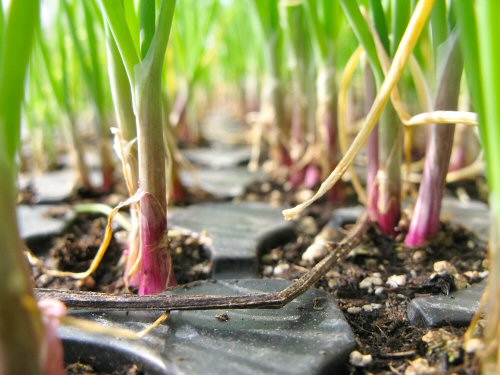
Red Wing onion seedlings

A last tray of onions—Red Wing hybrid red onions that did well last year—is hanging around the seedling room. What are they doing still not in the ground? Well, most of our onions—Stuttgarter-type yellow cooking, yellow Spanish, Red Wing, around 3,o00 in all—are already planted, in two sections, far apart. As I jigsawed together this season’s garden layout (now with the garden MAP), these guys just didn’t fit in the first two onion plots. So, they’ll get a bed of their own, somewhere, real soon, and we’ll see how they do compared to the others. Timing!

Comments (2)

Spring garlic?

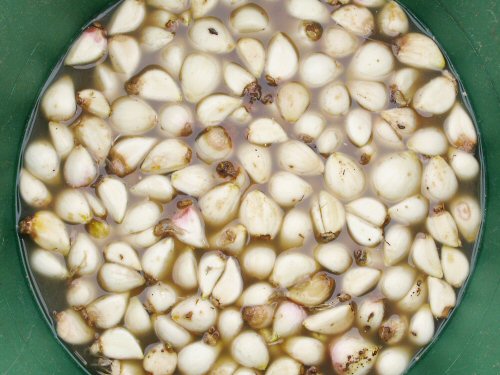
Garlic cloves prepped for planting

With the timing of the move to the new farm, there was no fall garlic planting for this year. Very sad—over the last three seasons, we’ve grown 2,000-3,000 bulbs a year, it’s a much-loved crop all around (starting with me!), and it’s been the very first sign of new veggie life as the fields wake up every spring. Oh, well, we should be back to full-on garlic this fall!

Meanwhile, what we have INSTEAD is about 200 of the toughest, most I-will-survive garlic cloves ever, going in today for a really late start, late even for spring planting! After long months of storage, and an accidental total freezing, the loss of garlic I’d been saving was pretty huge, these 200 out of maybe a thousand.

The guys who made it got an overnight cleansing and rejuvenating bath in a mild solution of baking soda (anti-fungal) and kelp extract (boost), and they’ll be quickly rinsed in alcohol just before going in. Especially for this small, late planting, all this prep probably doesn’t matter much, but they deserve it (personify and pamper your seeds and plants when you can, it’s friendly, until you harvest and eat ‘em!).

So, it’ll be a first-hand test of whether it’s worth planting spring garlic at all. From what I’ve heard, chances are we’ll get at best smaller, later bulbs, some misfires with no bulbs forming, and the same great garden-grown garlic taste! We shall see…!

Comments (7)

Seeding as we go…

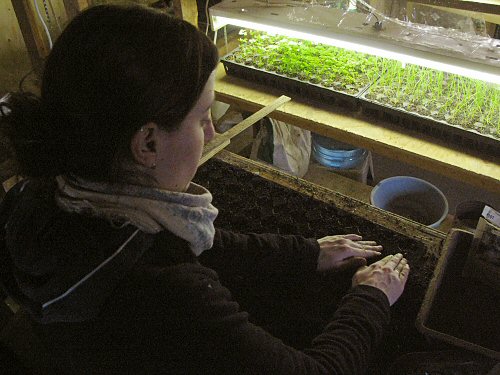
Seeding into plugsheets

It’s spring! The ground is clear, hasn’t snowed in a while, but it’s still cold, and the tiny farming action remains mainly indoors. We’re steadily filling up the racks (here, Lynn populates a plug sheet with Red Russian kale; under the lights, parsley and onion). I’m spreading things out a lot more than usual, instead of starting a whole lot on one day. We’ll see what difference a few days or a couple of weeks make to the various veg… It likely won’t be much, but some interesting things could happen if we get really drastic week-to-week weather changes around transplant time, like we did last year.  An experiment!

Comments (7)

Veggies in snow

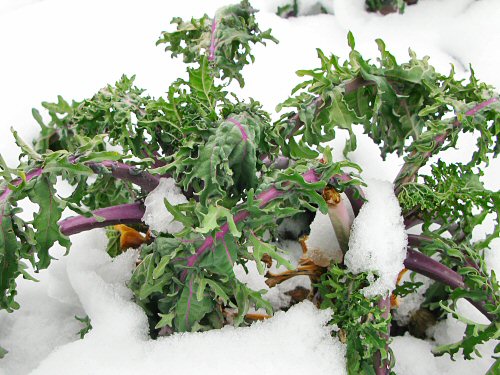
Flat-leaf kale in snow

Every season there’ve been hardy veggies left to the cold and snow, and this season, it’s a record quantity, with nearly 2,000′ (610m) of broccoli, cauliflower, cabbage, and kale that mostly started sizing up just as the farmers’ market finished at the end of October. It seems like a waste, but it’s only a typical garden gamble on the weather (I was trying for an extra, really late crop). The risk was clear back in August, and we didn’t get enough sun to push things along a tiny bit quicker. We did harvest a lot of the Red Russian flat-leaf kale (above), for a good four weeks, and one round of 1-2 lb (450-900g) cabbage (a nice size for a meal for one or two). And there’s been a lot of personal-use picking in November. The rest is a giant farm lab experiment, more exploration of the snow-on-veggies effect

Broccoli in snow

More than the snow, the many nights of extreme cold (-15°C/5°F) that came with it this year really blasted these guys, wilting them and burning leaves and buds. So, none of the crops are too firm or pretty, BUT, they’re still alive: for the most part, there’s good color and texture. The kale, always super-hardy, did the best from a let’s eat some perspective, with good texture and great taste. The broccoli, while a little wilty on the stems and burned on the buds, also tasted great, fresh and flavorful. The cauliflower did the worst, the heads really damaged by the freezing and thawing, too mushy for me to bother with a taste. (Eating raw was fine, but how would this all cook up? We may see…) We’d already reaped most of the filled-out cabbage, so the rest aren’t going to go anywhere from here…

Cauliflower in snow

What’s all this odd information worth? Not much, I guess, I’m not planning on deliberately planting for snow harvests. But checking things out is always fun, no experience goes to waste, and there is at least one advantage to knowing there’s still good eating out there: the laying hens will be feasting on a fabulous greens buffet for a while!

Comments (8)

Pumpkins and pigweed

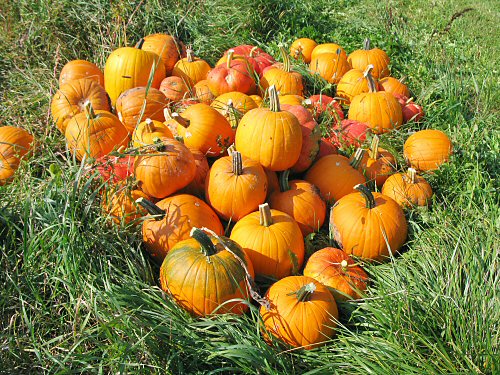
Pumpkin harvest

Today, the pumpkins came in, wrested from a jungle of pigweed gone wild. Every year, a few of the 40 50′x50′ sections that make up the 2.5 acre garden get a little overrun with one weed or another (usually, pigweed). This year’s pumpkin patch was a good example, with pigweed growing unchecked for a good six weeks—no time made to weed, not IMPORTANT enough a crop—until today, when Raechelle used the belly-mounted 52″ mower deck on the Kubota compact tractor to mow it down!

Mowing pigweed

Of course, this is exactly what you DON’T EVER DO in a garden: allow weeds to flourish and go to seed, then mow them down, broadcasting seed everywhere… Oh, well. The alternative, pulling the pigweed by hand, then carting it off, we also do when necessary—see the Pigweed Mountain—but once in a while, I go for the instant gratification of seeing a section clean and clear in an hour or two. The millions of pigweed seeds, ensuring healthy future generations for years to come, will be dealt with…later. (As long as we weed on time next time around, how bad can it get?! :) Anyhow, it’s all part of the grand experiment! Guest pumpkin photo by Lynn.

Raechelle and the Kubota compact tractor

Comments (5)

Veg variety

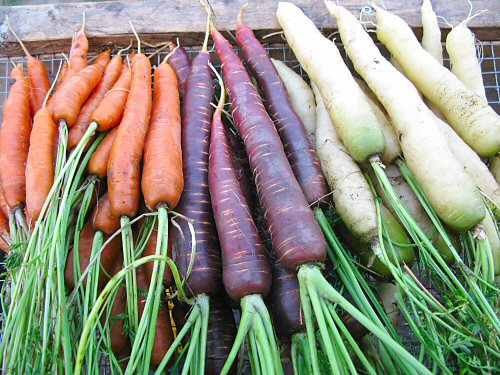
Carrot collection

This isn’t the first time I’ve pondered the question of variety on TFB, but the consideration recurs, so here’s another take… It would seem to be all around easier to grow just one variety of each veg crop, but that wouldn’t be any fun! One round, red beet, one big, round, red tomato, one shell pea, and so on. That’s the standard approach for most of the other full market garden growers at our small farmers’ market. There is SOME variation: green and yellow snap beans, maybe French Breakfast (red and white) radishes along with the standard round red ones, a few types of winter squash… Which is cool. Why bother growing three or more types of orange carrot, let alone orange (Nelson), purple (Purple Haze), and white (White Satin, for the first time this year)? I dunno. By growing several varieties of each veg crop, I’ve learned a bit, like the performance difference between hybrid and open pollinated varieties (in general, the OP tend to do better when field conditions get a little extreme, but that’s not a….scientific conclusion!). It’s not to be a novelty act, the guy at the market with the purple carrots, golden beets and round, yellow cucumbers. Or the round Eightball zucchini (below). If efficient tiny farming was the sole goal, I don’t have a really compelling…justification for all of the complicating seed ordering, transplant organizing, and extra direct seeding work it takes to grow as many different crops as I can, and numerous varieties of each. On the other hand, growing and offering variety, choice, and the non-standard make tiny farming so much fun. Which sounds good to me! It seemed like the thing to do from when I first pored over a seed catalog six years ago, and nothing’s changed my mind since! :)

Eightball zucchini

Comments (4)

TFB & the Web

Locations of visitors to this page

Best Green Blogs

Home and Garden Blogs - Blog Catalog Blog Directory

Add to Technorati Favorites

RSS Subscribe in a reader

Foxkeh

website uptime