
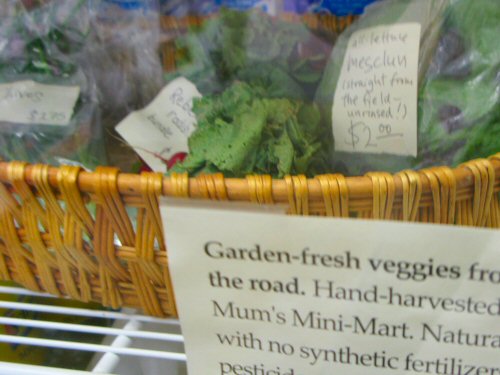
Last year, a little experiment with veggie sales in a town 12 miles (19km) away didn’t go so well. I guess you could sum it up as No Quality Control. This year, in line with the tiny farming trick of thinking SMALLER, I had the sudden idea to put some veggies in at the convenience store three minutes down the road in the village. This is now the only store for quite a ways around, and it has the post office where everyone in the village picks up their mail. Since I’m always meaning to get the farm stand fully open, putting veggies out a couple of minutes away hadn’t quite made sense, but the way it came to mind now was a little different. If I could get a single shelf in one of the coolers, this would be an interesting, easy way to learn about veggies and refrigeration, and even be able to watch a mini version of the supermarket, convenience-shopping experience, by seeing what sells, the effects of labels and pricing, and…whatnot. All on the most casual level. Refrigeration is, of course, yet another of those many worrisome topics that come up along with Peak Oil and the generally somewhat alarming state of the world, BUT, fridges will likely be around as long as any number of other taken-for-granted things, I figure, so whatever’s learned from a little, low-impact experiment like this should be worth it. It’s an extremely simple set-up, with a small sign taped to the inside of the cooler door, hand-labeled bags, and an honor-system account book for inventory. I also like the idea of super-fresh garden veggies popping up in this most unlikely place, just below the shelf where a few supermarket-purchased veggies are kept for resale. Outpost 2, the Shelf, has been open for around three weeks now, stocked with ones and twos of mesclun and spinach, a few radishes, some herbs. I’m by there every day anyway, so I check the veggie condition often…and things are selling… Interesting enough…!
experiments
Grass mulch, Season 2
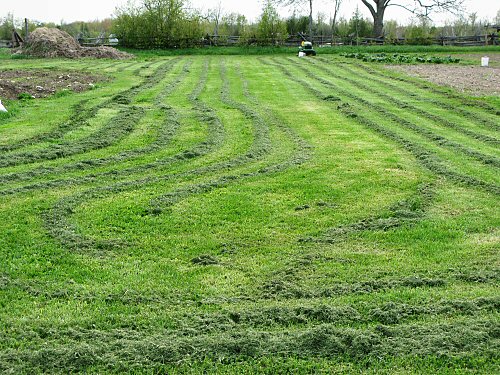
The grass seemed just long enough for a productive mulch cut without overloading the John Deere riding mower, so today was the day to start season 2 in the grass mulch experiment. This is just one part of the total mowing area: including the field perimeter and another big area behind where I’m standing to take the photo, there’s maybe four times that much (this area is being kept clear for the eventual bigger greenhouse). The JD’s deflector forms those nice mini-windrows instead of scattering the cut, making raking it up much quicker. I’m still not sure if the time it takes to mow, hand-rake and bag will be worth it on a larger scale: will the work be offset by savings in irrigation and weeding, and maybe better yield, for the crops that’ll be mulched? It takes a lot of big, packed leaf bags to properly mulch just a few beds… Well, we’ll soon find out!
Potting up
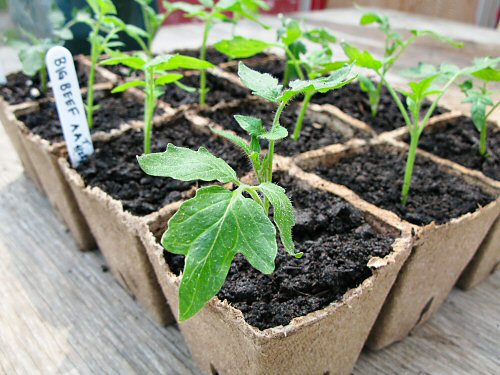
Many things are going on at once, and one of them is potting up seedlings and moving them out to the greenhouse. Already, onions, leek, parsley, lettuce, and the first trays of cauliflower and broccoli are out there, all of them hardy enough to take whatever cold comes along. What’s really going to use up space once they’re potted up are the tender tomatoes, peppers and eggplant. I’d like to’ve had them all done by now, BUT, there’s going to be a cold snap for 4-5 days starting early next week, a couple of nights may go down as low as -8°C (18°F), and I’m concerned that row cover and the kerosene heater may not be enough protection in the unheated greenhouse. So I’m waiting, potting up a few every day and finding room for them under the lights. I started with the Chosen 100, my earliest 100 tomato starts, 25 each of Big Beef (above), Juliet, Striped German and Stupice (in order, two hybrids and two open pollinated heirlooms). They’ve gone into 3″ peat pots, with a mix of peat, compost and soil, and I’m also hardening them off outside. The rest of the toms were started a couple of weeks later. They’ll move from 72- to 38-cell trays, all part of the spend-less-time-on-transplants experiments… Waiting on weather forecasts is a bit of a risky way to work, it’s really not a good idea to delay anything at this point in the year, I’ve found it’s generally better to get on with things and deal with problems as they come up, not try to second guess the future. But I have so much else to do, I’ll take the chance and wait a couple more days to finish them all…
Chicken check-in
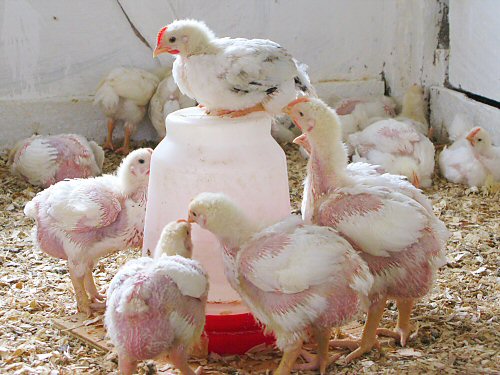
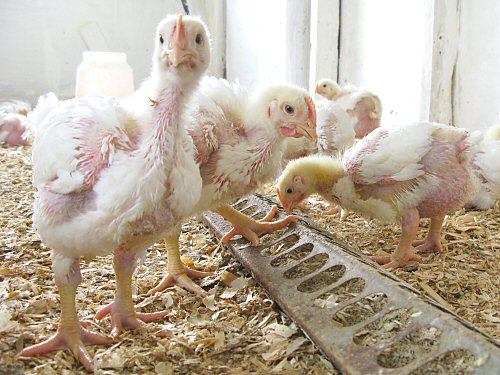
A week after their arrival, the chickens at three weeks old are doing fine. They settled in no problem, eat like maniacs, drink a lot, and I guess they’re too young to fight, ’cause they’re all getting along. I’ve been cycling through music—a radio is always on in the chickenhouse, to scare off PREDATORS—started with a couple of days of country, then a stretch of classical (they go a little crazy during big, building crescendoes), and now it’s rock (“’80s, ’90s and whatever”…a weird-format local FM station). So far, behavior seems pretty much the same no matter what’s playing—the experiment continues, maybe they want custom mix tapes. And they’re growing. They started off about the same size, but there are definitely some big guys now amongst the White Rock Cornish X, and the Frey’s Special are all at the smaller end, faster-feathering, too (there’s one on top of the waterer). They’re all getting along, but Bob noticed a red pecking spot on one of the White Rocks, so I’m gonna be watching the blending of the breeds: I read that sometimes the WRs get pecked (attacked?) because they’re slower to feather than others… The gang (the posse, the flock!) does keep busy, exploring corners and cracks, piling up and napping in sunlit patches, zipping around, drinking a lot, and of course, eating…
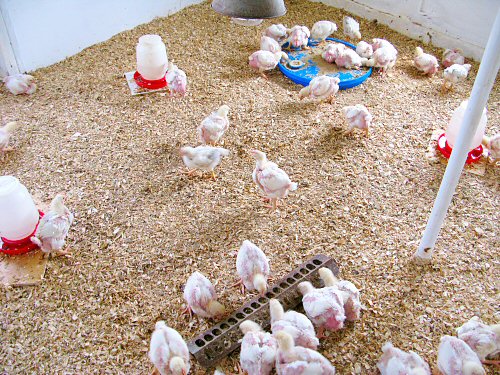
Definitely a lot of eating…
Back in the dirt!

Transplanted the arugula from the end of January into as small a corner of the greenhouse as seemed to make sense, two plants to a plug, about 6″ (15cm) apart. There’s no space to waste, and these guys, already a long time in trays, will likely be ready too early for market (first Saturday in May). So, another experiment in early planting, but leave room for others! The arugula has been out there in the plug sheet for a couple of nights, surviving 10°F (-12°C) nights under a few layers of row cover (an extreme rapid hardening off!; as you can see in the tray, a few much smaller seedlings, started in mid-Feb, didn’t do so well, most of ’em got toasted the first night). And now, the survivors are in the ground, free at last, in full sun during the day, and recovered at night. It felt great to put hands in the soil, first time this year. Mmmm…
More fun with lettuce
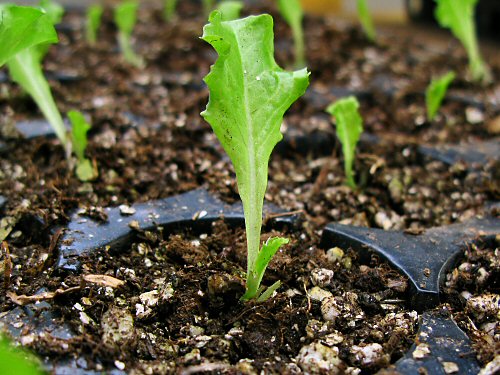
Some of the early lettuce I ended up leaving two to a cell, to see how they’d do. Now, I divided a bunch of those and potted them up singly to a much roomier 38-cell plug sheet (up from 72), and trimmed off all their leaves (and ate them). After the shock of transplanting straight from indoors to the greenhouse, the lettuce seedlings usually lose their bigger leaves anyway, so why not give them a head start?! It’s extremely time-consuming, all of this careful repotting and trimming—not practical for the market garden at all. But I know I’ll be closely watching the results of this early, cold-hoophouse planting, so I’ll see if they do better than the regular plugs. Later on in the season, I intend to keep experimenting in more practical ways, but time and many other things to do have their way with the best laid plans… (Hint: As a rule, it’s best to start seedlings in the biggest and DEEPEST container that you have room for in good light, and avoid potting up. The less you disturb roots, and the more room you give them to grow (especially, down), the better they seem to do when transplanted.)
First cuts
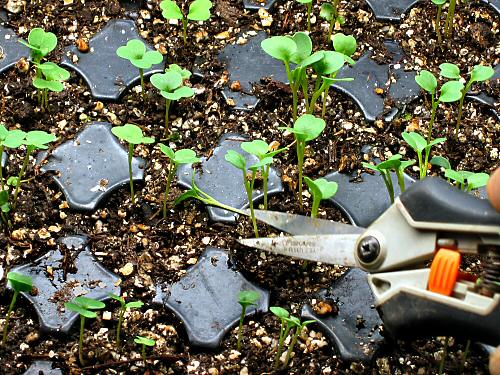
Time to thin out the lettuce and arugula. Between the seven varieties, some of the seed I used was up to four years old, so to be safe, I was quite generous, maybe 4-5 seeds per cell for the arugula, and a bit more for the lettuce (that tiny seed can get away from you, though with new seed, I try to go lighter). Germination was good, and the little seedlings are already shading out each other as they push for the light. I’m still getting used to timely, to-the-point thinning, both in the trays and in the field. I usually have the urge to leave ’em a while longer, but almost always, this ends up being not the best thing to’ve done. Give the best ones the biggest break as early on as possible, which means, kill off the rest. This also takes some timing experience, but in general, it’s hard to go wrong by not waiting around. Sounds brutal, but that’s about it! The lettuce will eventually be one per cell, although for now I’ll leave a couple per. Starting arugula indoors is a first for me, I usually direct-seed, so I’m figuring things out this time around. I’ll leave two per cell, and plant them out two together at 6″ (15cm) spacing and see how that works out. Here, I’m snipping arugula at the soil level with wickedly pointy little shears…