
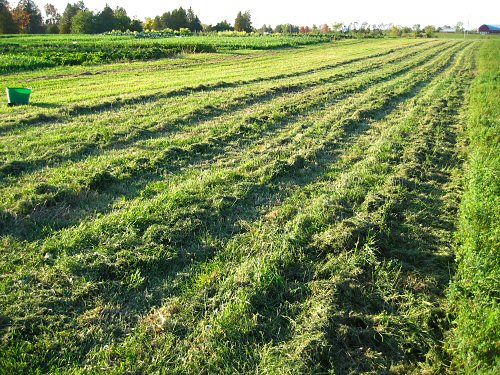
Yet another experiment: making mulch from some of the hay that grows alongside the garden. The hay, originally alfalfa and red clover, is dying out, and what’s left is mainly grass and alfalfa, currently around 10″ (25cm) high. I cut it with the riding mower, which instead of scattering the clippings, leaves a convenient tiny windrow. A couple of days drying in this year’s hot October sun, and it should be good to go. I tried thoroughly dried grass clippings as mulch a couple of years ago on a few tomato plants, and it worked out well, so on to a larger scale. This crop will be used on the garlic, to be planted in a month or so. The mower is sadly in need of new blades, so the cut is rough, but it should work out fine.
experiments
Return to Jerusalem artichoke
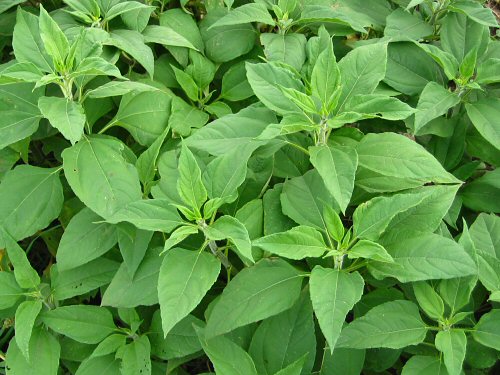
Various garden experiments are going on here and there. The new oats and fall rye green manure cover crops are doing well. There are five or six tarragon starters, three divisions from a potted lovage, coriander seed dried on the standing plants… Several varieties of hot peppers have to be given a final performance check. And so on. One I keep noticing and promptly forgetting again is the Jerusalem artichoke, planted so long ago. They’re definitely tough. The fuzzy-textured leaves seem rather delicate and wilt alarmingly without water, but they’ve survived with little weeding and maybe one watering all season, and they’re looking happy now.
Another unusual characteristic, compared to almost all of the other veggies and herbs, is how un-uniform they are, at least in this first year, with plants of all heights, ranging from around a foot to over three feet (30-90+ cm). There’s not much variation in leaf size, simply in…height. Well, JA’s supposed to be prolific—we’ll soon see when I check in on the gnarly tubers down below…!
Rye arrives!
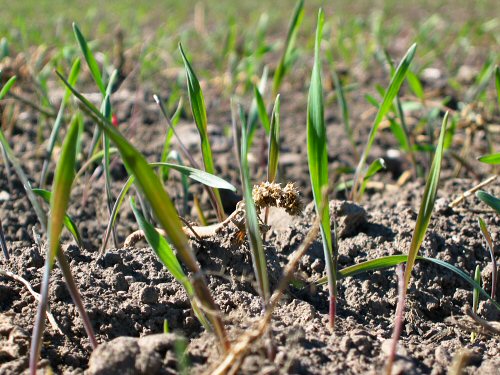
Where the oats arrived with a dramatic, iridescent splash of green, the fall rye made a much more sedate entrance, so much so that I didn’t notice it until today. It probably emerged a couple of days ago. It’s looking great! I dunno why I’m so extremely pleased by these green manure cover crops…but I am! The rye comes with a lot of promise. It probably won’t winterkill, instead, start up again in spring, making it good for sections that won’t be planted out till May. It thrives in cool weather, also making it great for fall and spring service. And it may have an allelopathic effect on PIGWEED, meaning that, on a plant-produced chemical level, future pigweed may suffer… That’s nice. On the caution side, if it gets too well-established, it could be a little tough to eradicate. No worries. I won’t seed it on sections that’ll be used for the earliest spring planting (there won’t be time to till it in), but otherwise, I’ll spread this around everywhere I can for the next month or so and see what happens!
Carrots like burlap!
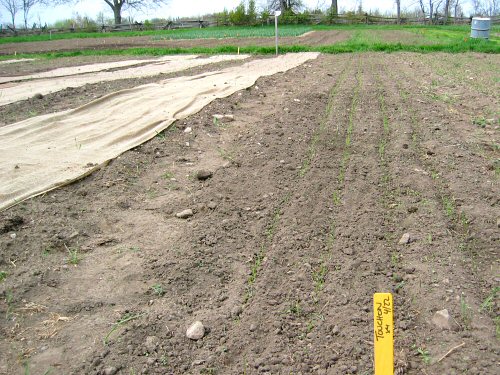
The carrot germination experiment worked like a…charm! They were coming up pretty good three days ago, conditions looked great under there (moist, airy, seedlings nice and green), so I left the burlap on a while longer to push the germination rate a bit more, and that worked as well. This bed just had a 10-minute clean-up of some grass and dandelion, and I test cultivated a few feet at this end for smaller weeds getting started. With the moist soil, it’s all easy. Now it’s off with the rest of the covers and time for a little irrigated rain (since Ma Nature is presently not obliging). Excellent!
Getting busy
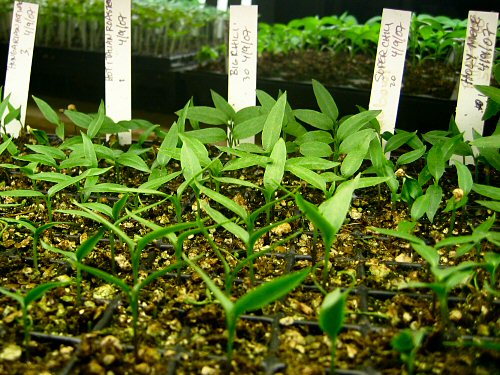
Hot peppers, and tomatoes behind. They’re some of the last set of seedlings, a bit of an experiment to see how late I can start ’em without slowing down later growth in the field. Outdoors, it’s been warm, gray and drizzling for two days now, things are starting to emerge, crops and weeds both, and it’s already time for a second planting of spinach and mesclun. Inside, the last several hundred seedlings are ready to be potted up and moved out to the greenhouse. We’re right at the point when things suddenly start to get intensely busy!
Carrot science
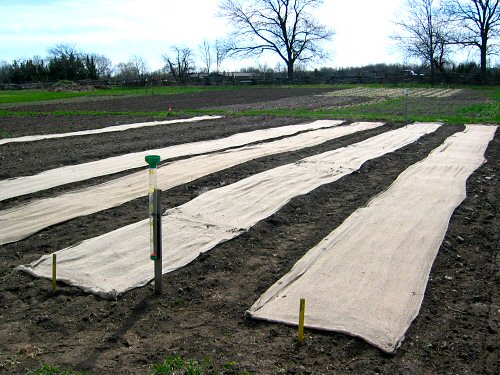
Welcome to my carrot lab! Carrots have been my biggest early spring headache. In cool weather, they take forever to germinate, 2 or 3 weeks, and by that time, the chance of weed competition is pretty good, and just about anything growing around the tiny seedlings makes excruciatingly time-consuming surgical hand weeding a necessity. What to do? Last year, I tried IRT (plastic) mulch over the bed. This worked great, heating up the soil, speeding germination to 7 days, and keeping weeds down. Problem was, miss the germination window (when a good number have emerged) by a few hours or a day, and the seedlings got toasted in the heat. Too delicate a balance. So, a new approach, something I’d read about. It involves a double layer of (untreated!) burlap. Simple. The burlap acts as a mulch to retain moisture and increase soil temperature, and it also allows in water and some light. What could be easier?!?! Now, all it has to do is WORK! (Update: it worked like a charm…)
Latest tomatoes
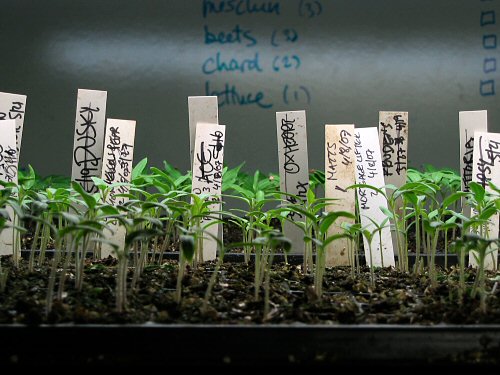
Some of the last-started tomatoes. This was a first-time experiment with starting toms in 200-cell plug trays, also, starting as close to last frost date as seemed reasonable. You can get a lot going in a little space, but they won’t fit in there for long. (Gotta admit, this photo’s a bit of a placeholder in my post-a-day plan. With the sudden fantastic weather, and my first full-time all-around helper in the garden just arrived—energetic, enthusiastic, no microfarming experience—I was totally immersed in fieldwork and FORGOT TO SNAP a slice of today’s main action. Tomorrow’s another day!)