All posts tagged with "hoses"

Water pipe

Irrigation pipe

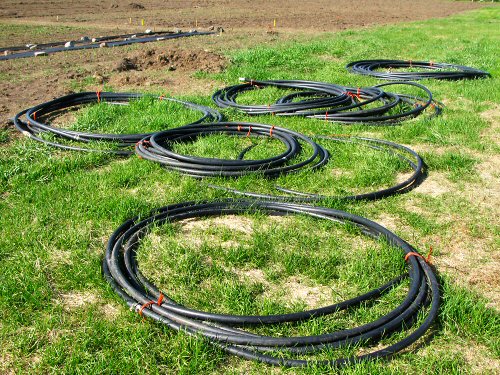
A bonus this spring has been the steady rain, not too frequent, like, once a week or so, and somewhere around 1″ (2.5cm) each time. Perfect! Still, today, in the middle of a hot, sunny stretch, thoughts turned to water (not that it was ever far from mind). Out came the coils of 1″ water pipe. In our barebones spot irrigation system, there’s 1″ pipe and a bit of 2-1/2″ pipe, endless 5/8″ garden hose and 50′ sections of soaker hose, the gas-powered irrigation pump, and even 55-gallon barrels and watering cans. Not to mention, piles shut-off valves, quick connectors, and various hose fittings. For now, all that I’m looking to set up is one central line running from the well pump at the house, right down the length of the side-by-side fields, where it can feed the garden hoses. So, uncoiling we go…

Comments (7)

Bringing in the pipe

Coiled irrigation pipe

Bit of unusual fieldwork on the menu today, something we don’t do every year. Bob and I brought in about 1,000′ (305m) of 1″ (2.5cm) and 1-1/2″ plastic irrigation pipe, that ran all the way from the pond to the gate into the garden field. Why wasn’t this done in better weather, when, besides having no snow to deal with, warmer plastic would’ve been a lot easier to handle, especially to BEND? There’s no good answer, except maybe, “Didn’t think it’d be this cold and snowy so soon!” Anyhow, it got done, and probably in exactly the same time…

Tractor dragging irrigation pipe

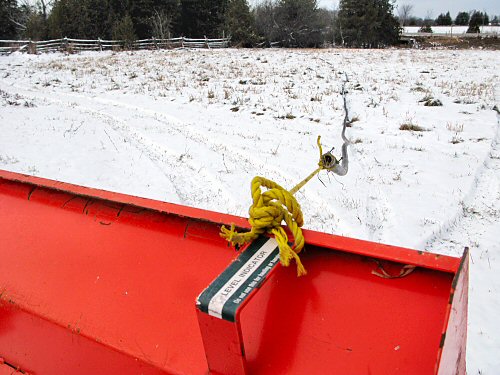
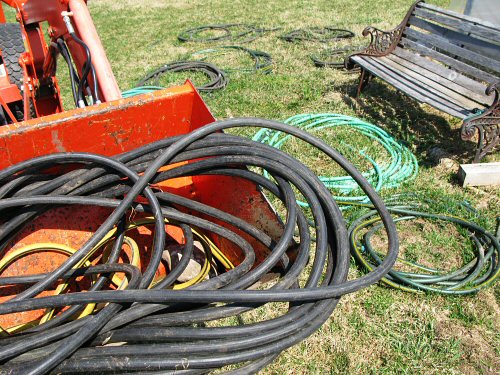
I used the Kubota compact tractor to drag the pipe in three 300′ sections, right into the barnyard (the rope is tied to the front end loader bucket; in the pic, this is at the very end of the garden, where it meets the hay, so all that stubble is mainly long grass). Backing up down the field, I worked it from the far end for the section that lay in the unmown grass right near the fence, so that it could more easily tear its way out of the overgrowth. Then, some coiling (that’s Bob), tying off the loops every few turns with baler twine (plastic twine used to bale hay, it’s all over the place)… Easy!

Rolling plastic pipe

Comments (2)

Tangling with hoses

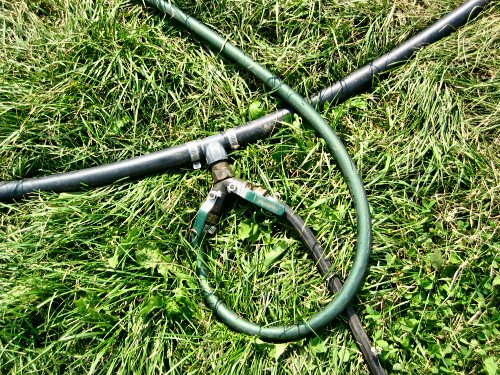
Sorting out hoses

In smaller gardens (tinier farms!), hoses are generally a fact of life. In spring, it’s time to uncoil them all, check the fittings, and get set to deliver water largely by hand.

On BIG veggie farms, “hoses” are usually big pipes (3″/7.5cm and up), part of full-blown irrigation systems that suck up and spew MILLIONS of liters of water a season. Here on this tiny farm, we’re way closer to the garden hose end of the scale.

Our irrigation system is a work in progress. Drip tape is the ultimate goal, but there are obstacles to work around, like the limited water available from the barn well, and the distance to and lack of electricity at the spring-fed pond. Right now, watering is about regular 5/8″ hoses, fed by a 1″ plastic pipe that runs from the barn well to the pond located WAY at the other end of the field, with taps at 100′ intervals.

Actual watering is done with a combination of soaker hoses, sprinklers when there’s no wind, and various hand nozzles for watering in newly seeded beds. Quick connectors are a major convenience when hooking up the various combos of multiple hoses and other attachments. I try to find a balance between not too many hoses, because you can’t leave them lying around, and not so few that you’re moving the same rig all over the plot.

Accidentally tilling hoses that were left snaking around instead of being promptly put away has turned into a not absolutely rare occurrence, and a time-waster (untangling and splicing takes more than a minute). Just put away that 300′ of hose plus 500′ of soaker hose when you’re done! ;)

Spot irrigation with hoses on two acres is a bit tedious, but like everything else, you do get used to it, it’s part of the routine, and it gets the job done, which is satisfying in the end…

That’s the state of the watering art around here as we head into a new season, and I’m promising myself advances on the drip side of things. Of course, it could happen to rain all the time, about an inch (2.5cm) once a week would be fine, and then hoses would largely vanish from the garden landscape. That’s not at all that likely (and when it’s a really rainy year, you wish for hot, sunny hose weather), but…YOU NEVER KNOW!

Comments (4)

Making water

Melting snow in water barrels

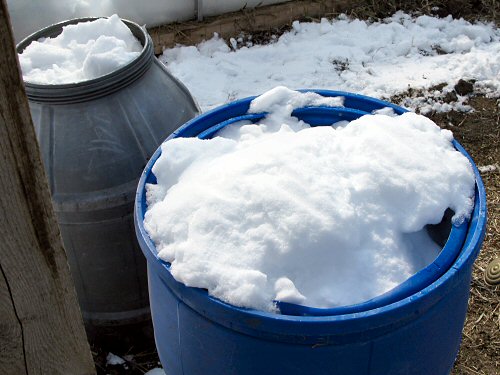
As far as winter irrigation in the greenhouse goes, melting snow in big barrels is the next best thing to a really long hose, a well and an electric pump. Fill ‘em up, cover with clear plastic, wait a day (even on a dull, cloudy day, it gets up to 60°F in the hoophouse). Repeat a couple of times, and you have 50 gallons of rainwater in a barrel! The alternative is dragging 200′ of hose through deep snow from the barn to the greenhouse, then reeling it in and draining it, every couple of days. The weather has put the kibosh on the early-March, barely heated greenhouse plan, the happy prospect until March actually came around. The nights have been regularly plunging to 10°F (-12°C), so it’s really not worthwhile to heat things up by 25°F. No worries. Adjusting expectations and schedules more or less by the day is all part of the fun… It’s never boring!

Comments (8)

Water in the air!

Evening sprinkler action

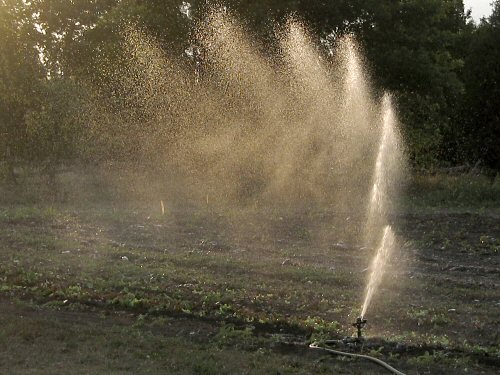
It’s supposed to rain tomorrow… I’m as skeptical as ever, still, as illogical as it is, you figure it’s gotta rain EVENTUALLY, so the longer it’s been, the more accurate the latest “60% chance of showers” forecast must be. Until then, we continue the piecemeal irrigation effort, with a combination of sprinklers and soaker hoses. The pond level is noticeably down, but bottom still isn’t in sight…and it’s gotta rain soon, right!?! :) Here, the latest beds of mesclun and spinach get their daily sprinkle. You can see by the fine mist in the air how easily much of the water can be lost to even a slight breeze, and to evaporation under a hot sun. Still, soaker hoses are only practical for larger standing crops, and pretty near useless for keeping newly seeded beds moist. From the pond pump, we get enough pressure to run four or five sprinklers and have 500′ of soaker hose set up, which means two or three of 40 sections can be covered at once. It takes a couple of hours to put down maybe 3/4-1″ of water. And the majority of days, we have to do early morning and evening sprinklers only, because of wind in the day. So, lots of moving hoses around… Next year, I’ve gotta figure out a drip irrigation solution…

Comments (4)

Milkhouse looking out

Milkhouse looking out

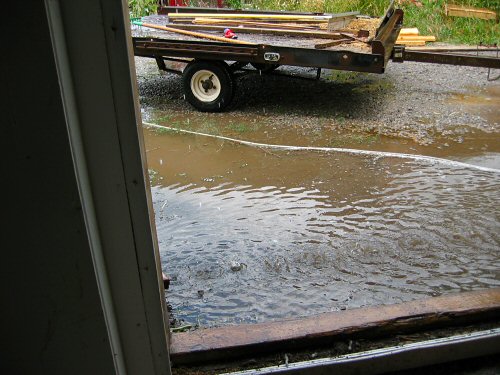
The view out of the extended Milkhouse sliding door is not yet a great one—gotta move the big storage shed that blocks the view straight out to the field—but it’s become a common one this year. Amongst other things, the Milkhouse is a place to take refuge from extreme heat and, very occasionally, from…rain. And the extreme teasing continues. The latest is rain from INDIVIDUAL CLOUDS in an otherwise largely clear blue sky, that comes down just heavily enough to make you take shelter. A gutter hasn’t yet been installed at the front of the Milkhouse, so water streams down from the roof, which picks up more from the main barn roof, creating a deceptively abundant pool in no time. Actual rainfall for this little session: 2mm. (The tiny grey hose running across the pic is the original lifeline from the barn well to the field that in the first two and a half years was all that supplied water when the weather didn’t!)

Comments

TFB & the Web

Locations of visitors to this page

Free PageRank Checker

website uptime

Best Green Blogs

Home and Garden Blogs - Blog Catalog Blog Directory

Download Firefox