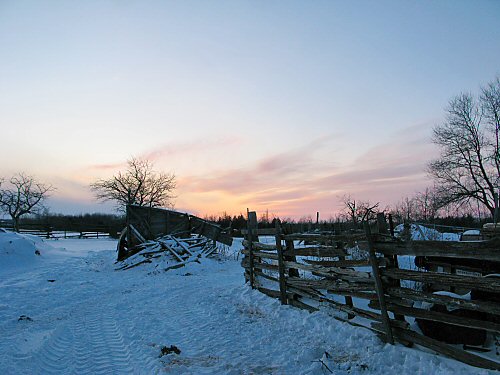
Frost is pretty when…

Frost burning off in the morning sun

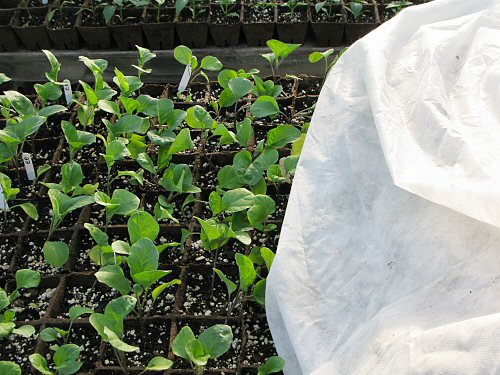
The days have warmed up now, mostly around 60-70°F (15-20°C), but the nights are unusually cold, dropping sometimes to freezing or a few degrees above. Frost burning off in the early morning sun is pretty when you don’t have anything in the field for it to kill, which I don’t… Let’s see: broccoli, cauliflower, radish, carrots, spinach, chard, beets, peas, parsnips, all-lettuce mesclun, tatsoi-mustard-arugula-bok choi mix… Nope, no worries there. (Funny thing, while pea plants are hardy, I believe the pods aren’t… I’ve never seen that in action, fall peas haven’t worked for me so far, and I don’t think there’ll be frost 40 days from now when this year’s first peas come in…). Meanwhile in the unheated greenhouse, although I’ve only fired up the kerosene heater once, just to be safe, row cover goes on all the tender stuff (toms, eggplant, peppers, and now, cukes, pumpkin, melons and squash, just about to poke up): on in the evening, off in the morning, better safe than toasted!

Removing row cover in the morning

Comments (4)

My old friend the min-max thermometer

Min-max thermometer on the hoophouse

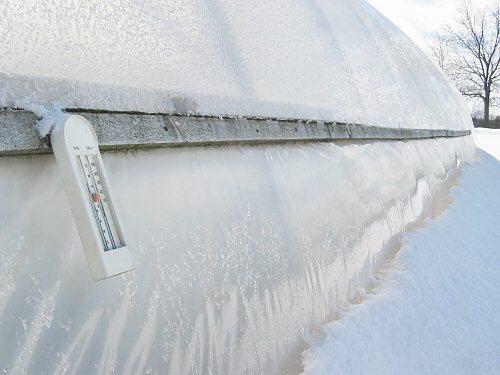
Clearing a path to the hoophouse today, I turned the corner and noticed the original min-max thermometer. I don’t usually. It was one of the first bits of gear acquired in Year 1, when the reality of FROST in the garden was a complete and scary unknown. The thermometer records the lowest and highest temperature that it’s hit; you reset it by pushing the little red button. It’s been hanging on the same nail in the same spot for three or four years, more or less out of sight and mind except in spring and fall, when I check it first thing in the morning to see how cold an overnight cold snap really got. Lately, the min-max is not such a big deal. Each different section of the field, and the particular crop in it, reacts differently to each cold night, so the only way to know what’s happened is to walk around and check things out. And I have confidence in row cover. I still check the thermometer, but it’s not like spring in the first couple of years, when I’d bolt awake at 6:00 a.m. and 10 minutes later be walking through the chill and dewy wet grass, adrenaline pumping, waiting for the verdict from the min-max to see what new transplants may’ve been toasted. It was kinda cool to be reminded, out of the blue, how that’s changed. In the case of gardening, at least, the more you know, the easier going you get!

Comments (3)

Getting started

Lettuce and arugula started

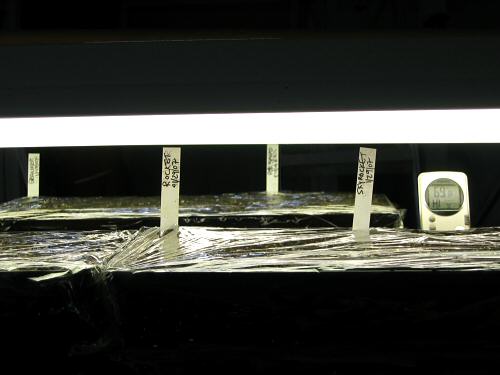
Started the first seeds of the year today: lettuce and arugula. At night, the grow racks remind me of a lab experiment, with the plugsheets in trays, carefully labelled and sheathed in plastic under the intense white light (fluorescents up close are pretty bright). And there’s the digital min/max thermometer, keeping score. The whole set-up looks like what it is. It’s great! In the beginning, I kind of obsessively (and largely unnecessarily) check every few hours to make sure the soil mix is sufficiently moist, the temperature is above 60°F, to see if anything’s emerged and it’s time to take off the plastic. Maybe after another five or 10 years, it will become simply routine, but for now, every single plant to emerge is still cool and exciting… For this, the earliest lettuce attempt yet, I’ve started five varieties, all with maturity dates of 50 days or less. There’s Simpson Elite (a really fast 40-day) and Two Stars, both green leaf, Granada and Red Salad Bowl, both red, and Sierra, which is red tinged. As a salad mix in any combination or all together, they’re a great blend of colors, textures and tastes. The arugula, Rocket and Skyrocket, intended for the mix, is faster growing than lettuce, but I felt like starting some now (I’ll start some more, later). If all goes well, these will hit the unheated greenhouse in the beginning of March, a good three weeks ahead of last year!

Comments (5)

Barnyard at night

Barnyard at night

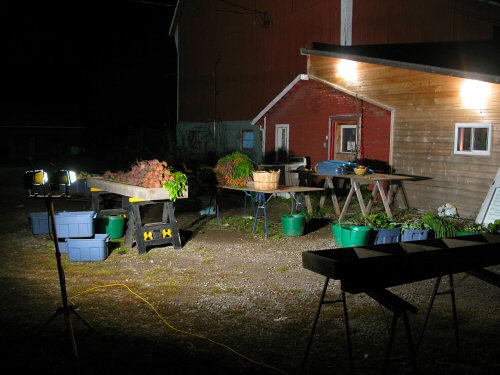
Here’s what I see coming out from the Milkhouse at night, as I head to the house. Facing is the goat barn, with the big old barn out of frame to the right, the farmhouse off to the left behind the rail fence, and the curve turning into the on-farm lane that meets the road. (I borrowed a tripod to check out photos by available light. It’s cool, way more picture possibilities. I’ve been using it for a couple of weeks, avoiding the annoying flash.) The light from the street light-type lamp pools brightly right below and fades across the yard. (Without that lamp, it would be pretty near pitch black around here unless the moon was out.) The scene seems sometimes picturesque, sometimes a little ominous, that desolate, deserted parking lot look…but it’s only the Farm. As far as anyone remembers, the lamp fixture was rented 20 years ago from the provincial hydro company, they still come around every few years in a huge truck with a cherry picker to change the bulb, or tube or whatever it is up there. I could call and find out the details, but at the moment, they’re not important…

Comments (5)

Field at night

Field at night

Nights are warming up now, so it looks like I won’t be cruising through the near pitch black field much longer, checking temperature in the greenhouse. There’s not much to see or do out there after dark.

Comments

Grow racks at night

Grow racks at night

Plant racks, light stands…I call ‘em grow racks. They’re filling up now. Pushed to capacity, they can hold a total of 36 trays. Depending on the size of the plug sheet—I use 38s, 72s, 128s, 200s—I can start between 1,368 and 7,200 seedlings. Sounds super-efficient. HOWEVER, it comes down to the light. With four trays per double fluorescent fixture, the light is pretty stretched, and a lot of rotating is in order. Also, most of the fixtures are the old standard T-12 type, where the light is stronger towards the middle of the tube. You can clearly see the difference in growth if you leave trays in the same position for a few days. The newer T-8 type lights evenly from end to end and uses less power, but I don’t feel like replacing all the fixtures (a couple in there are already T-8). I continue my experiments with what size plug sheet to best start in given the light (and which determines if or how often I need to transplant to larger quarters). All in all, I’ll get around 2,500 seedlings off the racks this year.

Comments

TFB & the Web

Locations of visitors to this page

Best Green Blogs

Home and Garden Blogs - Blog Catalog Blog Directory

Add to Technorati Favorites

Foxkeh banners for Firefox 2