
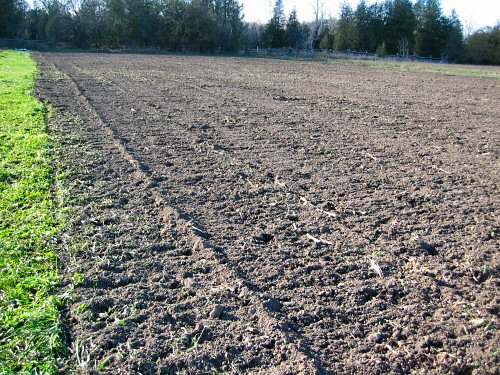
The new section at the north end of the garden, all clear after yesterday’s rototilling. The area is 120’x200′, about half an acre. Although it looks light and crumbly after drying for a few hours in a stiff breeze, the clayey soil is pretty heavy and moist. It never really dries out after mid-October or so, it only gets wetter until it freezes… A low cover crop, to winter-kill and then be tilled under in spring, would be great. I’m working on it, and this is the next best thing: no weeds!!
rototiller
More fall finishing
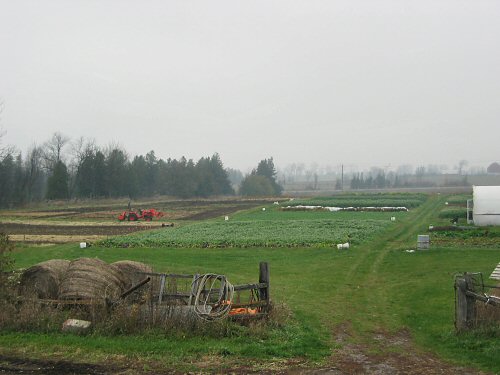
Fall clean-up is moving along bit by bit between the weather. Half the field is cleared, fertilized, and tilled or about to be. The rest is mostly covered by oats and a little rye. The Kubota compact tractor is ready to take up where it was stopped yesterday by the broken rototiller chain. At this point, I have an hour or so before the rain…
Rototiller breakdown
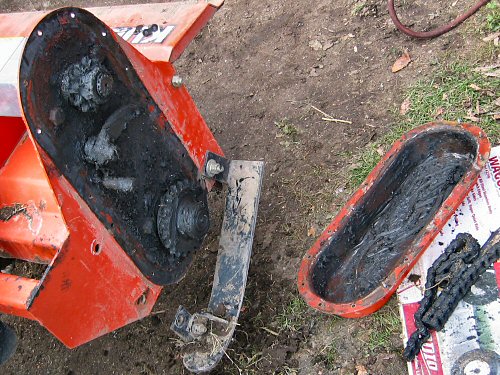
Like machinery everywhere, gear on the farm tends to break down just when you need it. This may be obvious, but it’s no less annoying for it!! Some breakdowns you know are coming sooner or later, like when you decide to let it wear out rather than fix it at the first signs of trouble. This you can avoid with regular maintenance including INSPECTION—checking things out for looseness and wear always eventually pays off—but often I, uh, don’t get around to it (as with, recently, the riding mower). Most breakdowns are, at least on the surface, sudden failures, like today, when in the midst of tilling with the 48″ rototiller on the back of the Kubota compact tractor, the tines suddenly stopped turning. This had happened once before, so the diagnosis was easy: broken chain. And that’s a good one. Every time something breaks and we fix it, I stock up on extras of whatever was used in the repair—DIY repair and a good selection of spare parts go hand in hand on the tiny farm! So, for the chain, there are parts: full links, offset links, master links. A replacement chain is also quite cheap and a good thing to have on hand. This particular repair job is dirty but extremely simple and straightforward, same as for a bicycle chain. Pop off the chain guard, scrape off the excess grease, bang out the rivets on the broken links and add new ones, or decide to replace the whole thing, put the chain back on…it’s about as simple as that, and you’re back in the saddle again!
At the wheel
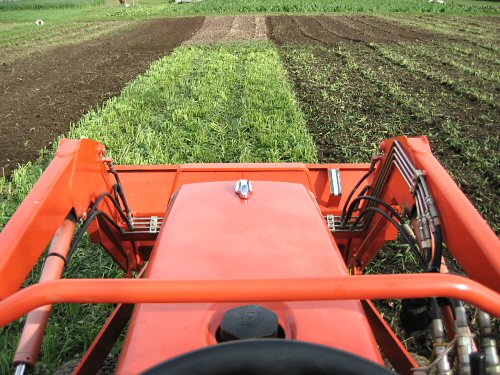
Tilling in the monster oats green manure/cover crop is a task where the Kubota compact tractor sure comes in handy. The oats is tall, dense and seemingly unstoppable by cold. It took a double mowing to get it down to a manageable state, and even then, it’s a slow till. The walking rototiller could’ve gotten the job done as well, but it would’ve taken several passes and a couple of tanks of gas, so I was happy to be at the wheel for this one. Originally, the plan was to let the oats winter kill, and work it in in the spring, but there’s just so much of it, I decided to take it out now rather than lose an extra week or two next year, waiting for it to break down. Decisions!
Getting ready for garlic
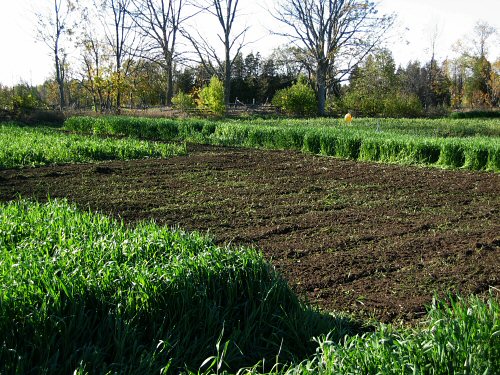
Home for next year’s garlic, carved out of the oats yesterday, is looking good! Mow the oats (the riding mower got a good workout and did a reasonable job), spread aged cow manure from the barnyard, and rototill in with the Kubota compact tractor. Simple! What sight is sweeter than a rich, freshly turned new garden plot, ready for another round?! :)
Wheel Hoe Day
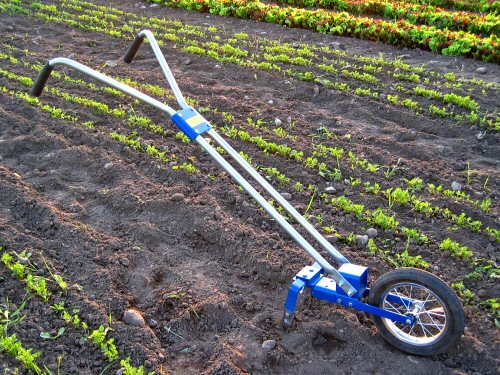
Finally, the new wheel hoe arrived today from the Valley Oak Tool Company in California! This simple and amazing garden tool is so little known in these parts, I had to order it from another country… I hadn’t used one before, but I had a very clear idea of how it should work, and it didn’t disappoint. You walk it along, pushing with minimal force, and the blade slices through the soil, beheading all weeds in its path. With ease. A slight arm adjustment translates into precise depth control, and the double-edged 8″ blade works on a back-pull as well. Even fist-sized rocks (a constant feature in this field) don’t phase it, they simply slip through the hoop. It’s at least 3-4 times faster than hand hoeing, and it matches the Horse walking rototiller for path clearing, minus the noise and gas. Amazing! (In the numerous shipping documents, I liked the note to Customs from the toolmaker, an organic veggie farmer himself: “Please let this package be delivered ASAP. There is a farmer awaiting his new tool.”)
Horse back in action…

The Troy-Bilt Horse walking rototiller is back in action for the first day of tilling in the field. I prepped a 50’x50′ section for snap peas. The Horse is noisy and uses a fair (though not unreasonable) share of gas, but it’s also a very handy machine for larger areas (in fact, I would’ve used the rototiller on the tractor, but the ground is still too wet to take the weight). All things in moderation on the way to becoming a fully-rounded, taking-it-slow, hand-laboring farmer! (Gear note: This Horse is c. 1995, from the original Troy-Bilt line, before the company was gobbled up by a bigger one and the construction got more lightweight. I bought it used, at half the price of new, and in near mint condition. It should last a long, long time—in my first farming year, I borrowed a rusty 30-year-old Horse that did just fine.)