Mon, Apr 21, 2008 · Filed under Fieldwork, Seed starting, Spring, Weather

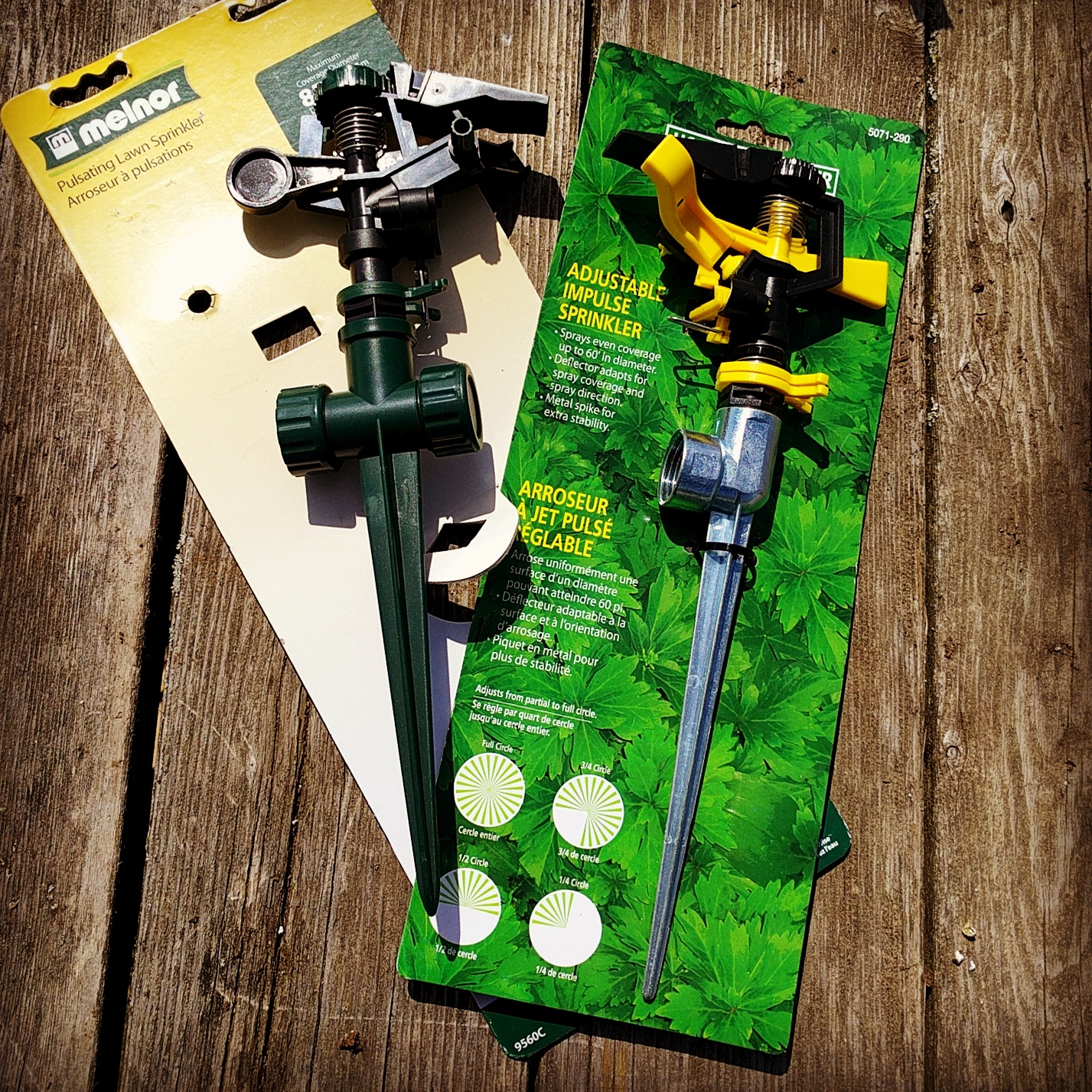
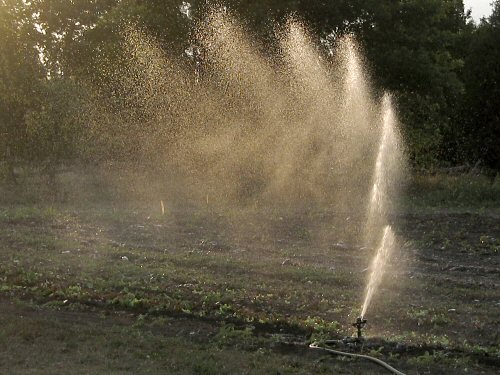
It’s like we’ve gone directly from winter to summer. Less than a WEEK since the ground dried out enough to walk on it and till it, I’m actually out there WATERING… This is really odd. I’m sure we’ve had unseasonably hot Aprils before, where watering in newly seeded crops was necessary, still, it’s only common sense to chalk this up as another of the consistently bizarre weather events we’ve been having in the last three years or so… In other words: global warming, I guess. “Normally,” April is a good month once it warms up, because our rather heavy clay-loam soil holds moisture well, and just post-snow, it’s wet enough that you don’t have to water in what you’ve seeded. A spring bonus! Instead, what’s going on here is, in a handful of days, the top inch or more of the ground has dried out completely in the unusual heat. That means shallowly-sown seed, like spinach, lettuce, radish, beets, and chard, is sitting in perfectly dry soil. I put in peas at around 1.5″ (4.25cm), and they were just barely in nice, moist earth. But these other guys, what can I do? I considered setting the seeder deeper, but that could just bury them too far for good, quick germination (I’ve messed around with too deep before…). Or, out with the sprinkler. I don’t like using sprinklers, I don’t have water to waste, but here, it’s much the more reasonable alternative to hand-watering a 50′x100′ area, when there’s so much else to do. The pond irrigation isn’t yet set up, so the water’s coming from the barn well, where there’s such low pressure that only the cheapest, most lightweight garden sprinkler will oscillate, where better quality, heavier duty ones shoot a stream of water straight ahead and won’t budge. Irrigation comes early, and cheap gear is every once in a while…good!
Permalink
Sun, Apr 20, 2008 · Filed under Veggies

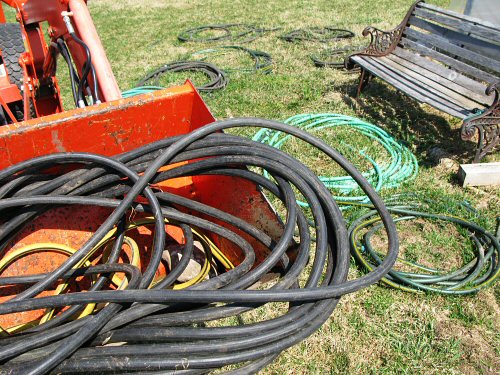
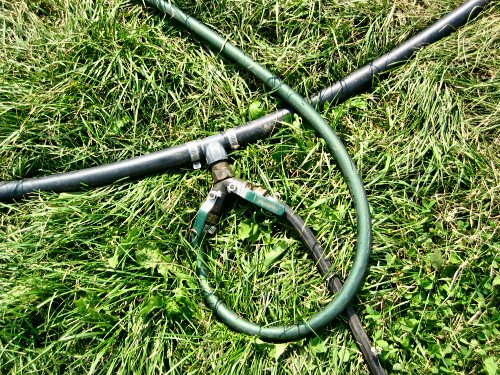
In smaller gardens (tinier farms!), hoses are generally a fact of life. On BIG veggie farms, “hoses” are usually pipes that’re 3-4″ inches (7.5-10cm) in diameter or more, and part of full-blown irrigation systems that suck up and spew MILLIONS of liters of water a season. Here on this tiny farm, I’m somewhere in the middle, but way closer to the garden hose end of the scale (in both water consumption and garden hose use!). The irrigation system itself is a work in progress, drip tape is the ultimate goal, but there are obstacles to work around, like the limited water available from the barn well, and the distance to and lack of electricity at the spring-fed pond. Right now, watering is about regular 5/8″ hoses, which are fed by a 1″ plastic pipe that runs from the barn well to the pond located WAY at the other end of the field, with taps at 100′ intervals. So, every spring, it’s time to check the fittings, uncoil the hoses, and get set to deliver water largely by hand. Actual watering is done with a combination of soaker hoses, sprinklers when there’s no wind, and various hand nozzles for watering in newly seeded beds. Quick connectors are a major convenience when hooking up the various combos of multiple hoses and other attachments. I try to find a balance between not too many hoses, because you can’t leave them lying around, and not too few that you’re moving around the same rig all over the plot. Accidentally tilling hoses that were left instead of being promptly put away has turned into a not rare occurrence, and a time-waster (untangling and splicing takes more than a minute). Just put away that 300′ of hose plus 500′ of soaker hose when you’re done! ;) It’s a bit tedious, but like everything else, you do get used to it, it’s part of the routine, and it gets the job done, which is satisfying in the end… That’s the state of the watering art around here as we head into a new season, and I’m promising myself advances on the drip side of things. Of course, it could happen to rain all the time, about an inch (2.5cm) once a week would be fine, and then hoses would largely vanish from the garden landscape. That’s not at all even remotely likely, but…YOU NEVER KNOW!
Permalink
Wed, Sep 19, 2007 · Filed under Fieldwork, Gear, Summer, Veggies

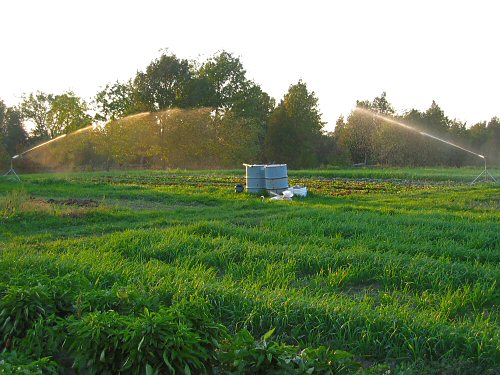
Although there’s still plenty of moisture in the ground from recent rains, there’s no harm in supplying a little more to take advantage of the relative abundance of heat and sunshine that we’re getting, even as the days get shorter. After a couple of near-zero nights last weekend, it’s all spring and summer conditions now, and forecast for the next week at least: warm, sunny days and oddly warm nights. More freak weather: it’s conceivable that the first killing frost, averagely due tomorrow, doesn’t show up for…another month! Weird…
Permalink
Tue, Aug 14, 2007 · Filed under Fieldwork, Gear, Summer

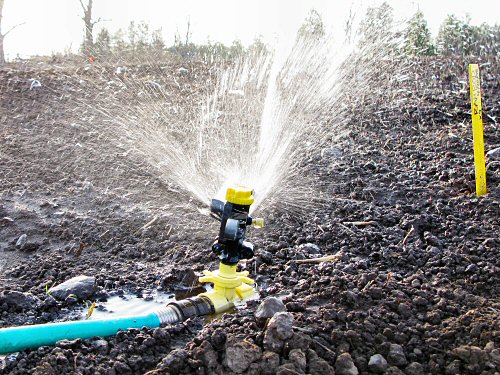
It’s supposed to rain tomorrow… I’m as skeptical as ever, still, as illogical as it is, you figure it’s gotta rain EVENTUALLY, so the longer it’s been, the more accurate the latest “60% chance of showers” forecast must be. Until then, we continue the piecemeal irrigation effort, with a combination of sprinklers and soaker hoses. The pond level is noticeably down, but bottom still isn’t in sight…and it’s gotta rain soon, right!?! :) Here, the latest beds of mesclun and spinach get their daily sprinkle. You can see by the fine mist in the air how easily much of the water can be lost to even a slight breeze, and to evaporation under a hot sun. Still, soaker hoses are only practical for larger standing crops, and pretty near useless for keeping newly seeded beds moist. From the pond pump, we get enough pressure to run four or five sprinklers and have 500′ of soaker hose set up, which means two or three of 40 sections can be covered at once. It takes a couple of hours to put down maybe 3/4-1″ of water. And the majority of days, we have to do early morning and evening sprinklers only, because of wind in the day. So, lots of moving hoses around… Next year, I’ve gotta figure out a drip irrigation solution…
Permalink
Sun, Jul 08, 2007 · Filed under Fieldwork, Gear, Summer, Weather

We’ve been watering heavily (well, as heavily as our gear allows) for what seems like weeks. Rain has been teasing us, 5mm a few days ago after an impressive, all-day cloud build-up; last night, 2mm following a brilliant extended lightning show and promising bit of a shower that soon faded away. It’s terrible. Conall has been honing his newly acquired hose rigging and sprinkler positioning skills. For heavier watering, the set-up begins at the pond and continues along a 1″ pipe (a little small, but it’s what I have from Year 1, intended for the much lower capacity barn well) that runs the length of the field. Water arrives through a series of shutoff Y-valves and from the valve of the moment snakes through up to 500′ of 5/8″ garden hose. (Fluid dynamics is something I should apparently be studying, to get a grip on the water-reducing effects of our often convoluted hose, valve and quick coupler combinations.) The hose leads to sprinklers (never too efficient, and quite a waste with anything above a hint of a breeze) and soaker hoses (MUCH better, but a pain to run up and down beds and then move again). The pump can deliver only so much, so it’s a multi-day rotation of gear to get around the entire field. The golden upside: WATER to the crops!! It’s amazing how much energy half an hour of heavy rain can save…!
Permalink
Mon, Jul 02, 2007 · Filed under Fieldwork, Gear, Summer

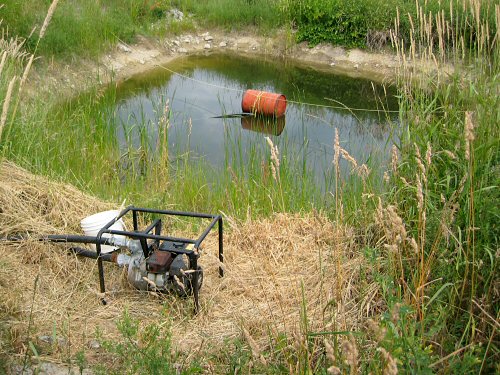
With only a little over an inch (25mm) of rain for most of June, and a near constant breeze on top of sun and heat to help dry things out quicker, we’ve had to hit the pond. Full irrigation here is a time-consuming process, involving dragging around and repositioning a network of hoses, soaker hoses, and sprinklers, and making trips every couple of hours to refill the pump set-up by the pond (see also “Pond and barrel”). The pond was dug out a couple of years ago, is ground-fed, drops level at an alarming rate (it starts the season full to the top of the photo), and replenishes slowly. If you look closely at the perimeter, the darker strip just above the water shows the level drop just for today. Still, it was used quite heavily last year and I’ve yet to see bottom! Meanwhile, I’m visualizing RAIN!
Permalink
Mon, Jun 18, 2007 · Filed under Fieldwork, Spring, Veggies

On the left, watering in the latest of six succession plantings of mesclun with a basic lawn sprinkler that’s quite efficient for shallow irrigation of newly seeded beds, when there’s no wind. Here you see the last three generations. I started planting four beds at a time, a week apart, and stretched that to nearly two weeks as the sun, heat and regular rain we’ve had so far made the growing fast. With the great weather, they’re catching up to each other—you can see the beds on the bottom right are moving up on the previous planting up top—and I’ll be tilling under a lot. This is absolutely strange for me, in past years, cutting every last bit of available salad greens every week was normal. But the people and planting expansion this year makes this sort of abundance the new normal, production levels that assure harvests for all the CSA members, market and stand, even if conditions get tough. It’s not WASTED, I tell myself, it’s organic matter and even nutrients, back to the soil… I’m getting used to it!
Permalink
Fri, Jun 08, 2007 · Filed under Spring, Weather

These days, great weather is as unusual and unexpected as anything else that comes along. The last month or so, we’ve been getting rain around weekly, with sun in between. Ignoring the two days of overnight cold snaps, it’s been excellent. Today, after a half day of sun and heat, clouds rolled in on a cool breeze, a good inch (25mm) of rain came down in half an hour…and it was back to clear skies! We haven’t touched the sprinklers in ages. Bonus!
Permalink
Wed, May 16, 2007 · Filed under Spring, Weather

Finally, not a moment too soon, 40mm (1.6″) of gentle rain over the last day and a half, with likely a little more to come. Slow and intermittent is best for soaking in. This is great. Things were starting to get really dry: over the last week, I had to fire up the pond pump and (inefficient!) sprinklers to help along the just emerging and newly seeded beds. Now, we’re good for better than a week, for some of the crops at this stage, even two (the clay-loam is great at holding moisture). Some days, gloomy is good!
Permalink