Pigweed rehabilitated?

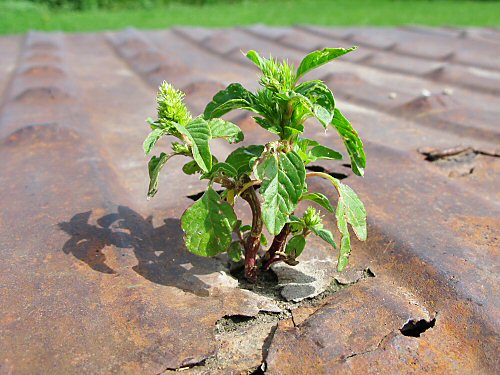
You’ve gotta respect pigweed. It’s resourceful, extremely flexible and adaptable, prolific…it just keeps on coming! It’s managed to grow in tiny dirt deposits, through rust holes in the trailer we use to get things around the field. It’s also run wild in one of the potato sections, where we’ve taken to hand-pulling it in one-hour concentrated weeding missions—it comes out by the trailerload…

The strangest development is that, this season, pigweed seems to be turning into a FOOD, a gourmet crop, even. Going down the lambs’ quarters urban trendiness path, I suppose. I started to hear about it from a couple of people, that it was being sold in Toronto (big city) farmers’ markets. There was even a comment here on the blog… Finally, browsing the web site of a farm not so far from here a couple of days ago, I read how they harvest PIGWEED at 12″ (30cm) and sell it as a tasty and nutritious cooking green…and they named it: Amaranthus retroflexus. Wow. Pigweed is the common name for a couple of varieties of amaranth, retroflexus being one of ’em. I’ve learned a fair bit about amaranth over the last few seasons, and there’s lots to like. There are many varieties and four general classes: vegetable (eat the leaves), decorative (the seed heads make colorful filler for cut flower arrangements), grain (more protein than wheat!), and…the WEED. Yes, I know a weed is only what you make of it, and it’s great to discover that we can EAT a plant rather than destroy it…but after all our hard-fought pigweed battles, this is hard to swallow. I CAN’T IMAGINE harvesting pigweed (that is, the weed varieties of amaranth) as a market crop. I mean, it would take some getting used to. And could I find a wholesale buyer, because I have a lot…? This year, I’m growing a couple of varieties of decorative amaranth in the cut flowers beds, last year, I grew one type of vegetable amaranth as a trial salad green, and a while back, I grew a couple of beds of grain amaranth, all from purchased seed, and all the while, weeding tons of pigweed… Weeding amaranth from amaranth. OK, I’m ranting a little… Maybe I’ll stroll out and gaze upon the mountain of pigweed for a while (that’s last year’s pic, it’s bigger now)—eventually, perhaps, I’ll get to a place where I’m simply wondering about all that wasted harvest… (Guest photo of trailerload of pigweed by Maria)
Beans and big weeds

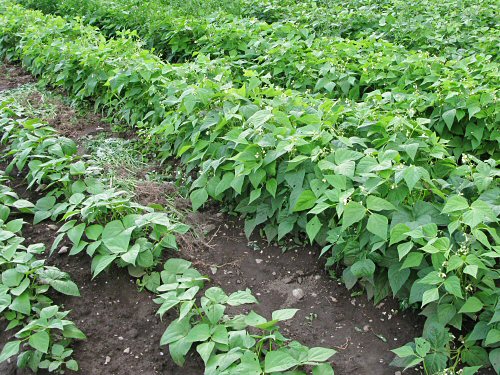
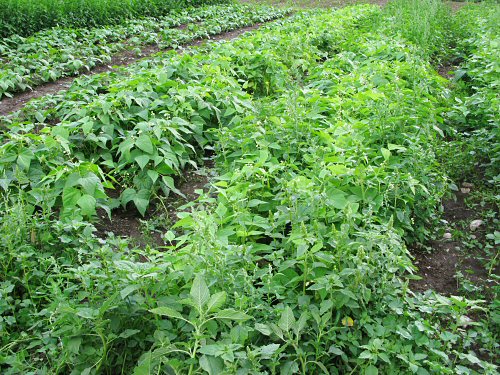
Hand pulling big weeds is a regular garden feature this summer of rainy, weed-favoring weather. In the before and after, the second and third plantings of snap beans (Jade and Indy Gold) are disappearing under soaring lamb’s quarters and pigweed: a couple of hours and a couple of pairs of hands later and they’re looking good.

View from the stand

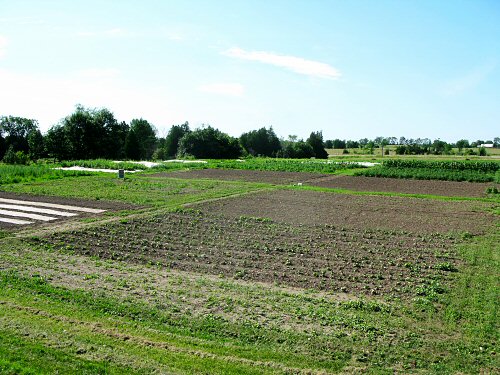
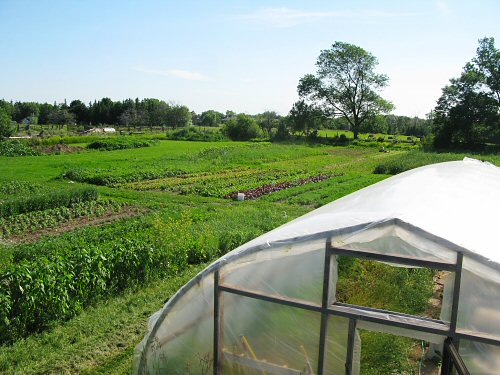
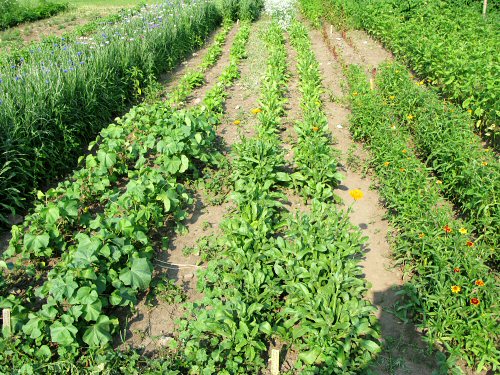
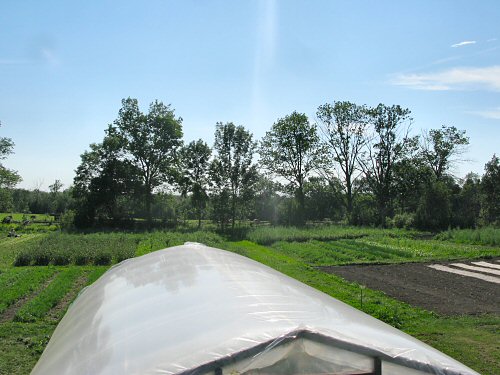
It’s mid-July, and on a (recently rare) sunshiney afternoon, things are looking OK. Better from a distance than up close, because a few sections, like the summer and winter squash, are quite severely in the weeds and in need of intensive hand pulling. And the ground remains almost constantly wet. Our moisture-retaining clay-loam soil, such an advantage in the usual near drought conditions we’ve had over the last three years, is now a bit of a hindrance. Sprawled tomatoes are particularly at risk if they don’t dry out against damp ground, and instead contract early blight (more about that another time!). Still, carpe diem, huh—seize the day! From atop the farm stand, the view is fine! We have the north end (above), with carrots under burlap (third planting), brassicas (newer transplants still under row cover), the cover in the far middle over squash, in front and more to the right, tomatoes, with a windbreak of giant sunflowers at the very right, and sweet potato bottom center. Open sections will include brassica transplants in a couple of weeks, and a fall cover crop. Out of sight to the north are onions…

In the middle, clockwise from the left, there’s a second planting of carrots, fifth mesclun right in the corner (with Maria weeding on the Greens Machine), garlic and parsnips, and potatoes in the distance (with more big WEEDS), the first planting of beets, carrots and green onions, and the edge of the third carrots under burlap from the first photo.

And then, the south end of the field, going left from the peak of the greenhouse, the garlic and Maia in the mesclun, the second planting of carrots and beets (that slash of of red is Bull’s Blood beets), the fourth mesclun , a weedy area with nasturtiums and tomatillos, and to the bottom left, herbs and flowers (fairly towering Jerusalem artichoke at the bottom left). (Guest photos by Lynn)

Cut flowers arrive

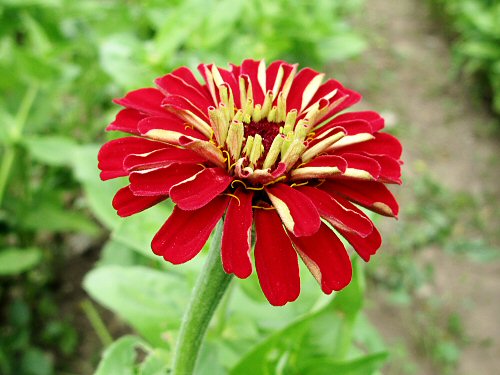
Zinnias bloom! At least, a few varieties are starting, along with many of the other cut flowers in this year’s trial bed. Much of last year’s first trial bed wound up worse for the wear after drought and infrequent weeding. This year, I tripled the amount of the same flower selection, about a dozen direct-seeded annuals, divided into two sections.

With all of the rain and and more attention, they’re doing a lot better…

Maria from Barcelona…

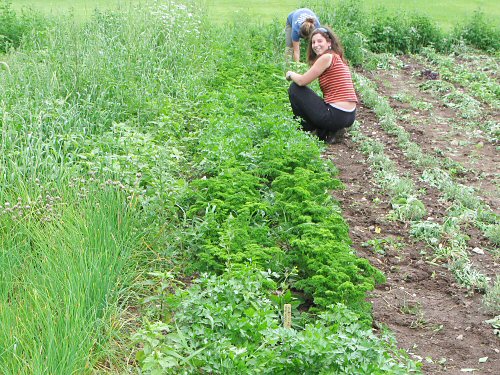
Less than 24 hours after arriving from Barcelona, Spain, WWOOFer Maria is in the weeds! Here, she hand weeds parsley with Lynn. Maria is our first longer-term WWOOFer, staying for about six weeks. I found it a bit tricky, committing to an extended stay without meeting first, but it all seemed good after an exchange of emails, and here she is! She just finished her second year of university in…food engineering. This is her first farm experience, and from what I can gather so far, it’s really at the other end of the scale from the scope of her studies. Her English is quite good, and her vibe seems right. And there’s never been this much steady help in the field. Overall, it should be an interesting exchange!

“I love intense!”

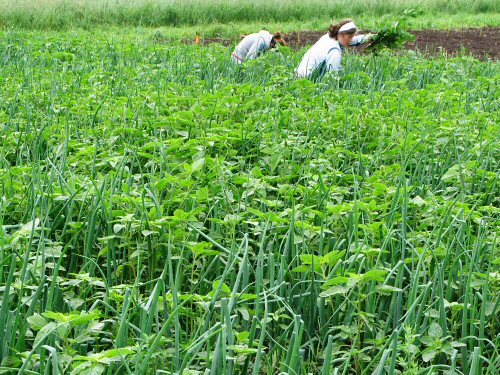
If you’re not on top of weeds by mid-June, things are gonna get ugly. Here, I’ve yet to come close to not having…problem spots, like this year’s onion section, where a perfect combination of heat and rain made relatively tiny pigweed JUMP in just a couple of days. At this size, and with the weeds growing right close to the onions, careful hand-weeding is the only option, other than tilling under the crop. Today. Lynn, Libby and I tackled the job…

Hours of weeding and a complete weather change later, the deed was done. As much as you think about the intense amount of labor, what that adds to the true cost of one of these onions, how things could’ve been done more efficiently, and so forth, you can’t help but be satisfied by such a complete…makeover. I asked Libby, after her very first crazy weeding spree, how she felt. With a big grin, she said: “I love intense!” You can’t help but love that attitude! :)

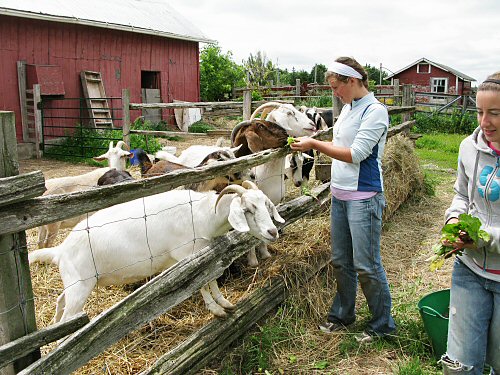
And there was still time for other fieldwork, an unhurried lunch break, and time out to play with the goats… Is this an economically viable way to farm? Well, it’s kinda working out so far, things are slowly, steadily improving, and we seem to be having ever more fun as it goes along!

Maintaining mesclun

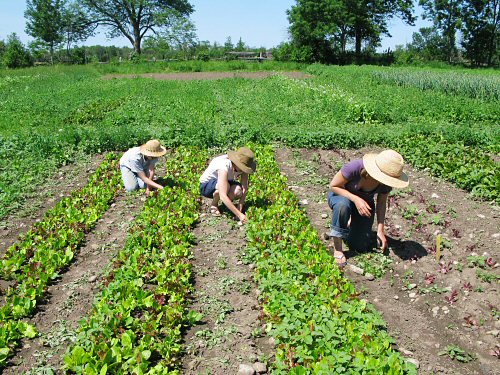
This pic reminds me of those “classic” Big Agriculture photos where a row of combine harvesters rolls up a field in impressive staggered formation, except, here it’s Mel (first day!), Lynn and Raechelle, not machines! Hand-weeding mainly pigweed from between tightly spaced rows of greens is unfortunately still in fashion this season, as it was last year, and the year before, and… The more hands the QUICKER, though, and this round went by in no time, under a gorgeous blue sky…