

In the foreground, a pigweeding throwdown with the crew of the day: Eoghan and Alison (trying out a little tiny farming for the first time), Jo, Mami (our second WWOOFer, also from Japan), Conall. Everyone pull! (The most alarming giant pigweed specimens had already been ERADICATED by the time this photo was taken!) In the background, a house on the subdivision to the east of the garden field (it was severed from the farm years ago), home of our nearest CSA member. Their veggie farm for the season is literally a stone’s throw away—local food doesn’t get closer than that!
weeding
More bean harvesting action
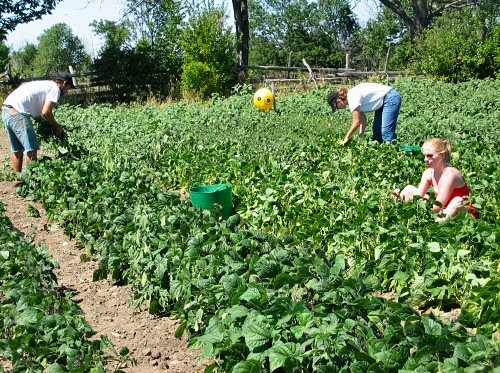
The First Shift—today, it’s Sherry and Andrea—picks Indy Gold beans in the early afternoon (Conall’s pulling weeds). On Fridays, everyone comes at different overlapping times, usually from the mid-morning on. Most Fridays so far have been sunny and hot, so I try to fit in greens in the later afternoon, anything but cutting them in high noon heat. So, it’s beans on a hot summer’s day. The Fridays have been getting smoother and more efficient every week, and so far, we haven’t been nearly shorthanded. Still, the lessons of the year of People in the Field are becoming plain, nothing startling, but made unavoidably obvious when seen first hand. The main one is, you have to maintain an equal balance of people doing general fieldwork or the weekly crop availability won’t keep up with the…harvest capacity! More on all of that later in the Fall… Today, only a bushel or so of first pick beans as we get caught been plantings, plus mesclun, carrots, beets, arugula, potatoes, chives, beet greens, a bit of kale, squash and cucumbers, and the first bushels of mixed tomatoes, along with onions and garlic from storage.
Pigweed: going in!
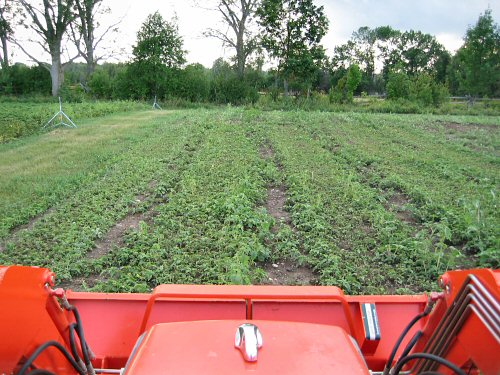
There’s no exaggerating the amount of pigweed in some sections of the field. Here, where the last seedings of spinach and peas failed—really poor germination in the heat—pigweed happily took over in no time. I mowed it down, and now I’m going in with the 48″ rototiller, prepping for fall spinach. Ideally, I’d keep the rototilling and any heavy gear off the garden beds, but this is practically an emergency. I apply the in-moderation rule here… It’s growing on me that round about next year, much of the pigweed seed, deposited three years ago in two-year-old manure, is due to expire… Right now, though, the seed seems pretty healthy to me.
Extreme makeover
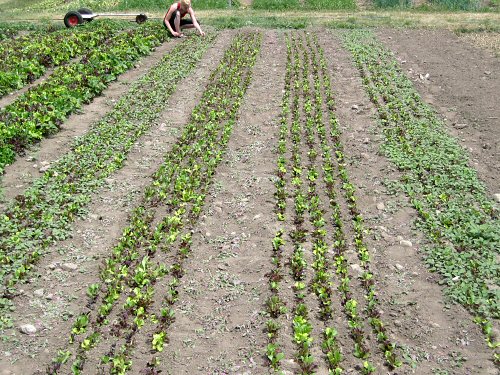
The one dark secret of this organic field, something you couldn’t really tell from selected photos, is the prevalence of pigweed (amaranth, mostly or all Amaranthus retroflexus if I’m ID-ing correctly). About two-thirds of the garden seems to be completely saturated with pigweed seed. Weeding two or three times for all-new outbreaks is common. In some spots, it’s literally as if some phantom planter is broadcasting new seed, thickly, every couple of weeks. And when it’s a closely space crop like the all-lettuce salad mix in the pic, this means painstaking fingertip weeding.
Here, Andrea and I spent about two and half hours clearing 200′ of 5-row beds, the entire latest succession planting. Luckily, conversation made the time transparent (thinking about all of the extra labor devoted just to de-pigweeding is a little painful). As best as I can figure, the pigweed came along with the two-year-old, not-fully-composted cow manure that we spread in the fall of Year 2 (three years ago). We put down I’m not sure how many, but many, tons on just over an acre—the ground was positively springy!—which was great. Except for the pigweed seed. Eventually, the vast store will be depleted (the seed is apparently viable for five years). Until then, it’s a lot of extra work… The pop quiz question: “What have those cows been eating?!”
Beet greens harvest
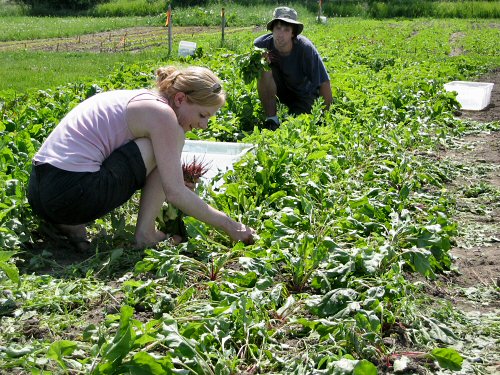
Andrea and Conall harvest Cioggia beet greens in the hot mid-afternoon sun. In tiny farming, it seems that every action has several different effects and offsets, some good, some not so, and a balance, hopefully leaning to the positive side, is struck each time. Here, harvesting greens in the heat is not the greatest for the freshly pulled leaves or the plants that remain, but this is the time we had (a cloudy afternoon with a mild, refreshing breeze every harvest day would be nice!). A quick bath in cold well water instantly refreshes the harvest, and the plants will recover overnight. This particular bed of beets had gotten quite weedy, so weeding while harvesting slowed things down. But, the fairly dense piles of pulled weeds, spread between rows, dries into a decent mulch that’ll help retain moisture and prevent more weeds from germinating. And, the harvest is also a thinning session, giving the remaining plants the space to fill out into proper beets. It all works out…!!
Wheel Hoe Day
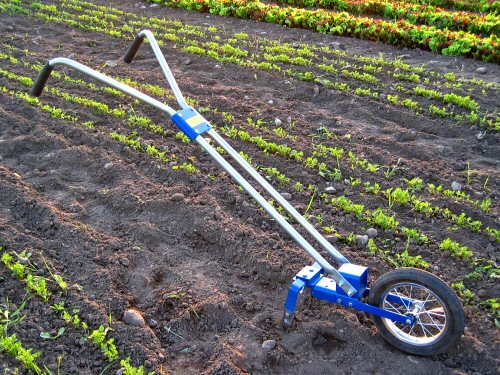
Finally, the new wheel hoe arrived today from the Valley Oak Tool Company in California! This simple and amazing garden tool is so little known in these parts, I had to order it from another country… I hadn’t used one before, but I had a very clear idea of how it should work, and it didn’t disappoint. You walk it along, pushing with minimal force, and the blade slices through the soil, beheading all weeds in its path. With ease. A slight arm adjustment translates into precise depth control, and the double-edged 8″ blade works on a back-pull as well. Even fist-sized rocks (a constant feature in this field) don’t phase it, they simply slip through the hoop. It’s at least 3-4 times faster than hand hoeing, and it matches the Horse walking rototiller for path clearing, minus the noise and gas. Amazing! (In the numerous shipping documents, I liked the note to Customs from the toolmaker, an organic veggie farmer himself: “Please let this package be delivered ASAP. There is a farmer awaiting his new tool.”)
After the rain…
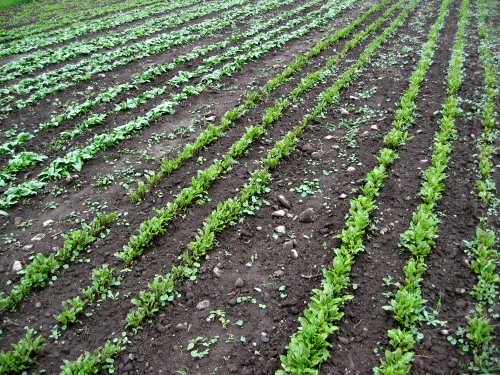
After a rain, it’s easy to see exactly how much work is ahead in the organic field! The dark wet soil and the flat light of a cloudy day make every detail stand out: weeds exploding, dense rows that’ll need thinning (thanks to the generous Earthway seeder), rocks to get in the way of hoes and tiller both. But it’s usually better than it looks. Here, the Horse tiller can be walked up each path in about a minute. Thinning the beets (first two beds on the right) is actually a harvest of excellent beet greens. The rocks, well, the bigger ones just have to be picked. The worst is in-row weeding, for stuff right in with the crops. This has to be done mostly by hand, but if you get the worst spots, the veggies soon grow to where they can more or less fend for themselves, shading out new weed growth. Or the crop is soon finished (like spinach, on the left) and the whole bed can be tilled up. With a little thoughtfully directed labor, it all works out! (We got 15mm (3/5″) of rain… Not bad.)