
Liming the Chickenhouse

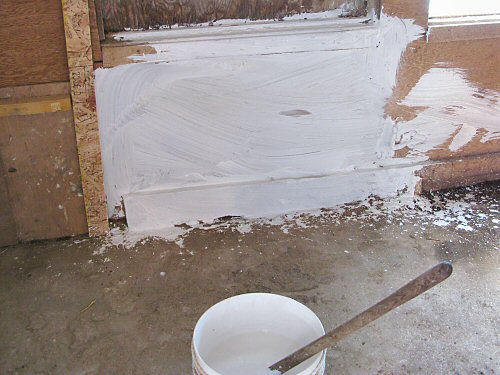
Whitewashed the meat bird half of the Chickenhouse today, using the traditional purist blend of nothing but hydrated lime and water. This is an old school farming standard from Bob, completely new to me.
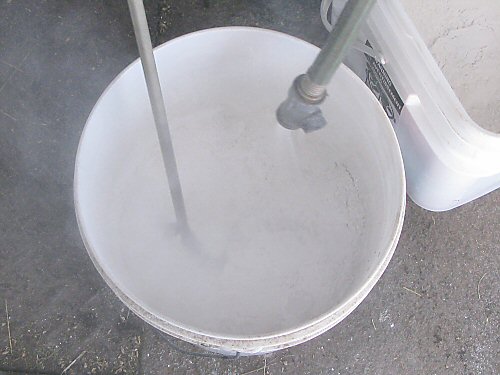
The lime is a very fine powder that comes in bags. Mixing was easy. A power drill mixing attachment churned it to a thickness a bit lighter than regular paint, and then on it went with big brushes.
The lime is a bit caustic, so wearing a mask when mixing, and gloves and goggles to avoid splatter, is a good idea, although I didn’t this time around (and I did take care not to inhale clouds of lime dust!).
Afterwards (it’s follow Bob’s lead), I did some reading and, not surprisingly, was quite amazed: yet another simple, inexpensive, effective approach that’s been complicated (in this case, into the costly world of high tech paints and sealants)…
Classic lime whitewash disinfects, repels insects, and preserves by sealing surfaces and wicking up water. It dries to an opaque white that beautifully reflects light to brighten up dim spaces.
It’s also safe for animals (which, yes, includes us humans, lime can even be used in chicken litter to keep it dry).
There are lots of applications, interior and exterior, for wood and masonry. It’s not as permanent as oil or latex paint, will rub off a bit, and needs to be refreshed every year to keep it in top shape.
It’s also INEXPENSIVE: a 50lb (22.5kg) bag was about $7, and you can mix up at least 15-20 gallons from that, the way we used it. That means you could whitewash an entire small building, inside and out, for maybe $20! For big jobs, a sprayer would make it real easy.
You can tint it, and there are also various recipes that include alum, salt and other additives that may improve adhesion, but the tried-and-true basic is just lime and water.
And you need hydrated lime, NOT dolomitic lime nor calcium carbonate, aka garden lime (both are recommended for raising pH in garden soil). We got ours from the feed store.
I’m not sure how popular this sort of whitewashing is these days, but it’s certainly still used, and a few decades ago, this was a standard type of paint. Anyhow, it looks and sounds great, and we’ll see how the chickens like it!


I’m with you all the way on this. I love whitewash, or badgeon as it’s called in France. I’m using it inside on my old walls, the ones made of sandstone and rubble. Since this house doesn’t have a damp proof course, moisture needs to be wicked up and out of the walls, and no it doesn’t mean I have wet walls as it seems to balance out.
I’ve also started on it in the chicken house and will give it another going over this summer when I refurbish that. I’m hoping that apart from the antiseptic properties the brightness will also help deter red spider mite.
I’ve also used it on the walls and concrete slab around and under my freezer to keep that area white and clean as it’s in an old lean-to. And finally I’ve used it to paint the steps into that storage area. With the difference from bright light outside to the dark interiors of the houses here it was very easy to ‘miss’ the step and tumble the foot or so down into the store area. To my surprise it doesn’t wear off very quickly and withstands brushing. I’ve not tried washing it but since the chemical composition changes on it’s reaction with air after you’ve painted it on, I think it would withstand a bit of washing too.
On the subject of tinting it, someone in France recommended a teabag or two in the mix. Apparently it gives it that antique look. Not tried that myself as I’m after the bright white to lighten up everything.
Here in Portugal it’s still widely used as paint, especially in the South, where the weather is dryer and hotter.
I’ve a mini tiny farm myself, with one and a half acres, altough for self consumption only, and I’m really enjoying reading your blog!
Neat to learn something new–thanks!
Been rereading the Little House books again, and Farmer Boy offers the standard whitewash option, when the boys are prepping the cellar for the year’s harvest…very neat to see that it is a “tried and true” method for safely covering walls.
I just love learning something new! I had heard the term “whitewash” but had no idea what its original purpose was. I am very excited to read about this and will definitely put the knowledge into use when our time comes! Thank you.
Here in the south of Portugal white wash was the traditional way to paint the houses. Using it in the chicken house sound a good idea. Do you use it in the inside and outside?
I’ve been reading your blog for quite some time now, I really enjoy it. Keep on the good work!
You have taught me something new and I will definitely share with my readers also. As other of your readers have commented, I had heard of whitewash but had no idea what it was made from or that it could be beneficial to my chickens. I will give it a try in the future. Thanks for sharing!
Came here looking for the recipe. I’m planning on white washing an old shed I’m turning into a rabbitry and my chicken coup as well. Funny thing is, I’m trying to become more self sufficient on…yep you guessed it, two acres. After seeing this site and a couple of others I think I’m going to white wash my goat barns as well.
Thanks,
Mike
Hi, I live in Toronto and I have bought a chicken. I have a yard facing SE some W sun. I have a problem. I can’t figure where to put the chicken coop or how to build it. I have a shed at the back but it is dark and no electricity and I think the chicken needs light. Could I keep the chicken in the shed? If I kept it outside in a tracter I am afraid it will die in the two foot snow drifts in Winter. I really need someone in the Toronto area who can build a coop for me who knows what they are doing. Do you know anyone and their number , please? Thanks. N.
I was pleasantly surprised to see this site. I am interested in white washing my coop and I have a couple of bags of Type S Lime that my neighbor gave me. He heard that there are many uses and one was for painting chicken coops but he didn’t have the details on how to prepair the mixture or if Type S Lime was ok to use. Any one have an answer?
Thanks
Yes to Type S. It is ideal, what you want to get. For a more technical view, try this lime factsheet. Or just use your Type S!
Nicole: I don’t know of anyone in Toronto who builds chicken coops. You should try searching the web. Maybe start with something like “chicken coop Ontario” or “building a chicken coop.” There are lots of plans available online and in books, and you could get a carpenter or handy person you know to build one, it wouldn’t be difficult.
Martin Perez: As I described in the post, we used water and hydrated lime, mixed by eye to a consistency a little thinner than paint, kinda like a bit watery pancake batter. If you experiment with a little bit in a small bucket and try painting a small area, it’s pretty easy to figure out. But there are LOTS of recipes online, some including salt and other ingredients. Search for “lime whitewash” and you’ll fine tons of info…!
I was looking for whitewash information and found this great site. We have a quite a bit more than 2 acres, but most of it is wooded. We are working on bee hives for this year, just finished maple syrup and are planning to whitewash and fill up our chicken coop this week. Thanks for the great information. We have raised chickens before, but have never used whitewash. My grandmother always mentioned using it on the family farm.
We had lots of advice on our maple syrup adventure, but did not come up with an ideal plan. The syrup we produced is very good, but much more time consuming than we were told. We used a propane outdoor cooker for this. We tried some equipment from a local guy using a large pan out doors over a wood fire. That was the fastest process, but that batch of syrup had a “smokey taste and smell”. I think I will save it for hams.
Without spending a ton of money we would like to come up with a better and faster process for cooking down the sap. Brenda
I’m brand new at keeping chickens – I have started out with 6 of them – 3 light Brahmas, 2 Ameracaunas, and 1 Buff Orpington. I think I have 2 roosters among them, but do not know enough to figure it out yet. They are a little over 4 weeks old, sassy, tame for the most part, and absolutely beautiful. I can’t believe I love these chickens like I do.
I just wanted to say that this is a fabulous site to learn new things and the photos are priceless. I have laughed and laughed at some of the stories and photos, and then I cried about the ‘battery’ hens. Now I’m on my way to the feed store to get some hydrated lime to whitewash the new 4′x8′ hen house my son helped me build. I hope to send some photos soon, but meanwhile – so many of you have helped me in my endeavours, I just don’t think I would have done nearly as well if I had not discovered this site. Thanks to all for the helping hints and photos.
Hi
I just found your blog and think it is fantastic – thanks for this info about lime washing – i’m off to paint the entire chicken coop right now!!
We have a tiny farm, 5 acres, and have been bumbling along producing very erratically but you have inspired me that we can do so much more with this little parcel of land.
cheers
Michelle
Lime or other suggestions?—-We had pipe that leaked water under our (1960s pier & beam) home for several years. The stench and sludge was horrible. My husband sump-pumped enormous amounts of water before he finally found the leak. It was like a lake, and water lines could be seen on the beams. The plumber and myself could only imagine “what lies below”. Someone suggested using lime. My husband is concerned about going under the house if the lime is dangerous. Are there any suggestions, methods and safety tips for this situation?
Nice to visiting here, i am looking for chicken house for about my 10 chicken families. They should stay at indoor because when it rainy days it feel cool and i think chicken house should completed with lamp to keep it warm. I am too looking for good design for chicken house for me. And as a compare i am look at this site with nice and unique color.
Liming to wall is good idea too, i will use it for my next chicken house. thanks.
I am delighted to be reminded of the old whitewashing method of painting the shed walls. I will do that.
My main concern right now is an understanding of the types and uses of limes. I have a large flock of hens lots of rain and mud and capillaria worms which I want to eliminate. I hope you can give me some direction.
Nicole:
I’m from Toronto too! living here in the Northwest now. Your single chicken needs buds, as many as are legal. Chickens are flock animals and one lonely chicken will not survive. Get her some friends. As for the weather, if she has nice clean dry straw for bedding down she will dow fine. chickens generate an amazing amount of heat.
Enjoy life as a chicken mama!
DottieTy
I added blue acrylic paint to the wash,just half a cup and I got this beautiful sky colour.You can use other colours,Must be water based.
Hello! I really love to read your blog. I am visiting your blog whenever I have free time
Thank you !!!
I have been wanting to do this I remenber my grandma’s white washed barn when i was little she had dairy cows and chickens. thank you so much for the information. I look forward to white washing my coop soon
leslie @ the chubby chicken egg farm
USA, Michigan
thank you
I added green acrylic paint to the wash,just half a cup and I got this beautiful lawn colour.You can use other colours,Must be water based.
Hi I just found this blog – very interesting. Has anyone heard of spraying hydraded lime wash onto the chickens themselves to rid them of mites and lice?? Our local pestman just told me his Italian wife has done this for years. Thought I’d better cast about for some second opinions? the lice are a real headache and are on the chooks and the ducks.
Chickens can be an entertaining addition to the family and building your own backyard chicken coop whether it is a portable or permanent fixture can be very satisfying. Check out http://www.buildingchickencoopsnow.com to see how satisfying building a chicken coop can be.
Very useful and something I will share with my readers
I gotta thank you the hydrated lime and water white wash what a great idea .
I am going to use this myself .The best bit is it’s cheap to do .
You have a great blog with lots of information .
Many thanks
Chicken George
Excellent and informative blog. Thanks for posting this. It’s informative and enlightening. Keep up the good work.
Can you use hydrated lime on chicken house floors and if so can you use it in powder form?
Hey, thanks a lot for this blog and the valuable writing here; I really appreciate everything on your blog, this is awesomeness!
thank you again.
Love this.. I have a bag of lime in the barn and the moment it cools down I am going to paint the inside of the chook house with it.. These old buildings would just soak that up i bet. i was just cruising and found this.. what luck. good job c
Thank you for this! we just moved into a place out here in Kansas with a damp dark old cellar; wanted to turn it into a place that we could use for storage etc.
I am originally from Ireland and have seen people whitewashing sheds etc all my life, but had never actually done it myself.
We bought a 20lb bag of hydrated lime from a home supply shop, and just mixed it with water to a thick paint like consistency. Initially we used a ‘recipe’ we found online that included salt and a lot of water, but soon found we wanted a much thicker product so just went ‘by feel’ as it were. The mortar was crumbling off the wall in some spots, so we applied very thickly there; elsewhere we just applied as you would any paint.
In less than 24 hours it has dried to a hard shiny white, the smell is 100% improved and the place is tonnes brighter and just cleaner all round – all for under $6!
I am struggling to understand why whitewashing has fallen out of popularity particularly here in the US – it works as paint, primer, antiseptic and dehumidifier all in one. In these rough economic times who knows, maybe it will make a comeback!
“I am struggling to understand why whitewashing has fallen out of popularity particularly here in the US” – that’s what I wonder about so many things I’ve discovered for myself since doing the city-to-tiny-farming transition. Like, basic scratch cooking with fresh ingredients instead of eating all kinds of processed junk: cheaper, easier, as convenient as you chose to make it, TASTIER. Of course, living in cities as three-quarters or so of the world does now is a gamechanger… :)
A great, classic material for barns and basements – inexpensive, effective, and a beautiful chalky white. So much better than paint or stain. We use it in all of our barns and it makes a vast difference.
One word of caution: wear eye protection. it is a strong base and will literally melt your cornea off (yes, I learned this the hard way). Fortunately, it healed, but I never touch the stuff without goggles now.
Just outside of Toronto here. Looking for someone who still comes to spray full size barns. Or, can I rent a sprayer do you know? White is NOT the same as paint (too gritty) so I won’t be able to use paint spraying equipment.
Thanks for your help
Hi – wonder if it would help to whitewash the toe-boards of my hoophouse. they are constantly moist from condensation here in south AL.
Also, been looking at salad driers and convinced by your info that i should just go ahead and get a used washing machine since the 5 gal are so expensive anyway. Is there anything I should look for, other than the fact that it should be in working order?
Thanks for great info!
Jodie
Thank you for the great blog post! We didn’t stain or paint our chicken coop (like we should have) last year and now we really need to! This is such a great solution to our problem! THANKS!!!
A previous question about whether you should paint the inside of the coop as well as the outside was not answered. Can anyone reply on whether this is okay for the chicks or should it be left in the raw? We are going to be whitewashing very soon as our “TajmahCoop” is almost complete! And a good thing…our babies are growing out of the brooder very quickly. Thanks for any advice you can give on this question!
Yes, the lime whitewash I wrote about here is for inside. I haven’t tried it on the outside, it will be washed off to some degree by the rain, but should be fine as well, with repainting or touching up maybe every year. For the chickenhouse, though, it is on the inside where it does the real good!
And it is safe for the chicks. That’s all answered in the post, actually hahaha :)