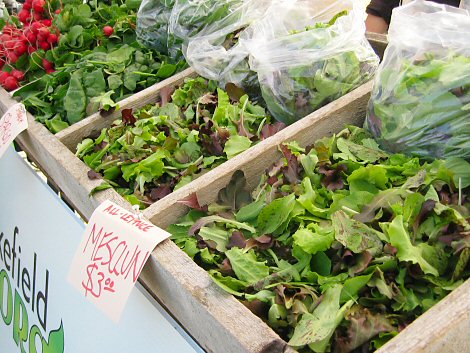
First veg at the new farmers’ market!

At last! Our first day at the new farmers’ market, with a large sign (we temporarily used our new roadside sign to make a…big entrance :), and a small but superfresh and tasty (and seasonal) selection: all-lettuce mesclun, spinach (Spargo) and radish (Rebel). Lynn was happy to be at market in her home town, and Tara made her new-tiny-farmer market debut! The flow of people was steady, and we sold out by 11 am. Pretty good!

Pricing at this market is quite a bit different from the old market: everything is more expensive! It’s not quite at urban market levels, but a lot closer in this bigger town. Basically, the same harvest as in previous seasons sells for almost twice as much.

This is for sure more realistic and fair. I think about the ridiculously low (though rapidly  rising) cheap food supermarket pricing that sets the baseline for what small growers can charge at the market. I recall that in North America and Europe, we apparently spend less than 10% of income on food, when quality produce just can’t come that cheap. And these aren’t ridiculous, high-end, boutique veggie prices, simply a more realistic price—processed foods are still sooo much more expensive, while possibly (probably) killing you at the same time…

STILL, it kinda feels weird putting less into a bag than I’ve been used to for six market seasons. Oh, well, change is always a little strange, this one is good all around, and I’ll get used to it! :)
Hand-tended

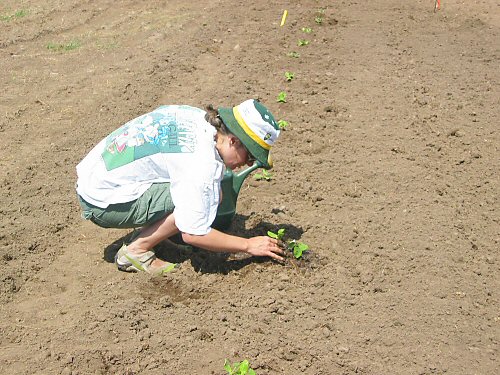
Hand-tending pumpkin transplant

“Hand-tended” is one of the phrases that usually gets popped into the occasional bit of promotional writing about this market garden. Sounds good! If asked (hasn’t happened so far), I’d explain that we don’t use many machines, most of the garden work is done with hand tools, or just hands, as in, hand-weeding, or plucking off bugs…by hand. And lots of time is spent through the season, crouching and crawling around, checking out what’s going on with particular plantings of this or that. Which all seems pretty cool. :)

Today, Tara and I hand-transplanted two beds of early-maturing Neon pumpkins (above), along with a few more Snack Jack (tiny pumpkins bred for producing lots of tasty seed). The Neons are 70-80-day hybrid, kinda freakishly quick to mature (pumpkins are mostly 100+ days).

At this point in the season here, it’s getting kinda late for winter squash and pumpkins, but there are a few beds still to fill in, so a bunch of 70-85-day varieties, coming up in pots in the greenhouse, will be heading out to the field over the next week. With anything but the worst in cold and cloudy weather over the next three months, they should size up just fine!

Behaving like chickens!

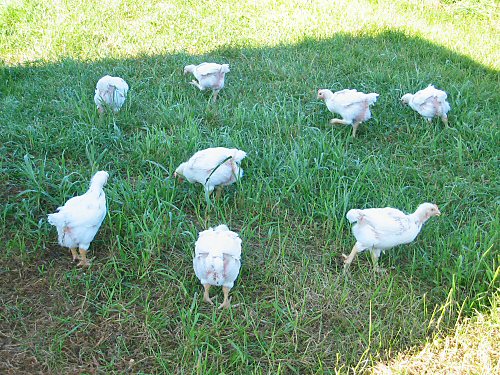
The White Rocks, bred over decades for insatiable appetites and rapid growth, and likely to just eat, drink and SIT once they get growing, are behaving like CHICKENS! Every morning the door opens, three quarters of the 40 burst out on the run, tearing around, facing off in sudden skirmishes, and eventually settling down to scratch in the grass. At five weeks, they’ve practically doubled in size from when they arrived, they eat feed like maniacs, BUT, they do get out… We’ll see if all this exercise makes a difference as they keep growing and growing at their startling rate—for now at least, they seem happy and active and knocking back the bugs!

Planet Jr. rising

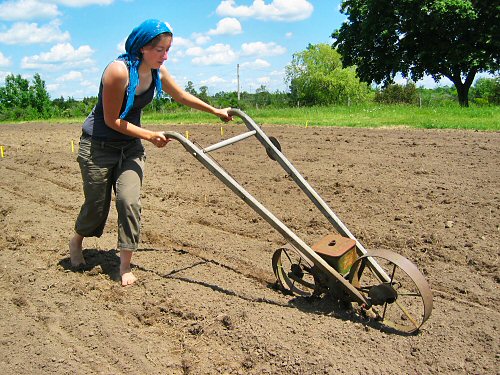
This year the antique Planet Jr. seeder finally took over from the Earthway, to handle most of the direct seeding. We’ve been using it for everything but tiny carrot and lettuce seed, where the lighter Earthway is easier to maneuver for closely spaced rows. Here, Lynn rolls out a third planting of beets, no problem. The PJ is heavy and initially hard to handle, but also more precise, uses way less seed than the Earthway, and lays down a well-packed row.  And the choice of 60 or so seed holes, at first a pain, turns out to be a great way to appreciate variations in seed between varieties and fine tune seeding rates—we used three different openings to best fit three types of beet (Golden Detroit, Chioggia, Kestrel). It’s great. With this well-aged Planet Jr, old turns out to be our new and improved!

Beet greens!

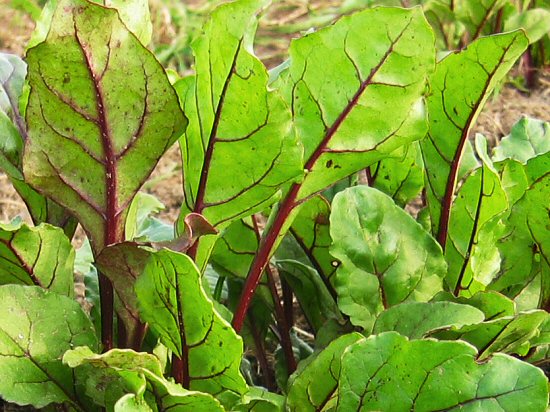
First beet greens

If you love beet greens, you can practically taste this photo! Fresh-picked, sauteed just to wilting in olive oil and butter, with a smashed and chopped clove or two of garlic, salt and freshly ground black pepper. Heaped on a plate. Topped with a couple of poached farm eggs. It’s hard to imagine anything easier to cook and more perfect to eat.

The greens from the first planting of beets—Kestrel (above) and candy-striped Chioggia—are just sizing up. They can be harvested at any size, from quite tiny for eating raw in salads, to huge, for cooking. I’ve never grown beets just for the greens, they come from thinning the plants, which usually happens when the leaves are 4-6″ (10-15cm).

On Friday, we’ll thin the beets for Saturday’s market. For the beet greens with poached egg, our new 20-week-old hens arrive on Monday, ready to lay. Life makes sense. :)

Welcome back, my friends

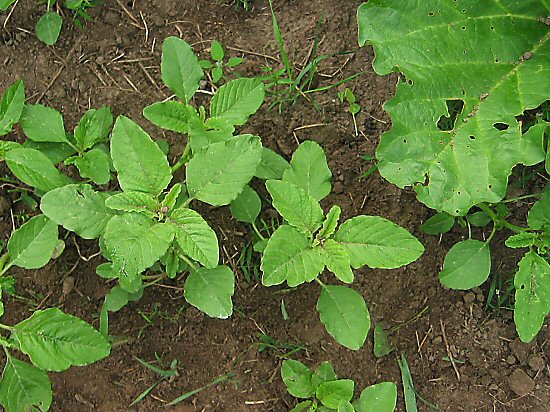
An interesting surprise discovery today, my own little transplanted patch of pigweed, accidentally imported from the old farm, growing strong in the shelter of three relocated and thriving rhubarbs (top right). I suppose some pigweed seed got shaken out of the root clumps of the transplants, and eventually made their way to germination. This is the first time I’ve seen pigweed on the new farm, and it instantly brought back a flood of memories from our multi-year…relationship at the old place. Not unpleasant memories, pigweed is forever a part of this tiny farm experience, still, it’s not missed. Nice visiting, now it’s time for a quick hand-weeding!

Last of the spring planting

It’s another week till the start of CSA shares and the first picking of peas, and at least 3 weeks until some of the heavier crops—broccoli, cauliflower, summer squash—are ready, so Friday’s are still about general fieldwork, not HARVEST. Just ahead of the end of spring, Lynn, Libby and Jordan planted out a last wave of winter squash and some fast-maturing (80-90) Neon pumpkins. That brings the spring planting to a close, a little later than usual, overall, but considering the first-year, start-up situation, really good!

We also put in one bed of melons under infrared-transmitting (IRT) plastic mulch (above).  For a couple of years, I planted 5-10 50′ beds under IRT mulch (more heat to the soil), but yield wasn’t worth the effort, including the extra watering (didn’t use drip tape under the plastic). This year, with one bed to focus on, it’s an experiment—we’ll try to give them extra special care!

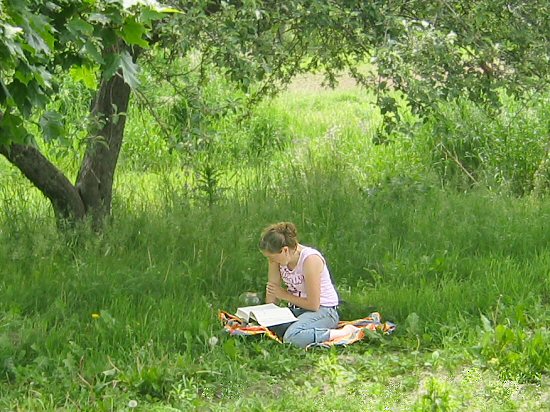
Lynn vanished early from lunch, only to be found reading her new herb book under a tree. This photo (below) doesn’t nearly capture the scene: it looked like an impossibly peaceful countryscape, from a simple, carefree world—fit for a postcard. We were laughing, and Jordan spontaneously got out his camera and took photos, too.  I asked her if she’d scouted the location for the setting (joking, but I can also be a bit of a cynic! :), she said it was just the best spot she could find for shade!