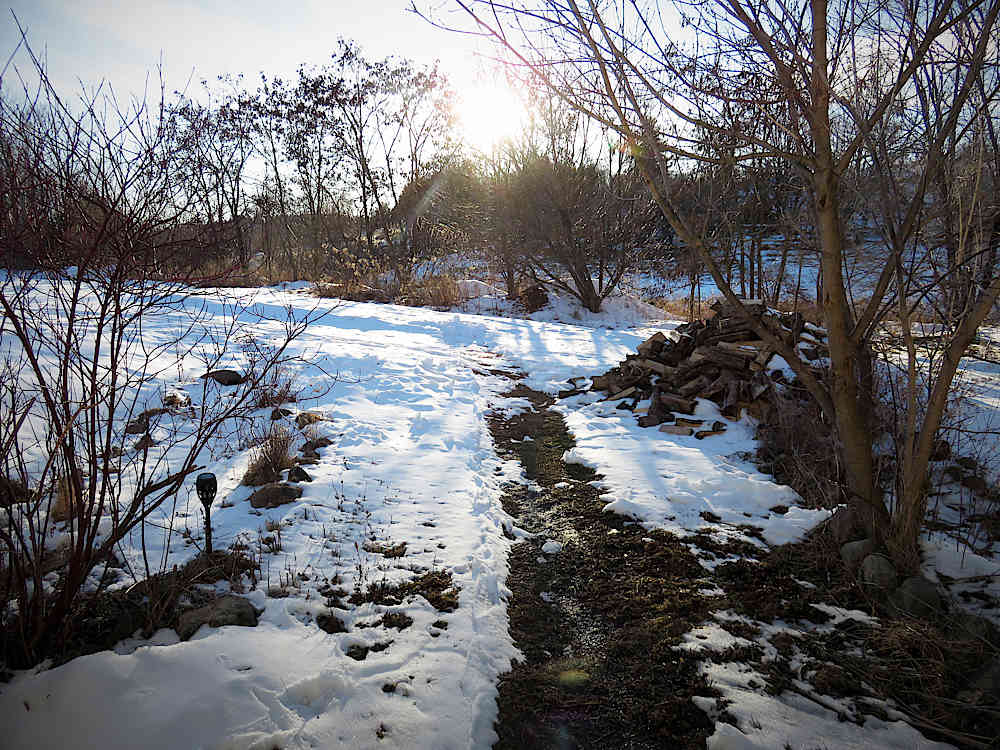
You can only come up with so many titles for the same photo, taken every few days, to show the ups and downs of the local weather. The sun is getting warmer, more head-on. That’s normal! Wondering when the fields may dry out enough to start working is still a ways off, six weeks. Before then, even if it seems like it’s gotta be summer, the risk of a cold snap, or a week or two of snow, makes it probably not worth getting such a super-early start. When will they ever get weather forecasting working like we want it to?!?
Planning
Simple system
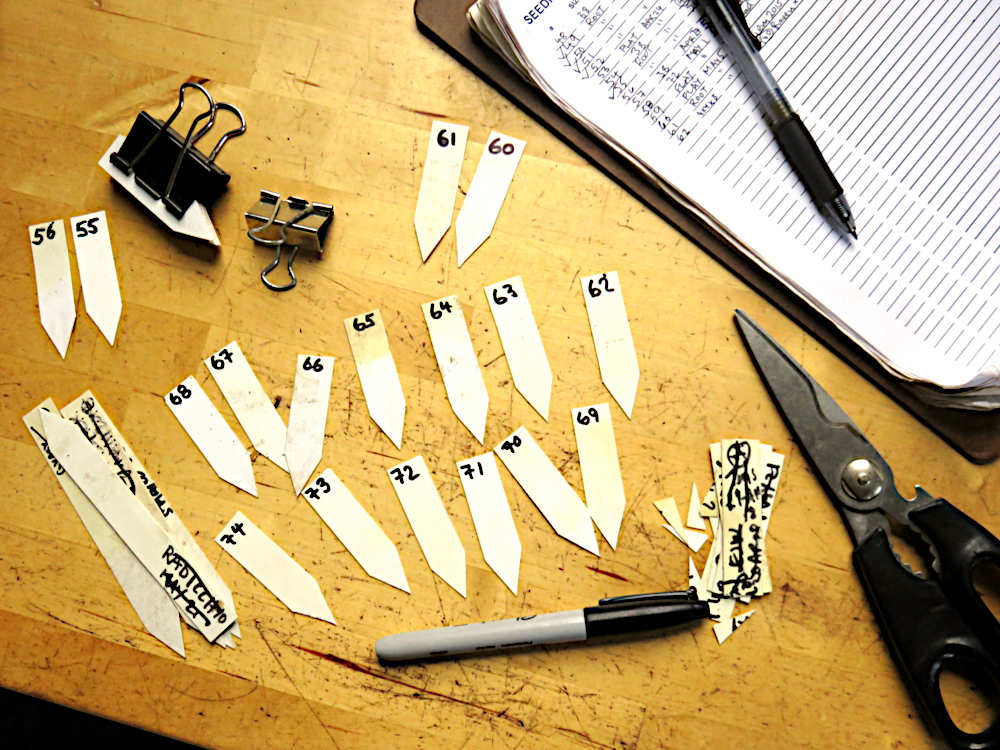
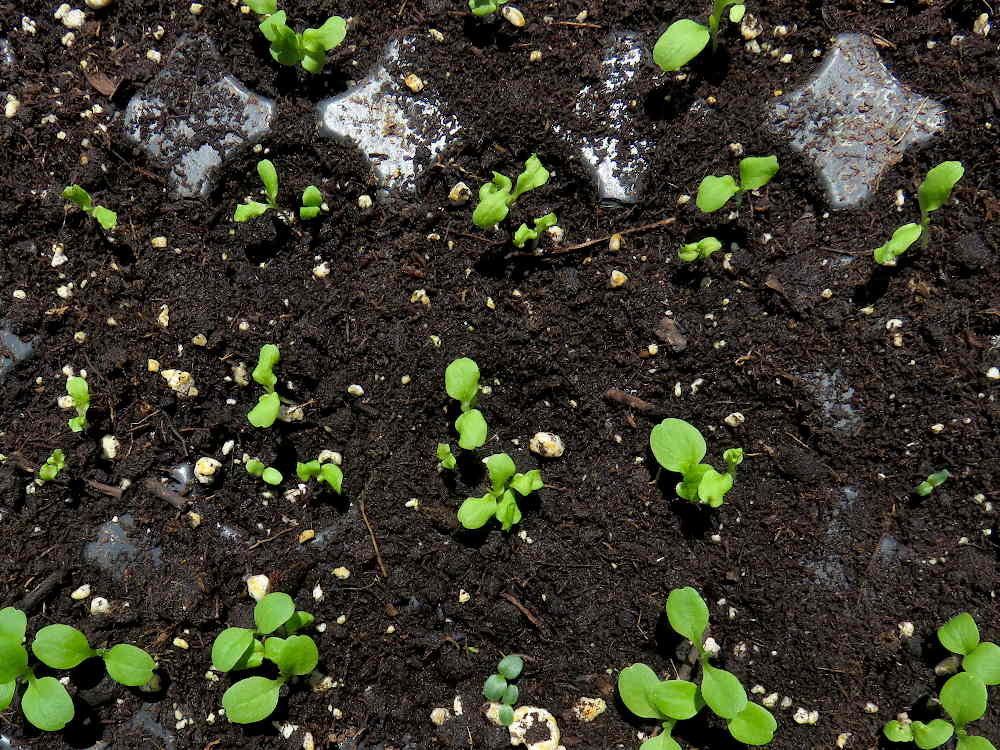
Nothing like improving a way to keep organized! This may look like some sort of craft-y looking set-up, when in fact it’s my new, state-of-the-art seedling tracking system. For years, I’d print the variety and seeding the on these tiny plastic stakes with a trusted Sharpie fine point, and stick them in the plug sheets. You can see the old approach on some of the stakes I’m reusing (old-fashioned recycling). Recently, I started instead to use a number code, writing the variety, date, and notes on a form I printed up. Why the change? Who knows, it just suddenly seemed like the thing to do.
It’s so much better! With only a number to read, the stakes can be half the height and don’t stick up and get in the way. It’s also a lot easier to see what’s going on overall by looking at the sheet. I always kept a list anyway, but now I’m doing half the printing and labeling work. I can also reuse the numbers season to season. The biggest advantage is psychological: I find that, when doing repetitive manual work, like seeding a few plug sheets, the less steps, the smoother the process, and less mental resistance. Rather than find a clean stake, print the info, pierce the plastic covering the plug sheet to stick it in, and rewrite the info on paper, I just insert the next number at almost soil level (no holes in the plastic wrap covering) and fill out the form! If this doesn’t resonate with you with a feeling of simple satisfaction, well, I guess you never had to keep track of a bunch of seedlings! :)
Early look at a new season
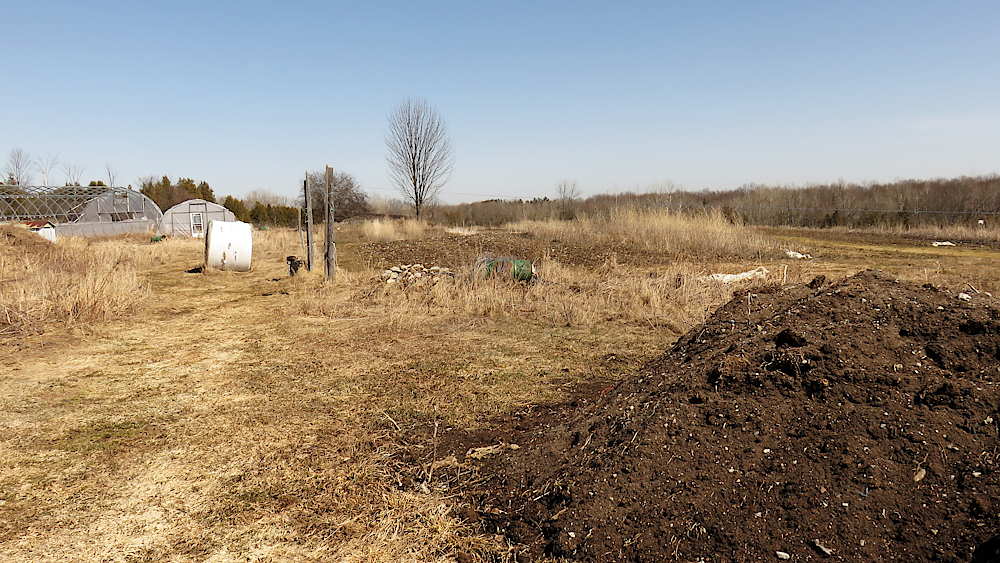
An unusual absence of snow in this early look at the field. The end of the compost pile poking into the photo is color-coordinated with the spring browns of all the dead vegetation. Center and right, a good amount of the market garden area is pretilled—clear and near set to go. In the mid distance, the little greenhouse is still standing, while the big guy is still bare, having had its plastic savagely ripped open by unusually high winds. That white object is a round bale of straw, sheathed in protective plastic, ready to use as mulch. It’s the broad canvas for another new growing season!
First winter harvest
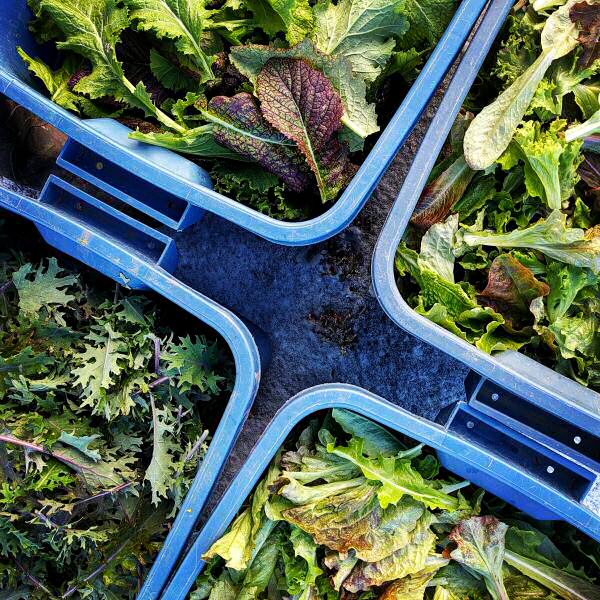
Yesterday’s harvest that went to today’s farmers’ market, my earliest market start by almost two months! From the unheated greenhouse: kale, green and red mustard, and lettuce mix times two. Harvest conditions: -2°C outside, a perfect-working-weather 10°C inside. At the end, the sun came out and it started to get sweatingly hot under a T-shirt, shirt and fleece. But, already done! No rinsing, just covered and into a cool room for a 6 a.m. pick-up this morning. It felt a little odd, starting the year’s Saturday markets so early, and indoors—this fall, if all goes as intended, weekly market will cease to end for winter and become instead a fully year-round thing…
Spring begins with the weather!
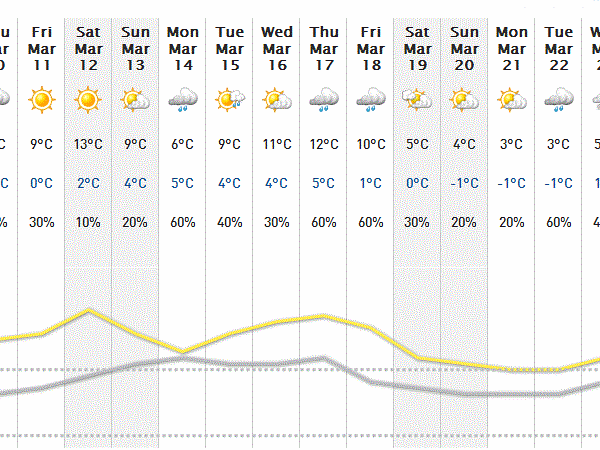
There’s official calendar Spring, and then there’s spring in the field, that ignores exact dates and goes by the weather, marking winter as over whenever the freezing temperatures end. If today’s two-week weather forecast is anything to go by—it is, in this case, when being off by ±5-10°C (14-23°F) either way isn’t a big concern—market garden spring starts now. For the moment, I’m mainly concerned about overnight lows in the unheated greenhouse, and whether row cover is necessary. If it stays above -15-20°C, my safe-with-no-cover cutoff, it should be fine to pull back the covers and let the sun shine in (prepared, of course, to put it right back if there’s a sudden severe dip, which we hope doesn’t happen). Nothing complicated, just a little of the gambling that’s called working with the seasons!
Excellent soil building book
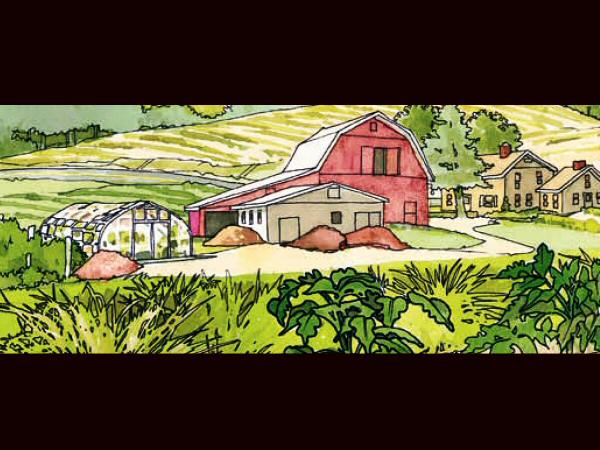
A reminder: Building Soils for Better Crops: Sustainable Soil Management is an excellent, book about soil for growers, free to download, or you can buy a hard copy. Follow the link, or read a bit more where I posted about it quite a while ago. The image above is cropped from the cover, a very specific type of old school farm view and set-up, which happens to be the one I’m familiar with; where you are may be totally different, as may be the soil, but the idea of growing is the same, and chances are this book is useful!
Seed catalog, 2016
Here’s my main seed catalog for this year. Once again, unlike several seasons ago, when I’d receive a dozen catalogs, order from two main suppliers, and pick up a few things from two or three others, lately, I’ve simplified and get everything in one place. This year, though, and for the second year in a row, there was a crop failure on a variety of mustard that I grow, and no close substitute, so I had to look elsewhere. Which, of course, opened up a world I’d kinda forgotten, the wonderful world of price comparison shopping.
The puzzling thing about pricing is the seemingly bizarre differences in price for the same items between different sources (it’s the same in seed as everywhere else). Some suppliers are clearly overall more expensive than others, so if quality and service are fine, it’s easy to go with the savings. But then, on any one item, prices can vary quite dramatically either way. For example, I found the same variety of mustard at $10 and $17 a pound, and something similar at $50, at three different places, and that’s expected. Less so is that, for just one common variety of lettuce, it’s $33 at my usual place, where the same amount is only $19 at a usually more expensive other supplier.
Yep, I could’ve gone on and on like this, with multiple lists and endless tabs of online catalog pages, like a full-on coupon clipper, looking for the ultimate bottom line big score. Instead, though, I ordered my mustard and stopped! Maybe not the best every-last-penny business thinking for a tiny farm, and tiny farm definitely does not equal big budget, but sometimes at least, for a few bucks, life is too short! :)