
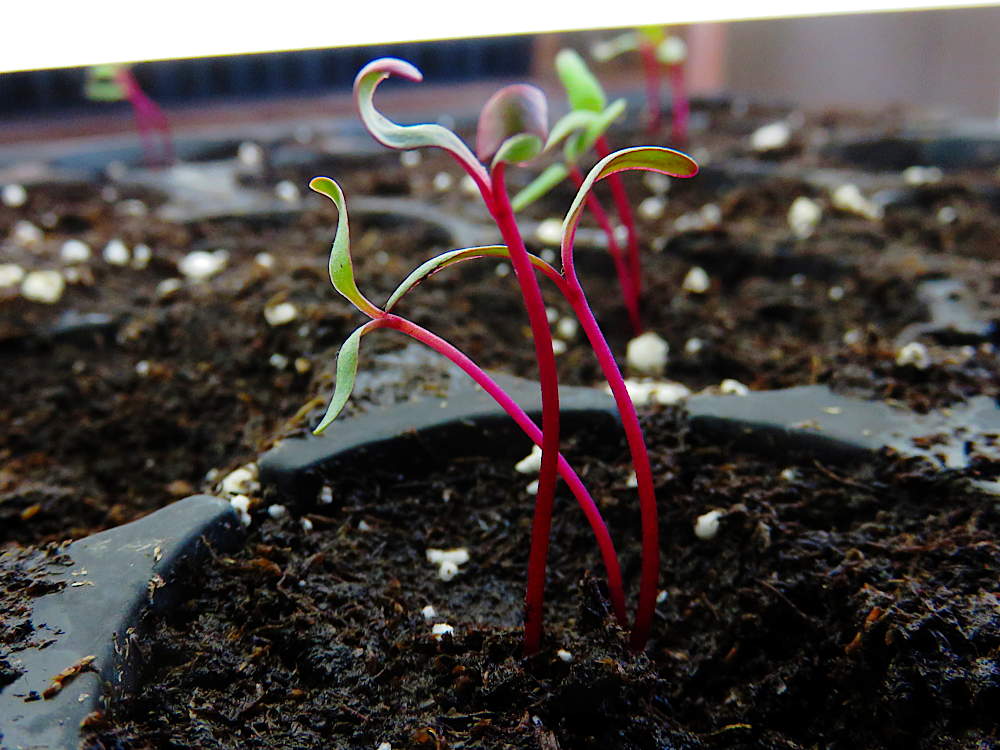
One of the basic things you learn about growing beets is that the seed isn’t actually seed, it’s small dried fruit that contain up to three or four tiny seeds. You’ll often get a tight little cluster of seedlings emerge, which could be a problem if you were precision seeding, going for exact spacing and no thinning. That sort of preciseness has never been a factor on this tiny farm—dealing with the vast volume of tiny carrot seed poured out by Earthway seeders in early years totally eclipsed any thinning issue one may have had with beets. Still, here’s PROOF. Beets aren’t transplant crops, but in this gardening year, I decided to try some in plug sheets. One shriveled fruit per cell. And here you can see, one “seed”, three seedlings! Could’ve also cut one open, but what’s the fun in that! They’re looking quite stretched under the fluorescents. Carrots definitely don’t like to be casually transplanted—they grow, but in my one experiment, they produced stubby little carrots. Probably something to do with the tap root being disturbed. Beets could be the same!
Seed & Seedlings
Basic tomato cage
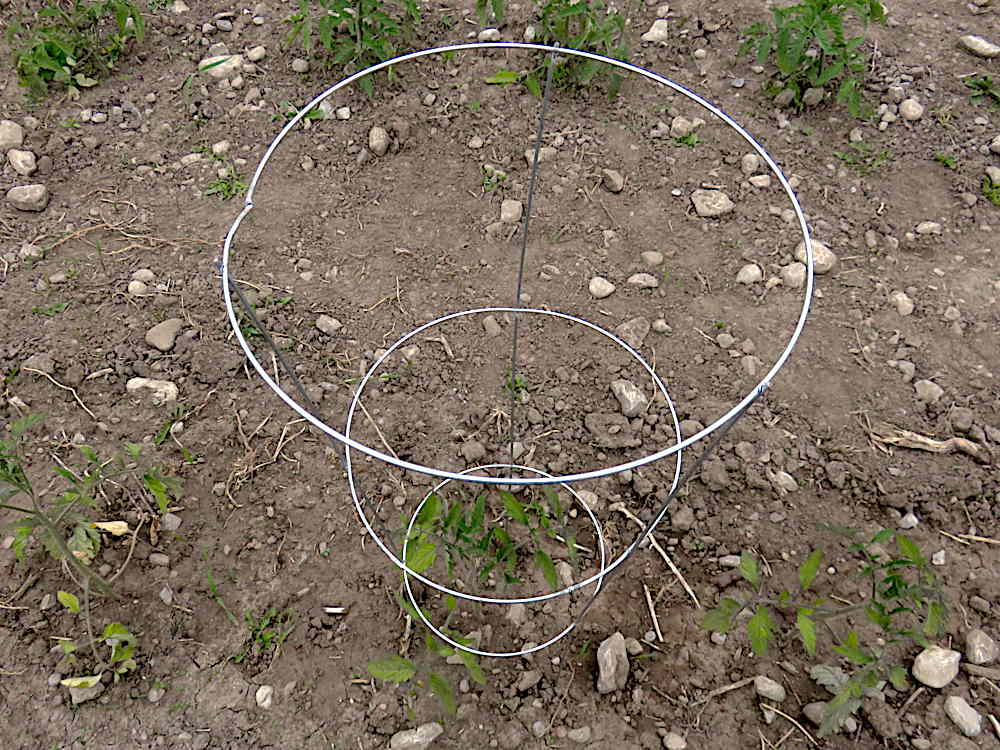
Ran into these cheapest of tomato cages in town, two bucks a pop, so I picked up a few. They’ve been around unchanged since I started growing veg over a couple of decades ago: three hoops flimsily spot welded to three support legs. Can’t speak for every last use, but from first-hand field tests, they’re pretty useless—a nice, neat-looking gesture to being in control when the toms are tiny, but prone to sag or tilt or snap at the joints under the weight of grown plants. Not great for a home veg garden, and really not for any sort of tiny production quantities. So why bother now? Well, one can always hope and dream. Since these toms went in late, given our short season, and the small number of plants, I can imagine carefully tending them—suckering enough to keep them productively compact, harvesting regularly before they get heavy. Plus, they take literally 30 seconds to place, and, at first at least, they look kinda cool and organized. Like a Jetsons garden. We’ll see how it goes!
Birds 2 – Beans 1
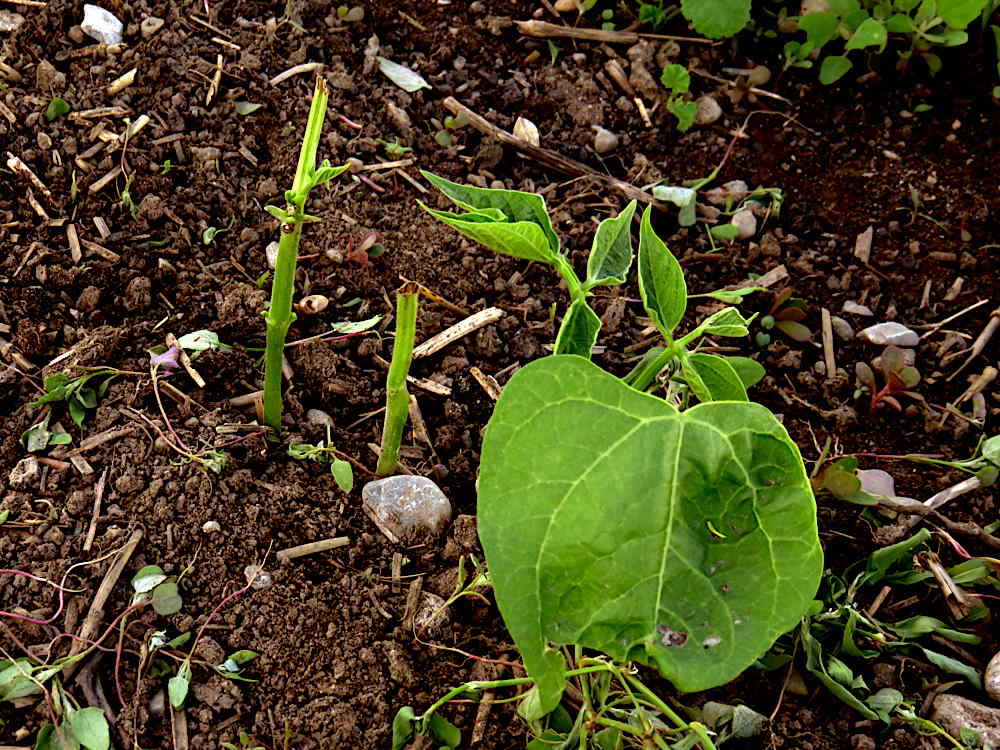
The first small bed of green beans was coming up fine—then I lapsed for a moment, and the beans were mercilessly attacked. So it goes in the rough-and-tumble world of the country veggie garden. I suspect birds. Can’t be sure but I’m pretty sure. I’ve seen them in action before. The ragged tops of the stems seem to point to pecking action, not the clean angled slice of creatures with teeth.
Instead of seed leaves, beans emerge with the actual bean split in two right on top of the stem, like an irresistible treat on a stick. Not sure what sort of garden raider survival strategy that represents. I usually put out anti-bird measures: inflatable scare balls or aluminum pie plates suspended on string. Or toss on some row cover—the duct tape of the garden—until a few leaves develop.
Here I didn’t act as soon as I saw the first signs of emerging beans. Also, I’m not used to hand-seeding and probably got a little too precise and seed-saving. With a seeder, plenty of seed drops, so there’s room for thinning, even by birds. Unforced human errors!
Anyhow, there are still enough plants for a decent first harvest, and a bigger bed is seeded and underway, with pie plates heading to the field. Bonus quarter point for the beans—you can see a tiny new leaf on one of the bare stems as it goes for a comeback!
Pot experiment update #2b
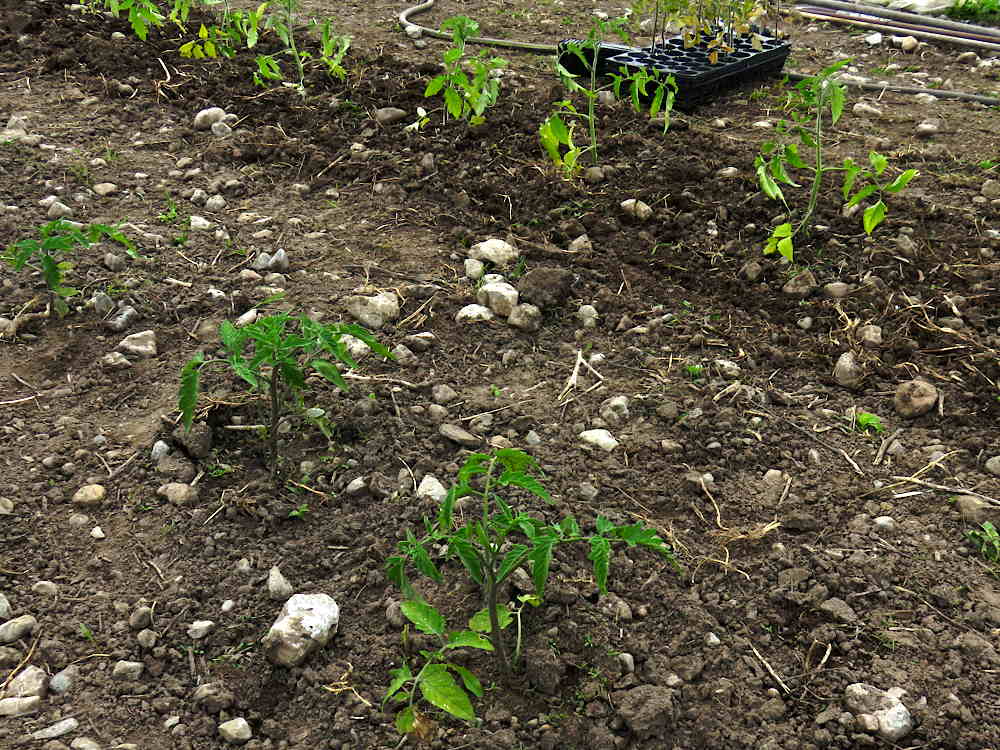
Here it is, the final phase of the tomato pot size experiment: side by side and in the ground. It’s a little hard to compare, so far apart and in this weird semi-overcast sunlight. The deep pot toms across the way went in late yesterday, and the plug sheet seedlings, up close, were transplanted 10 days ago. It’s a bit of an odd match-up for an experiment, but this was all an afterthought. The plugs have a big headstart in getting fully rooted, while the potted toms are starting in pretty much twice as big, with a lot more root mass. And they’re off…!
Debatably late
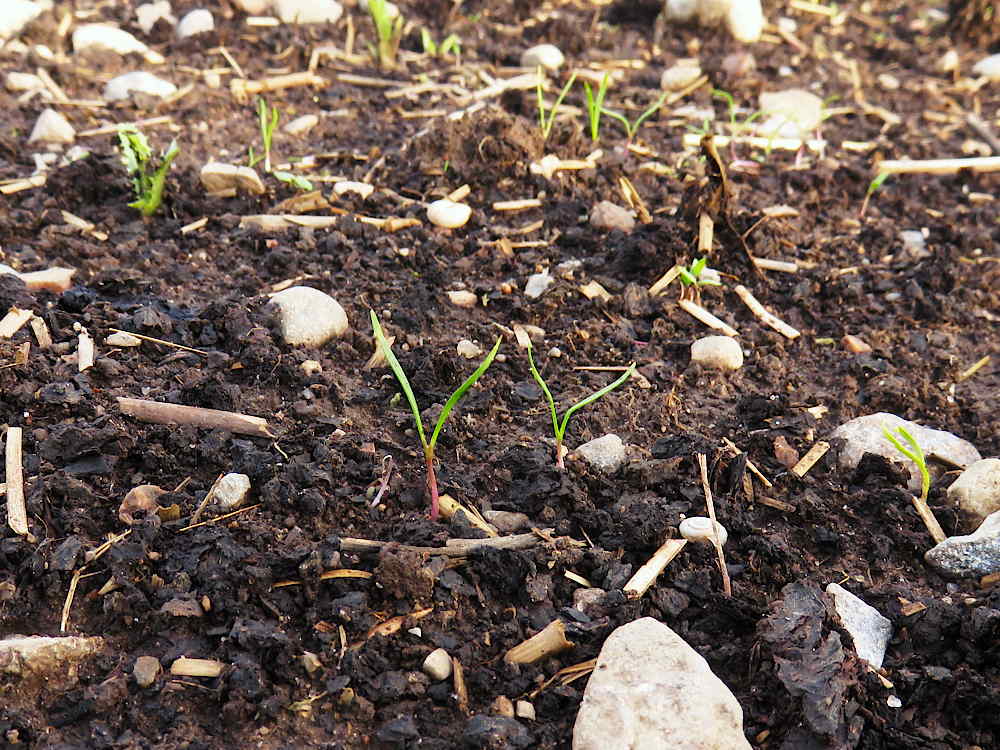
Much more me than the carrots in thinking they were taking so long, they weren’t going to arrive at all. The variety is Miami, a reliable hybrid, and the seed is from last year. To me, that’s fresh and ready to go. Given the recent soil-warming heat, uninterrupted moisture from watering and rain, and nice thick black landscape fabric cover to keep the heat and moisture in, I figured when I checked on day 7, then 8, they should be up and yelling for the sun. But there was nothing. I took off the cover, and didn’t let the bed dry out, but I was about to reseed. Then one more day went by, and there were a few tiny carrot seedlings starting to arch out of the soil. Still skeptical, I ignored it for another day, then checked this evening and…decent germination—actually, they’re really popping!
It’s not out of the ordinary, this production thinking that gets out of sync with reality. Patience is often rewarded. In this case, it’s not as dense germination as an Earthway seeder overseed, but it’ll do for a first round, and that’s over a week not wasted in re-starting the season’s first carrots! :)
Potatoes settle in
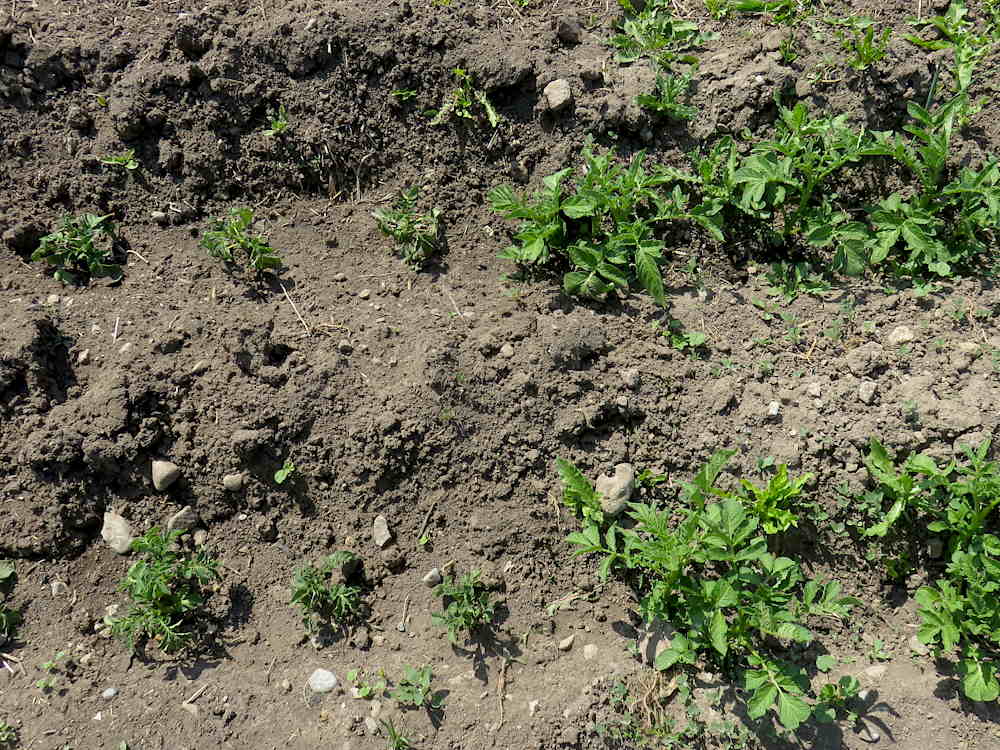
The volunteer potatoes from elsewhere in the garden, dug up and transplanted a couple of days ago, sit side by side with the original settlers in these trenches. Guess which! The transplants seem to be doing fine, but the directly overhead high-noon view is the harshest. They do look a little huddled and scrunched, not like the expansive riot of green growth of their neighbors. The roots of the new guys haven’t reestablished enough to pump a full measure of water to the stems and leaves, that’s my simple guess. Give them time to settle in.
Thirstier and thirstier
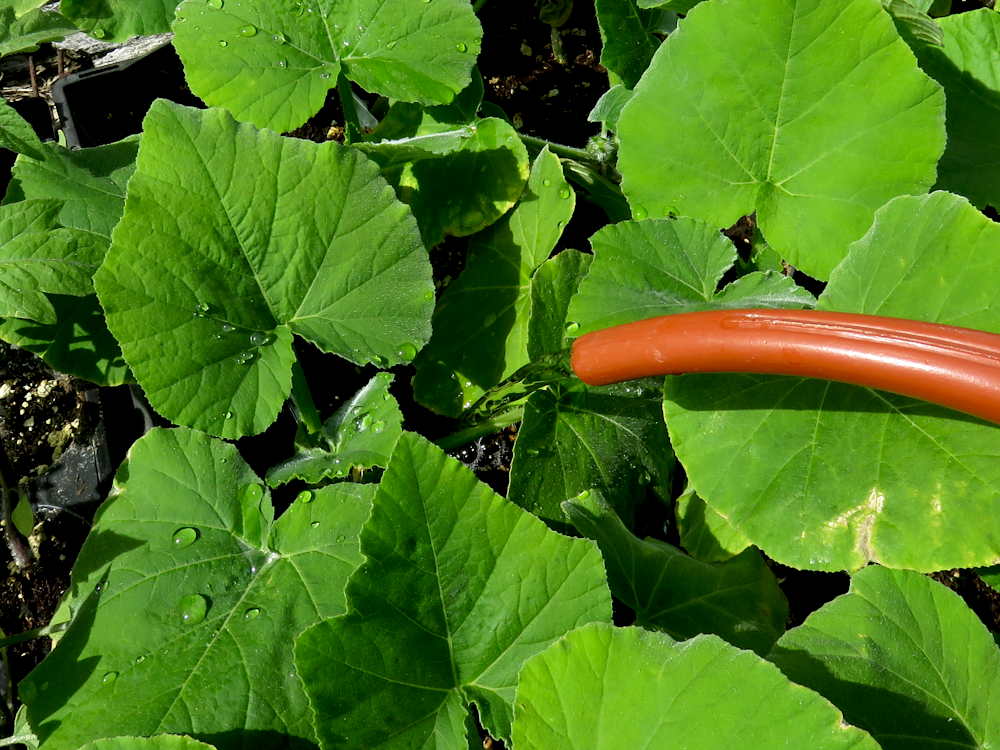
The seedlings are filling out fast now, with full days in the sun. Feels like they’re raring to break out! Stuck in their little pots, they could be being called to by their siblings already transplanted out in the field. Who knows?! One thing for sure is how fast they’re soaking up water now. Of course, it makes sense, it’s no surprise—but the little routine meter in my head sees that a good watering lasted a couple of days just a week ago, and now, especially in the tiny plug sheet cells, the surface is dry in hours and the trays feel light. There’s the sun and the wind to help evaporation, but still—thirstier and thirstier as they wait for the field!