
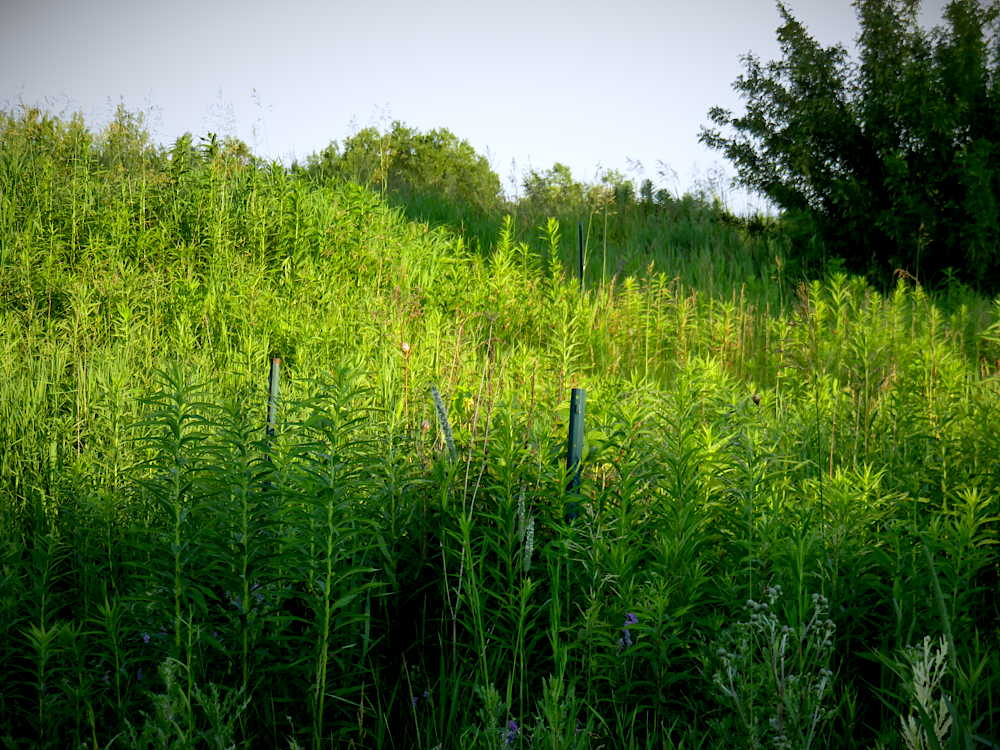
A field of goldenrod and tall grass—what the garden would look like, left to its own devices. It’s Day 4 of the first official heat wave of the season, coming to an end. I’m headed to the veg plot, a couple hundred feet slightly up and to the left, to turn on the electric fence for the night. Earlier in the afternoon, it probably hit around 34°C, which isn’t quite up to the crazy new highs we’ve been getting in recent years. Still, it was exhausting because of the thick, oppressive humidity, so spent much of the day indoors with a fan. Uncomfortable, but here at least, not as scary as the scrolling list of warnings and advice on the weather app made it seem, mixed with equally dire details of a possible sudden, severe thunderstorm. All the weather alerts get kind of annoying when most aren’t as bad as the extremes they describe, but I guess they’re overall useful, especially in cities. We’re being looked out for! And the heat is supposed to end overnight. As the sun goes down, it’s already quite cool and relaxing and the mosquitoes aren’t even bad!
Pests & Disease
Pie plate protection
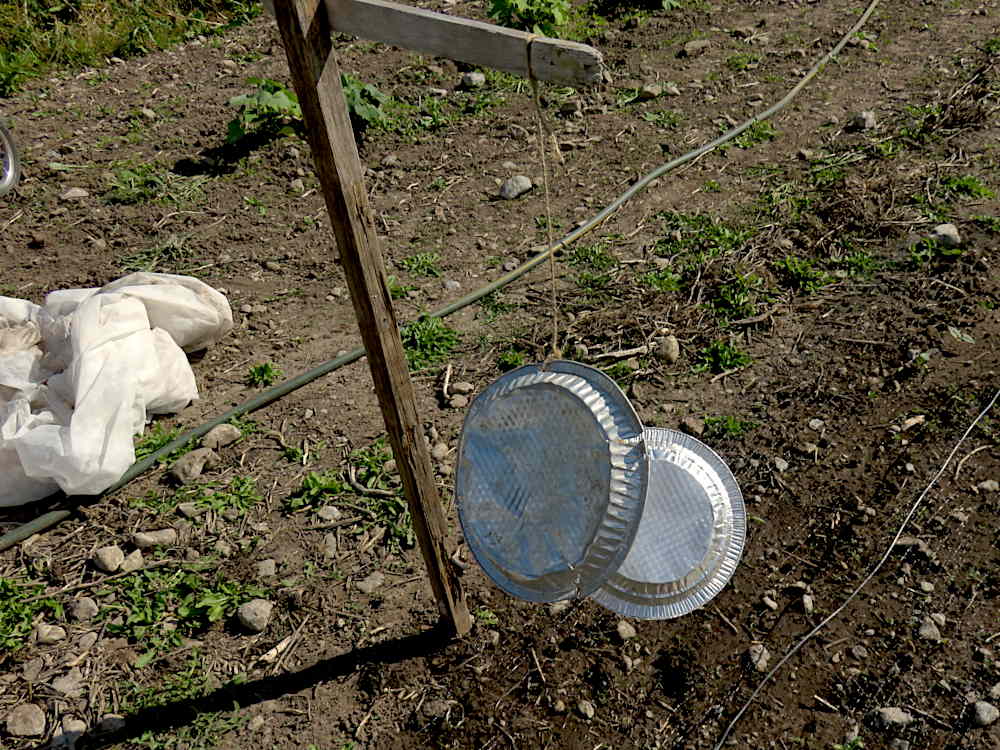
A couple of pie plates tied to a post, fluttering and lightly clanking in the breeze…scares birds. Why mess with the birds? In this case, to protect green beans as they emerge as perfectly peckable bird treats. To prevent avian decapitation, pie plates work, more DIY than scare balls, with the added dimension of sound. Not as soothing as wind chimes, but relaxing in the background, probably because it signals…protection!
DETAILS: Wind is always at work, doing what it can. The holes in the soft aluminum, tugged at by the twine, slowly enlarge. A day of heavy gusts and the plates can eventually tear off—there’s a rip from last year on the upper pan. But that’s an extreme. You could reinforce the hole, but I don’t bother. For the next year, maybe make a new hole. There’s a lot of years in one pan. For the post, which can also get blown over, I dug a small hole with a trowel, filled it with water, then pounded it into the mud. Probably a foot down. The whole rig should hang together just fine. Windproofed!
Melons in training
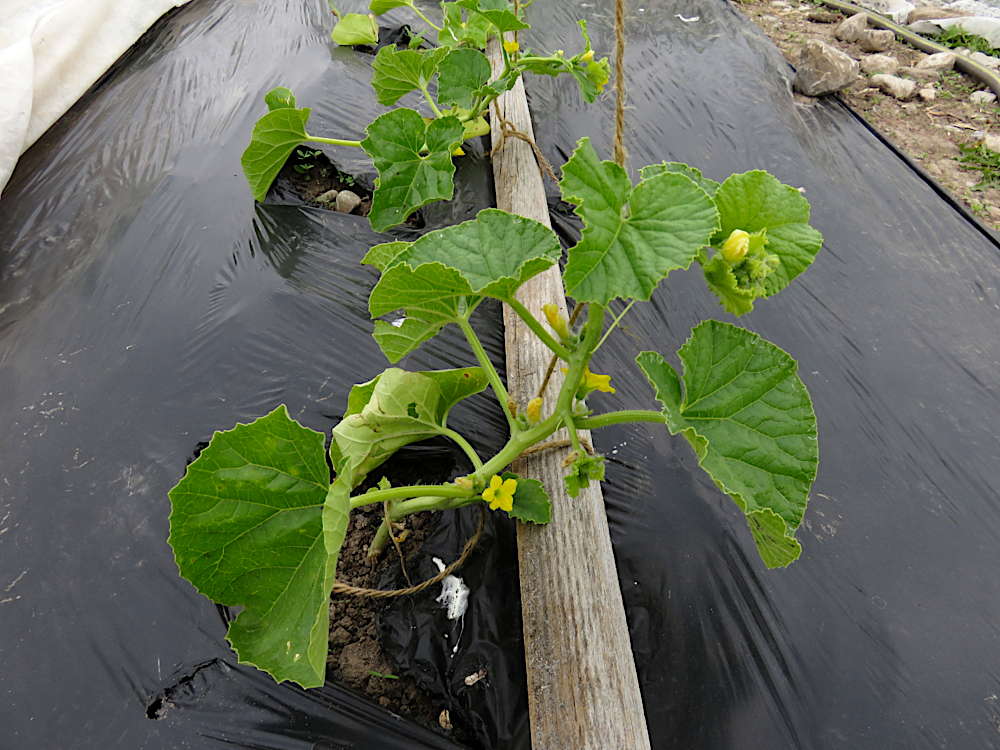
Melons have been out from under row cover for a couple days now, and seem fine. They look a little more vibrantly green in the photo than they do to me. It’s been weeks now of more cloud than sun, and none of the crops have the deep green, raring to grow look so far. But hot sunny days are forecast. I moved the vines to lean on the twine so they can head up. The tendrils haven’t figured it out yet. Those little yellow spots on the one leaf at the bottom left are maybe some sort of bacterial attack. Being out in open with good fresh air circulation will hopefully keep that from spreading. I’ll remove the leaf if it gets worse.
Since I don’t use pesticides, other than occasional plant soap spray, it’s really up to the plants to do their thing. The row cover as cucumber beetle protection worked, although using heavier cover made it more humid under there, perhaps promoting the bacterial spots. Giving them something to climb improves air and keeps them off wet ground. I try to be helpful, without getting in the way! :)
Layers of protection
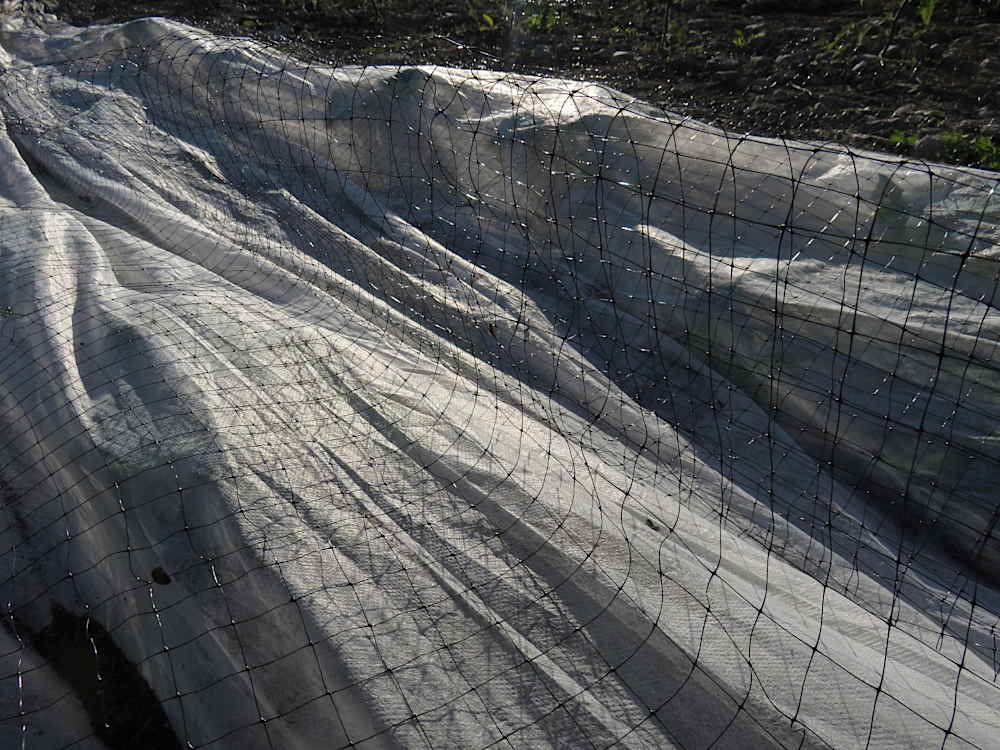
Layered protection for beds of cabbage and cauliflower. First, row cover for the flea beetles, who are out in force as usual. Loosely laid on top, deer netting, that doesn’t actually work for deer (it didn’t for the deer around here) but will hopefully deter the groundhogs. The net could easily be chewed through, but it’s springy, tensile tough and very easy to get tangled in. That may be enough!
Birds 2 – Beans 1
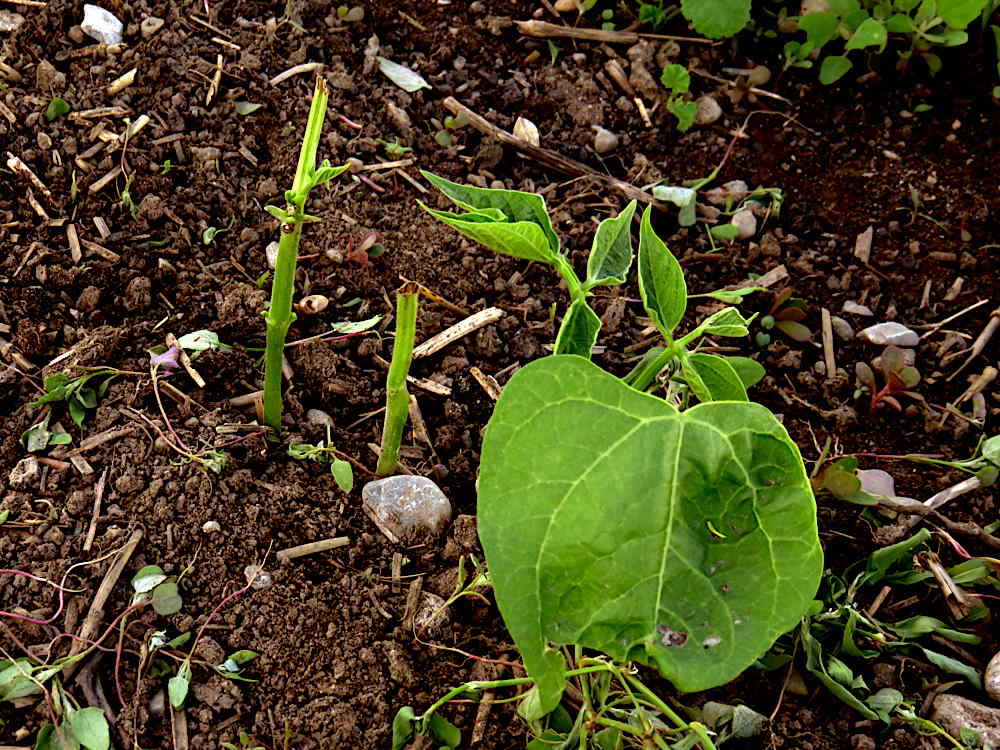
The first small bed of green beans was coming up fine—then I lapsed for a moment, and the beans were mercilessly attacked. So it goes in the rough-and-tumble world of the country veggie garden. I suspect birds. Can’t be sure but I’m pretty sure. I’ve seen them in action before. The ragged tops of the stems seem to point to pecking action, not the clean angled slice of creatures with teeth.
Instead of seed leaves, beans emerge with the actual bean split in two right on top of the stem, like an irresistible treat on a stick. Not sure what sort of garden raider survival strategy that represents. I usually put out anti-bird measures: inflatable scare balls or aluminum pie plates suspended on string. Or toss on some row cover—the duct tape of the garden—until a few leaves develop.
Here I didn’t act as soon as I saw the first signs of emerging beans. Also, I’m not used to hand-seeding and probably got a little too precise and seed-saving. With a seeder, plenty of seed drops, so there’s room for thinning, even by birds. Unforced human errors!
Anyhow, there are still enough plants for a decent first harvest, and a bigger bed is seeded and underway, with pie plates heading to the field. Bonus quarter point for the beans—you can see a tiny new leaf on one of the bare stems as it goes for a comeback!
On the right side of the fence
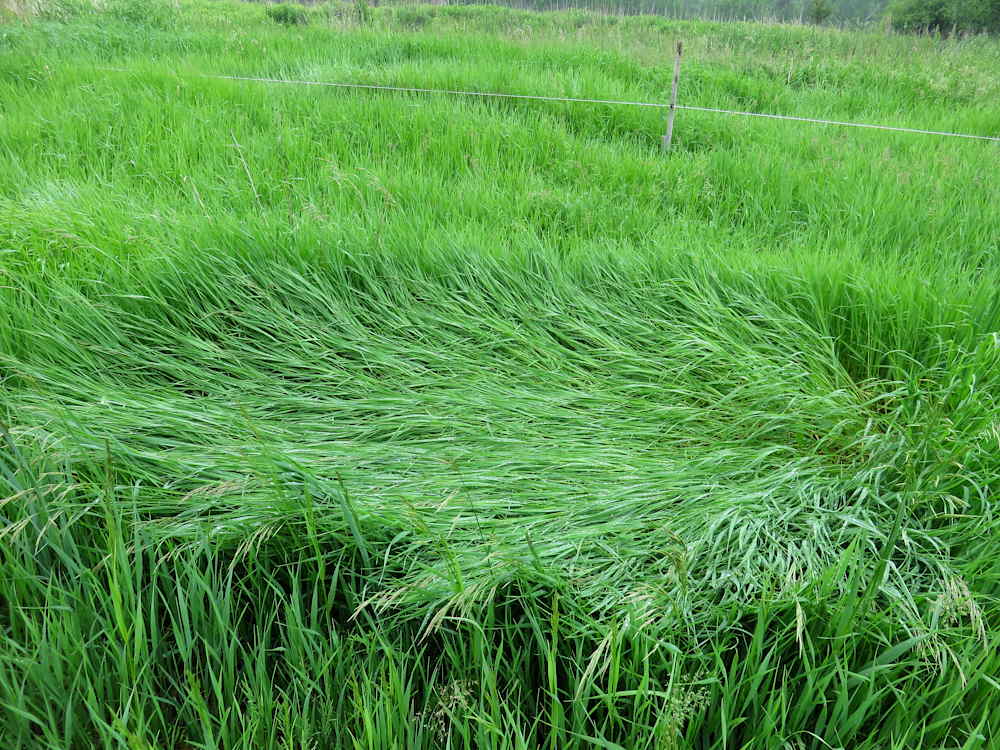
Wonder who spent the night here in the tall grass, so close to all those veggies. At least they stayed on the right side of the fence! It’s endlessly satisfying how that single white line and its steady pulse of intense electrical jolts have managed to keep the veg plot clear of deer. I can’t say for sure that’s what’s doing it, but deer are definitely all around, traveling through these fields, and they were a big garden forager before and during various lighter-weight fencing attempts. They only completely stopped devouring after that single line of defense went up. No electric fence guides I’ve read suggest just a single line, and yet, the plot’s been deer-free for years now. Can’t say the same for groundhogs, that extension of the electrical defense was a fair bit of work and a fail. But, still no deer!
“It’s flea beetles on radish, baby!”
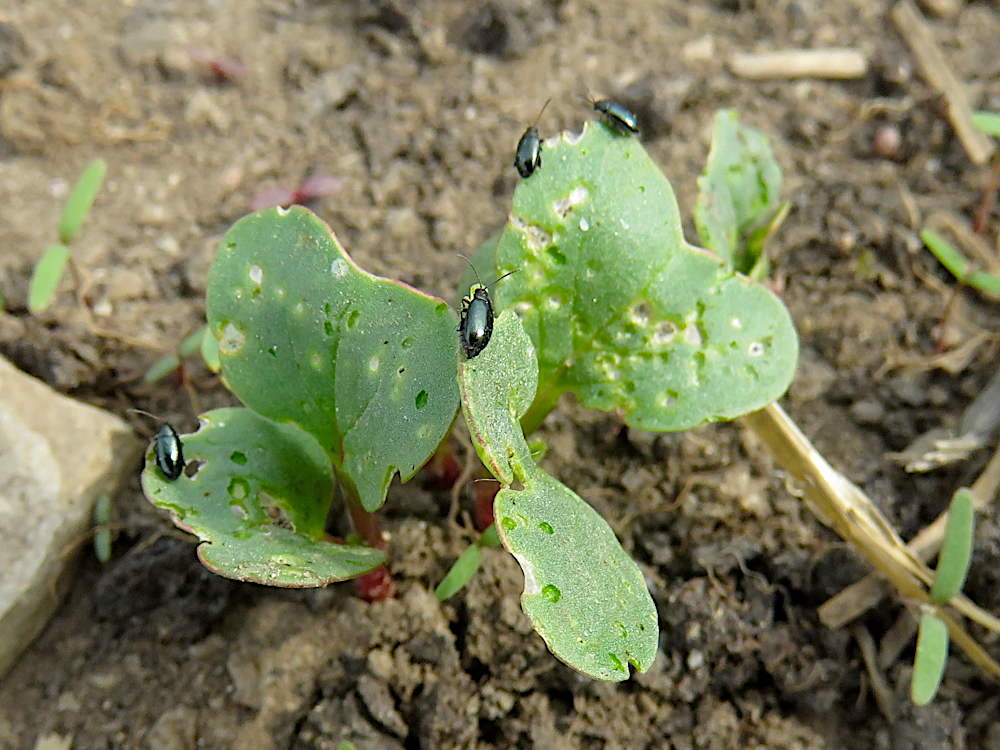
Yes, the flea beetles are back! They’re the size of a pinhead or less. In the photo, they’re at work on the first pairs of radish leaves that’re smaller than a fingernail. The action is all quite tiny-scaled. With the radishes, I’m not concerned about the damage. In the large veg-garden brassica family that the FBs favor, unlike the rest, radish grows so fast, the flea beetles can continuously feast and their damage is outgrown. Outcompeted in the veg garden arena. The leaves are scattershot with holes and dents, but the radishes themselves are fine, and…no need for row cover!
Grabbing this photo, getting as close as possible without making them flee, I notice how my relationship with the FBs has changed over the years. Even though they’re a scourge on the brassicas, meaning lots of row cover expense and labor right through the summer, they’re no longer an enemy, more like fellow travelers. Welcome, even—on the first radishes, they’re a sign that all is still in order this new season. They arrive, I row cover, except for radishes. They do their thing, I do mine. “Hey guys, how’s it going?” “Good, good. Just getting to work on these radish leaves.”