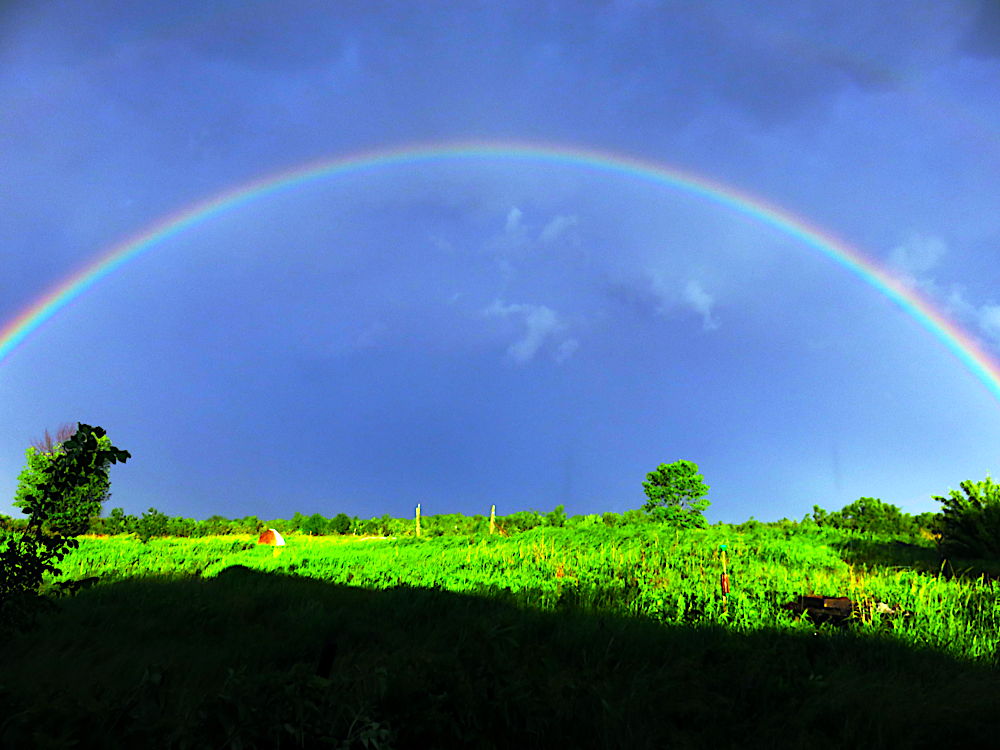
The sun’s almost set but the howling wind and bursts of heavy rain aren’t slowing down. It’s pretty wild out there, with ankle-deep marshy wet patches hidden in the grass. Stepped out for a last look around, and the tree at the end of the field caught my eye as it usually does. It stands alone in the middle of a large pasture at the point where the main veggie beds end. It seems quite independent, holding back on the leaves when the other trees are already green, exactly the same shape year round, with leaves or without. Lots of big trees, sheltered in the surrounding forest, were snapped like twigs in the big wind and ice storms of the last four-five years, but this guy remains unbothered. I’m glad because it’s a central part of the tiny farming scenery here these last many years. Would be sad to see it snapped!
Spring
Peering down a rabbit hole
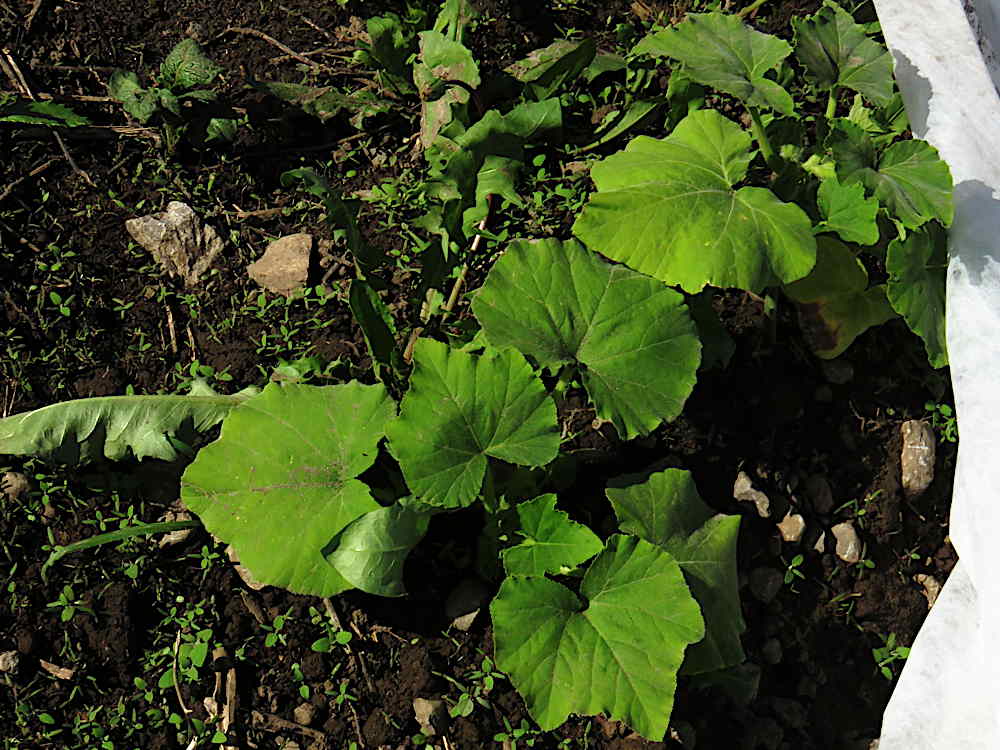
Not a literal rabbit hole, instead, the one that I started down when just for fun I looked into sunburn leaf damage, like what appeared today on a single squash seedling leaf. Sunburned leaves during hardening off isn’t what you’re aiming for, but it’s never been a big deal. So long as the seedlings are well-watered and the roots aren’t getting cooked in their containers, they’ll be fine has been my experience. Still, since only one leaf among around three dozen squash and melon plants got burned, after several full days in the sun, and yesterday half overcast, I took a mild interest—if I was a lot busier, with hundreds or thousands of seedlings on the go, not a second thought. Odd one-offs happen all the time.
There’s no end of gardening articles, university agricultural extension papers, science mags, and scientific studies to be had online, and I started browsing. Not in a next-few-years-of-my-life determined research way, just reading and skimming many sources. Of course, we know that UV is still strong on cloudy days from our skin cancer and sunscreen training—SPF!—but why just one leaf so toasted?
Then I discovered the UV spike. Not so widely written about, not as precisely stated as ~80% of UV makes it through clouds, but scientifically real. When certain types of cloud pass in front of the sun, like perhaps the fluffy cumulus ones that floated by most of yesterday, the fringes of said clouds can act as a magnifying lens that focuses and directs UV straight down, resulting in an intensity spike of maybe 25%. Could it be that one big early leaf hadn’t been shaded by the others on previous days and gotten more exposure, and just couldn’t take a day of high-powered UV micro-blasts, a few seconds each as the sun disappeared and reemerged, over and over. Hmm, that sounds fairly reasonable.
A gathering of the world’s top experts on UV and sun and plants would no doubt be in at least polite disagreement on the finer points of the basics of leaf burn, long before we came to UV spikes, not to mention, why only the one burned leaf.
I’ve found with tiny farming that learning is great, but what you take in is also critical, like lots of food vs a healthy diet. The one burned leaf isn’t a mystery, it just clearly happened. And unless more unusual things happen along the same lines, I’m not particularly curious. To harden off, a couple hours max outdoors the first day, and keep them watered and not boiling in their pots! When they get into the real ground, small ups and downs along the way will be forgotten, they’ll spread their roots and do just fine. Conditions in the field being favorable, of course!
Bed prep: Step 1
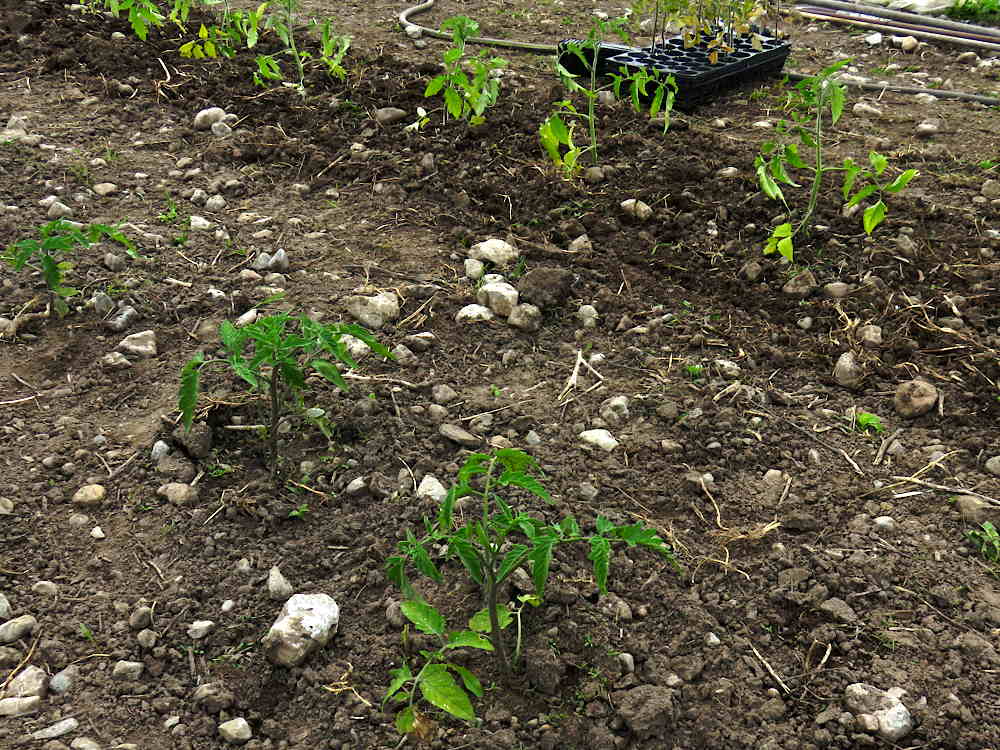
Here’s a chunk of this year’s tiny veg garden, looking particularly rough in the harshly slanted evening sunlight. As unlike seeing for yourself as this photo may be, it does accurately capture the wild and not ready look of it all. Lush dandelion, prickly thistle and grass already starting to soar, mixed about with the dry dead stems of last fall’s overgrown then winter-killed weeds—that’s step 1 of hand-prepping the bed, completed. It’s not at all like what the rototiller on the tractor would’ve done.
For this first pass, I used the up-for-anything Valley Oak wheel hoe. It’s probably not intended for hacking through this sort of cover, even so, it does the job amazingly well, moving forward and pulling back, using both sides of the blade to slice through tough spots. The green, intact-looking plants have actually been cut off just below the soil level—a day in the sun and they’ll all be fairly dried out, shrunken and browned. Next step, raking it clear, then, another pass with the wheel hoe. Tomorrow!
The water is high
If you live in a big North American city—the kind of cities I’m familiar with—the average ground is asphalt and concrete, and water table is not a household term. If on the other hand you rely on a well, or a smaller town water processing plant, or you grow things at some scale, water table is a big deal. You know the term whether or not you understand it beyond the basic idea of either abundant water or water shortage, and drought.
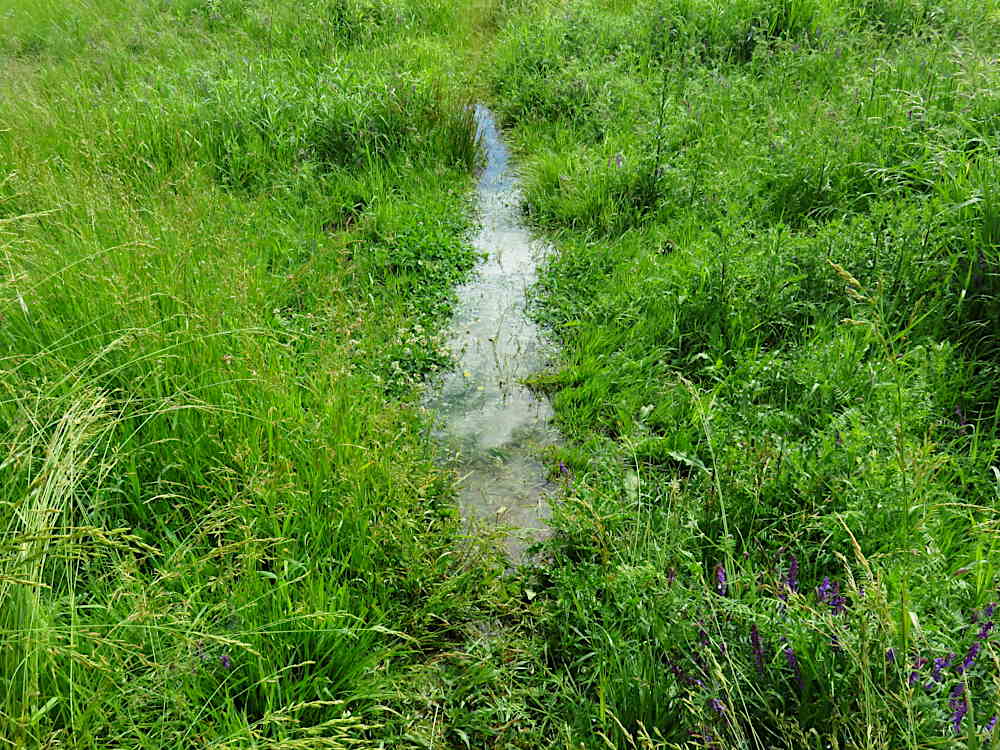
The puddle zone in the photo, in a particularly low-lying area of the field that my path to the veg garden cuts through, is my own local water table indicator. Earlier in spring, with snow melt-off and the ground still frozen quite far down, it starts out as a shallow pond, to be sloshed through in rubber boots. As the ground unfreezes and the water seeps off, down goes the puddle pond, until it disappears leaving dry ground. This is the water table level, like an underground lake or ocean that’s everywhere, except unlike when it breaks out in an open lake, here the water is running through soil. The lower the table gets, the drier the ground and the less water there is around. When you see a river dramatically drop in a droughty summer, that’s the water table, going down!
This year, the puddle has been dry for a couple of weeks, but after nearly two inches (5 cm) of recent rain, it’s back! Nearly a whole day later, it’s still pretty big, which means, lots of water right at the surface. At this point in the year, its main meaning to me is that lower spots in the field will still get a little flooded, so don’t plant there for a bit! Later on, since there’s no open water near the garden field, if we haven’t had rain for a long while, I’ll start checking the level in the dug well—lower down the string!
Thigmomorphogenesis
Squash seedlings in a stiff breeze—gale-force wind would’ve made for a more dramatic image, but thankfully not. This bending and fluttering of leaves is another benefit, besides the sun, of taking indoor-started seedlings out into the real world.
Movement, like blowing in the wind, triggers the catchily named thigmomorphogenesis process in plants, where they dramatically toughen up after getting a little pushed around. It could be wind, a pummeling rain, animals or hands brushing by or moving them about. Makes perfect sense for them to armor up.
I’m not particularly into the details of how they change, develop sturdier stems and whatnot—tougher seems to sum it up just fine—but it’s good to know about (I used to use an oscillating fan in winter). And I really like the term. For most of my life, my casual thought was that knowing everything would be cool, kind of like AI tries to today. At one point, though, conveniently marked by a certain blog post, my thinking flipped to often wanting to know less. Not cheering for ignorance, just comfortably sticking with what’s necessary for the moment. So, thigmomorphogenesis—long, unwieldy, yet surprisingly easy to pronounce after a couple of tries!
Garlic revealed
For the first time after years and years of growing garlic, they’ve been under row cover since planting in fall, protection from a repeat of last year’s surprise invasion of the leek moth. No longer the one crop that every garden pest, from deer-sized to flea beetle, seemed to studiously ignore. I covered them right after planting so I wouldn’t have to muck about in the marshy field in April before it dried out, and loosened it up earlier this month.
Today, a full day of unfiltered sun. Leek moths are out and about at night, so the garlic should be safe even if the moths are in the neighborhood. The plants look fine, healthy and growing quite fast, though the leaves were a bit bent at first by pushing up against the cover. Cover went back on late in the afternoon. Better that than be bored (by leek moths).
Burying Gold
Yukon Gold seed potatoes, placed in a trench, covered with a layer of on-farm compost made from cow manure, and carefully tended—watered and weeded, and hilled up with earth as the potatoes form upwards. In seven or eight weeks, scrabbling around in the dirt underneath the plants is rewarded by the first golf ball-sized new potatoes. So delicious. Yukon Golds were the first potatoes I planted—I almost remember reading about them and thinking of them as a kind of super-potato. “All-purpose” was the magical attribute. Starchy enough for fluffiness when fried, roasted or mashed, yet still with the firmness to hold up quite well in potato salad or a stew. These guys are spaced a foot apart, close enough to commune with their tribe, not so close they start to eat each other’s dinner. With decent weather, this batch will be a mouth-watering harvest just down the line!