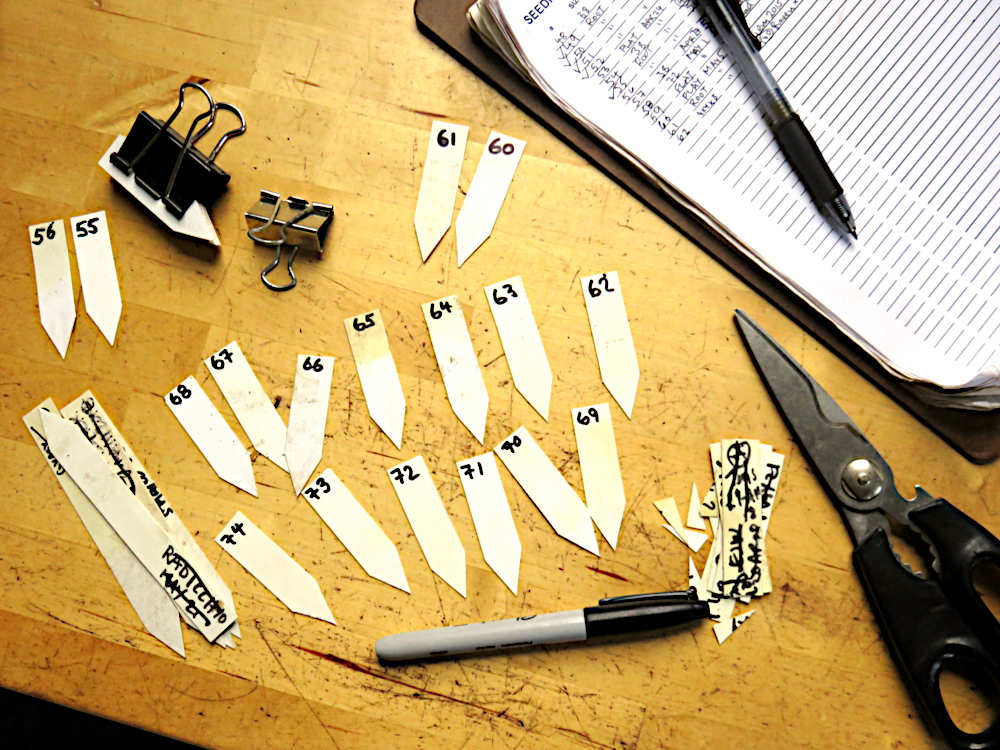
Nothing like improving a way to keep organized! This may look like some sort of craft-y looking set-up, when in fact it’s my new, state-of-the-art seedling tracking system. For years, I’d print the variety and seeding the on these tiny plastic stakes with a trusted Sharpie fine point, and stick them in the plug sheets. You can see the old approach on some of the stakes I’m reusing (old-fashioned recycling). Recently, I started instead to use a number code, writing the variety, date, and notes on a form I printed up. Why the change? Who knows, it just suddenly seemed like the thing to do.
It’s so much better! With only a number to read, the stakes can be half the height and don’t stick up and get in the way. It’s also a lot easier to see what’s going on overall by looking at the sheet. I always kept a list anyway, but now I’m doing half the printing and labeling work. I can also reuse the numbers season to season. The biggest advantage is psychological: I find that, when doing repetitive manual work, like seeding a few plug sheets, the less steps, the smoother the process, and less mental resistance. Rather than find a clean stake, print the info, pierce the plastic covering the plug sheet to stick it in, and rewrite the info on paper, I just insert the next number at almost soil level (no holes in the plastic wrap covering) and fill out the form! If this doesn’t resonate with you with a feeling of simple satisfaction, well, I guess you never had to keep track of a bunch of seedlings! :)