
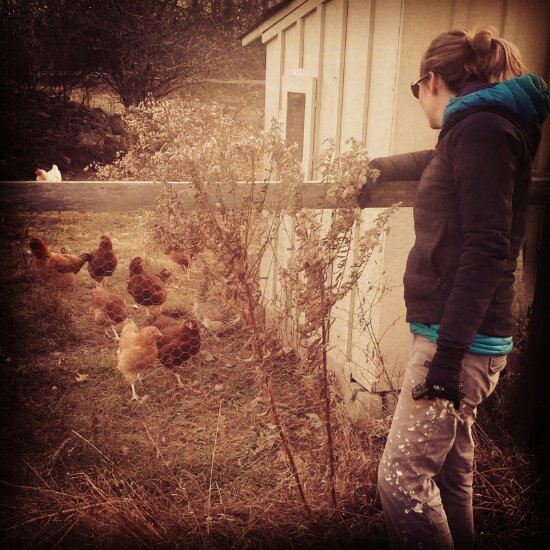
Chickens after harvest: Andrea M checks in with the girls after one of the quickest Friday harvests ever. Beets, carrots, a small amount of arugula and spinach from the unheated greenhouse… Several way freezing nights have left the field mostly in shades of brown.
chickens
Chicken Tractor: The Book
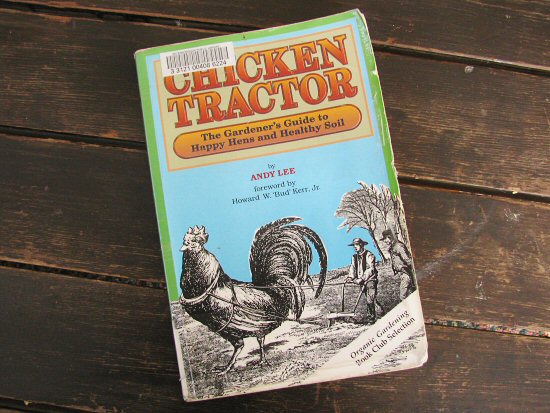
CHICKEN TRACTOR! My book-of-the-moment, a happy find at the municipal library (thanks to Kendall, I rediscovered LIBRARIES a couple of months ago—haven’t held a library card since school days, long, long ago).
The chicken tractor concept is simple, and it’s been chatted about around here quite often over the last few years…but not yet tried. The idea is to provide a mobile enclosure for your chickens, and move them to new sections of land every day or so, rather than keeping them in the usual chickenhouse and yard set-up. The chickens work up a small area of ground and fertilize it with their manure, and then it’s on to the next patch—the birds are always happy with fresh places to scratch and bits to eat, and a large area can be improved in no time. The rig can be any design you come up with that keeps the chickens in, predators out, offers shelter from the weather, and is easily moved. Easy!
Like most good things in smaller-scale farming, the chicken tractor is a startlingly simple and inexpensive approach that offers deep returns on many levels, from food quality to all-round satisfaction. It’s also kind of the EXACT OPPOSITE of high-tech industrial farming gear and methods that make so little sense to me. And the system works for various other farm animals as well, as in well-known (celebrity!) indie farmer Joel Salatin’s chicken-and-beef rotation at Polyface Farm.
So simple, why do you need a book? Well, it’s WINTER around here, all is snow, and reading about growing is the next best thing! In this case, Chicken Tractor, like its to-the-point title, is a perfect example of an energizing just-do-it how-to book, written in enthusiastic, full-on farmer-scientist mode. It’s jam packed with practical instructions and advice, the text assisted by numerous charts and illustrations, with a non-oppressive serving of sustainability philosophy and general food politics worked in, plus chicken trivia (the term “chicken tractor” was apparently coined by permaculture founder Bill Mollison, so now I know).
It’s cool to see this copy so considerately well-worn, although this being the original edition from the mid-1990’s, maybe it hasn’t seen that much use. It was published in 1994, quickly followed in 1998 by an “All New Straw Bale Edition,” with the subtitle upgraded from “The Gardener’s Guide to Happy Hens and Healthy Soil,” to the better-keyworded, “The Permaculture Guide to Happy Hens and Healthy Soil.” In any case, this edition is fun tiny farm reading from the library.
Anyhow, so much for the book review, let’s see how well this year’s chicken tractor plans actually fly! :)
Chickens, frozen
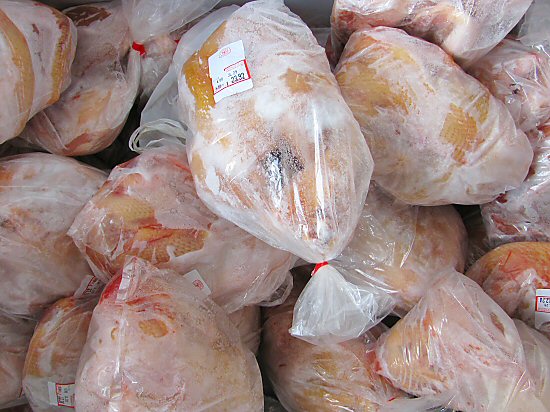
There they are: 38 newly processed chickens, freezing solid in the chest freezer (39 minus the one we took to roast fresh). It’s the last stop before the table on what was a pretty fine meat bird run.
Like everything else on the tiny farm (and in life in general!), when you get down to freezing chickens, there are the details. What I noticed this year is the amount time it takes to actually freeze chickens solid. This wasn’t quite as apparent last year, when we started with under 20 processed birds. Here, checking out the new freezer’s manual, I loosely followed the advice against freezing too much at once. I put in half, around 20 chickens, for a few hours, then added the rest. I’ve also been rotating them—they freeze faster when they’re exposed—but after a day, they’re not all rock hard.
I have it in mind that the faster you freeze stuff, the better it is when you thaw it out: firmer, not mushy. Something about smaller ice crystals doing less cellular damage. Sounds plausible to me!
Luckily, the chickens came heavily pre-chilled from the processing house. Processing your own in any sort of quantity, I imagine you need a fair bit of refrigerator space to cool them down, or a walk-in cooler, or lots of chest freezers. Another thing to look into for…the future!
Of course, the whole freezing thing is another puzzle. It’s quick and easy, and works really well for all kinds of food. Newer chest freezers seem quite energy efficient: this 15 cu ft one uses 400 kWh a year, which is like keeping a 60W lightbulb on for 9 months (at current electricity rates around here, that’s about $50). Doesn’t sound so bad, and there’s room for lots more in there. Still, we’re trusting a lot to yet another plug…
FINALLY, there’s the sticker, another fine feature of commercially-processed chicken. The meat is Ontario government-inspected (a provincial inspector is always on-site, that’s the law), which is indicated by a little logo on the label. Plus you get the date, weight down to two decimal places of precision, AND a price-per-pound of your choice. I picked $4. These birds are for our own use—not for sale—but it’s always fun pulling out an EXPENSIVE farm chicken for dinner, as long as it’s priced kinda within reason…
Chickens to meat
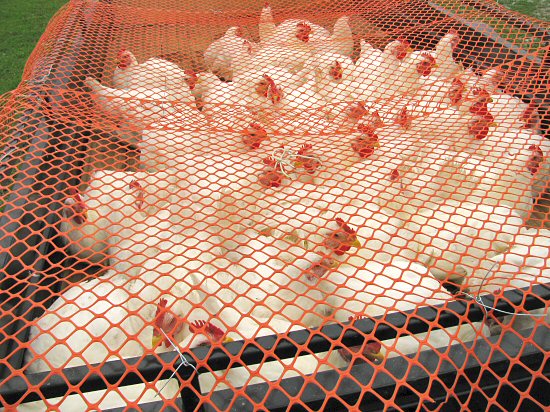
The White Rock Cornish X meat birds are now…meat! Today was to-the-processing-house day. Up at 5:15 a.m. to get them rounded up for the trip. And it seemed to be a pleasant one for them. They arrived looking laid-back and content after a breezy 35-minute drive. This was gonna end up their “one bad day,” but so far, so chill.
To save an hour plus round-trip drive to pick up cages from the processor, we decided to load ’em directly in the trailer. The original idea was to cover it with a tarp, but I waited till the last minute (this morning at dawn) to fit it, and there was no easy way to get the tarp secure. So, a last-minute solution that turned out great: snow fencing and wire.
Three sections were cut from a roll, overlapped, and fastened with twists of light-gauge electric fence wire. Really quick, secure, easy. Perfect! At the processor, I helped hand off the birds right through the slaughterhouse door. And that was it: back at 5:30 p.m. for the pick-up.
The trip was smooth, but the end was still a little impersonal: in one processor house door, out the other. I hope to fill in that last killing step soon.
So there we are, 39 free-ranged chickens, after what seemed to be a happy, active, fast-growing, 11-week life, are now government-inspected, weighed (average about 7lbs/3kg), packed in plastic, and pre-chilled for the freezer. This seems pretty close to sane meat production. Chicken dinner!
Weighing chickens
Booked a chicken processing date today: slaughterhouse day is July 29. They’ve been looking good all along, but now the White Rocks seem mighty…tasty. I keep remembering one of them hurrying by with a long worm trailing from his beak, then gulping it down. The last batch got nothing but feed. These guys have foraged for a varied diet, literally free-ranging (no fence!) for most of their lives. Feed plus bugs, plants, and whatnot. Should be a delicious combo.
On this, only my second flock of meat birds, I’ve noticed a new feeling for food animals. The first round was a novelty and a learning experience, now, it’s a comfortable routine. I observe the chickens with appreciation. I like them. I talk to them (although, not about much), hang out with them when I have time. I size them up as soon-to-be FOOD as I look out for their comfort, well-being and cheerfulness every day. There’s no pet-based sentimentality, instead I am grateful. The I-raise-you-then-eat-you feeling may sound harsh, but it feels…natural.
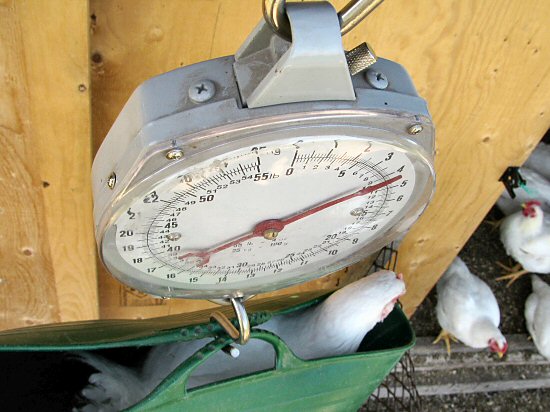
Weighed a few for the first time today, using a hanging scale and a trug (flexible plastic utility bucket). This can-do set-up works fine for spot checks. With the handles pulled together, the top of the trug is pretty well closed, so the chicken inside tends to sit still for a while before starting to look around…
At 9 weeks, most of them are around 7-8 lbs (3.6 kg). About 6-8 of the 39, like the one in the pic, are a little smaller. They’re around 6 lbs (if you’re checking the scale in the pic, the outer number is kgs, inner is lbs, and the trug = 2 lbs). All things considered, that seems good! According to the hatchery catalog, the White Rock average is 6.3 lbs (2.7 kg) at 7 weeks. I assume that’s with confinement and unlimited feed. These guys are out and about, exercising, and I let the feeders empty for 4-5 hours every day. The lighter weight seems to make sense. A couple more weeks and they should be White-Rock-plump, still healthy and happy, and…supertasty!
Chickens: ranging too far
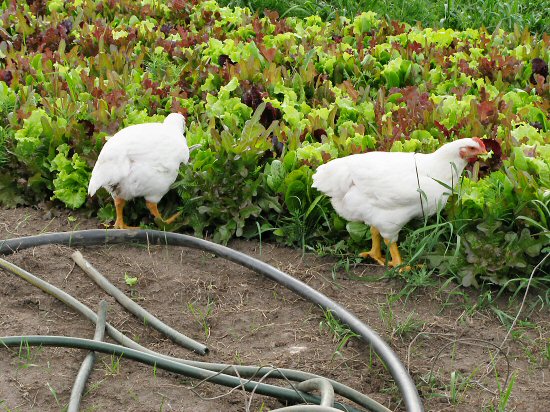
These guys, the White Rock Cornish X meat birds, have free-ranged too far, making it to the edge of the veggie garden in the big field. Luckily, although it looks good in the photo, this all-lettuce mesclun is done, cut at least twice and now too full of damaged and crowded, stretched leaves to make harvesting for market worthwhile. So, the chickens are actually putting it to good use. But of course, they won’t stop here.
So far, they’ve been completely free to roam during the day. I count and shut ’em in out of harm’s way at night, and pop open the door soon after sunrise. If they found farm life dull, they could hit the road and head to town, just like that. Instead, they tend to wander further from home bit by bit.
I’ve been watching their circle of foraging territory gradually expand away from the chickenhouse. A few advance scouts lead the way, sometimes alone, or in twos or threes. Eventually, over a couple of days, more follow. It’s fun to watch the process, and they seem to appreciate the freedom (since they use it), but it’s still three weeks to Processing Day, and they’ll keep on exploring right into the garden. Time for some fencing action…
(In front, pieces of old hose and water pipe are being sorted out on a clear patch of ground.)
Extending the chickenhouse
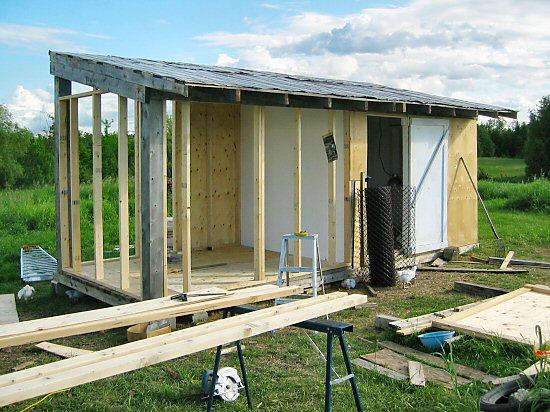
First day of summer, and the day before the arrival of 25 20-week-old, ready-to-lay Shaver Red Sex Link CHICKENS. Clearly, time to begin building out their new home. It shouldn’t take too long! :) Working on and off through the day, the frame went up, and by early evening, the plywood flooring is down, the door is built (on the right) and even a first plywood panel is up. A little more work tomorrow, and we should be good to go. No problem!