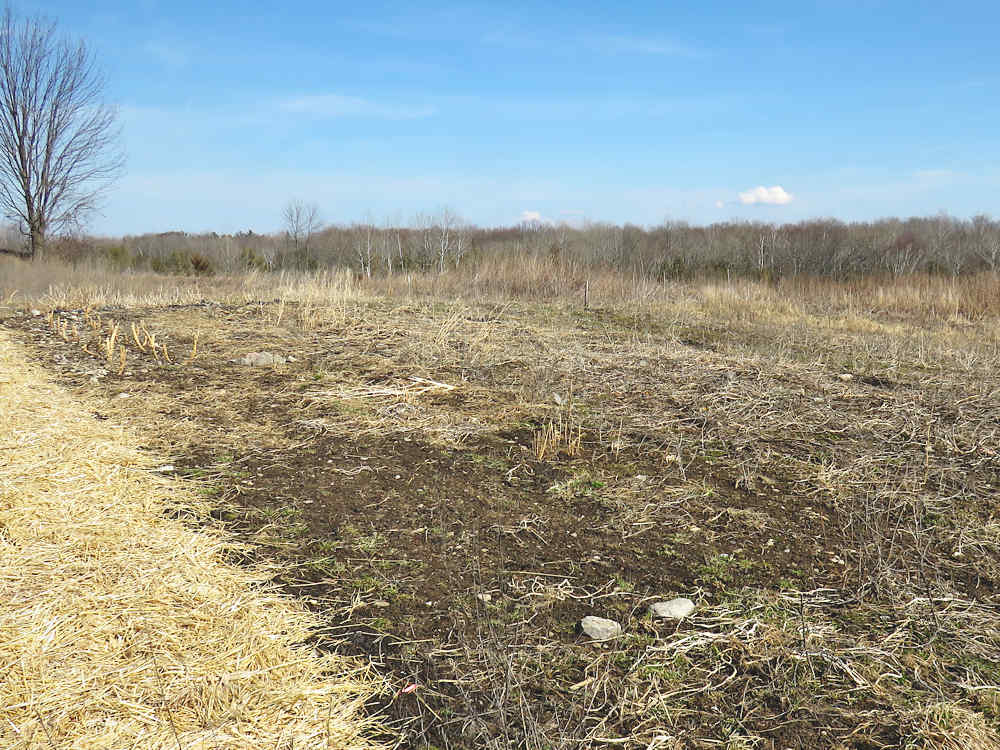
Today’s view of the field, my first since last fall! I’m about a mile (1.6 km) down the road, and I do sometimes pop by in the off-season. Usually, though, it’s out of sight, not out of mind for the whole winter. I’m still getting used to how much tinier the garden has been since I left the farmers’ market and the pandemic had its way. In any case, it’s looking fine. Most of it was cleared last fall. The straw-mulched garlic on the left seems cool, nothing poking up yet, I suppose not too early is good. And it’s really not wet, not the former usual dense, clinging, suck-you-down mud of the after winter melt-off (I’ve pulled my foot out of rubber boots trying to step forward in that stuff). Unless there’s a mini monsoon season coming up, I’ll be able to get out there pretty early, to set up the anti-deer-and-groundhog electric fence and prep beds. There’s still a broken rototiller to deal with on the tiny tractor, so that could slow things down. As always, we shall see!
mechanical repairs
Repairs
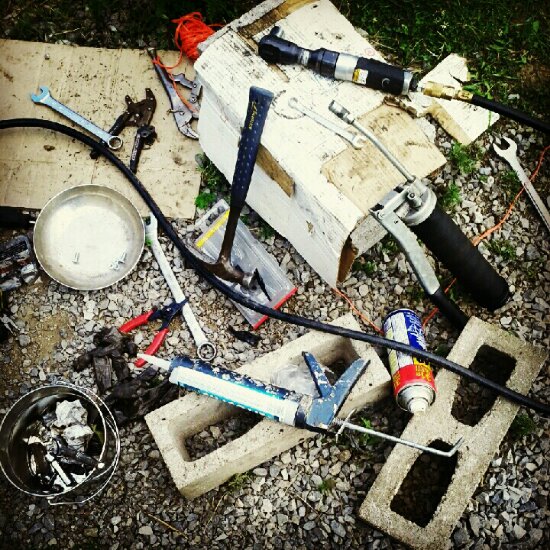
Tiny tractor: More rototiller repair, taking it apart to replace a bearing housing. These jobs either go fast or take exactly 5x as long as your worst case expectation because of little snags. (It would be quicker if I did this stuff all the time!) Here, I’m fixing the chain, a straightforward mission that involves lots of little nuts and bolts (remove and replace the housing) and a lot of grease. The caulking gun is for running a bead of silicone to between the two halves of the housing to seal it up. Concrete blocks and cardboard make a surprisingly workable instant workshop.
Compressed air and rototiller repair
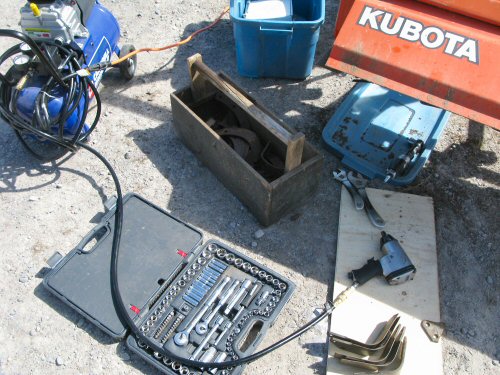
Looks like a whole lotta gear for swapping out one broken rototiller tine. Two bolts. BUT, this was a chance to try out the air tools with the new, tiny (8 gallon) compressor. So far, all it’s done is inflate tires.
The compressor is a smaller-scale replacement for the heavy duty one at the old farm. It’s not an absolutely essential bit of gear, but it does a lot of farm work: inflating, cleaning out things like screens and filters with blasts of compressed air, loosening big nuts and bolts (impact wrench), and removing lots of nuts quickly (air ratchet). And it can do more. I use it at least once or twice a week.
This unit is the top end of the home handyman line. The smaller tank means it can’t put out full pressure continuously for too long.
Sometimes, getting “home” gear for the tiny farm just doesn’t make sense, the equipment isn’t up to what you need it for, or, it breaks. But you often don’t need or can’t afford the same heavier equipment as, say, a more tractor-driven farm. Then, the choice is to rent/hire, or buy lighter duty IF it will really work.
Buying used equipment is another great approach, but, you need lead time—you want a tool there when you need it, not only after a good deal comes along—and you need extra buying skills to make sure you’re getting good used gear…
In this case, compressed air is used quite frequently, I couldn’t justify the cost of a commercial/industrial compressor, and I wanted it right away (here, the difference was two or three hundred dollars, and that adds up). Of course, I figured this one would work out, but you don’t know for sure until you try!
The impact wrench did just fine for de-bolting and re-bolting (I finished tightening up by hand). Now I know this little compressor can handle all the usual tasks on a tiny farm scale. Another CHECK on the new-farm, getting-set-up list. That’s good!
Big rototiller breakdown
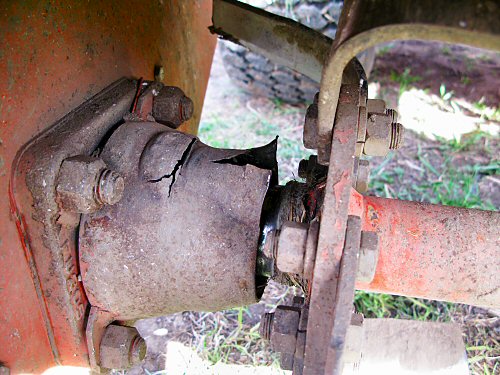
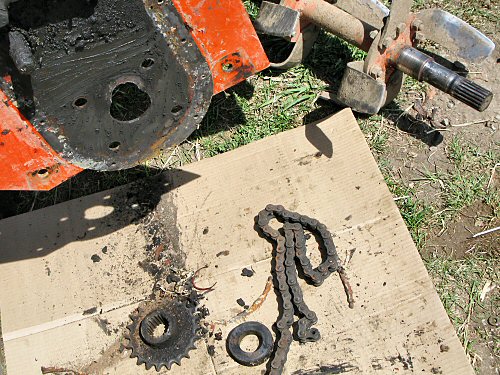
This is the not-good look of torn metal, not something you want to see on gear that’s both fairly essential to the tasks at hand, and ALWAYS expensive to repair. Right in the middle of some very satisfying tilling on Thursday, I heard a mild, unalarming scraping-squeaking sound coming from the rototiller on the Kubota compact tractor, so I stopped to check, just in case. When I rotated the tines by hand, I noticed the shaft had a lot of play on the left side, you could move it up and down a good inch or two. I cleaned off some wound up bits of plant and then dirt from the end and found the cap protecting the bearings had been split and peeled back. Uh-oh. It turned out to be not great, but could’ve been a lot worse. Somehow—not enough grease, or dirt finding its way into the bearings and gearbox, or both, or…something else—the shaft that drives the tines had completely pulverized the bearings and had been rotating directly against metal! Imagine the heat, the tortured, red-hot metal-on-metal—but it was still tilling real good… In the pic below, you can see where it ground out its own path, that extra piece of hole on top of the larger one. It had burned through the tiller housing, another plate behind it, and a heavy die-cast fitting that supports the shaft (that bolted-on square piece in the pic above), and jogged up enough to split the dust cover. Man!
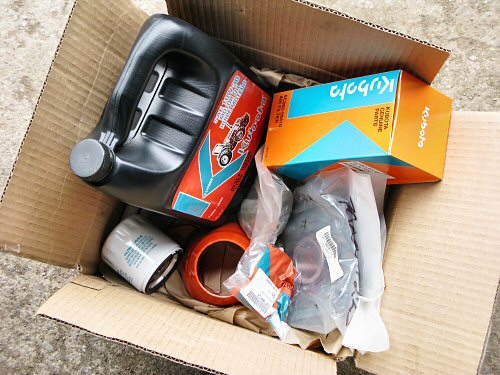
Of course, PARTS are always at hand, it just takes cash and a call to the tractor dealer, and presto, delivery by next day. Like an expensive little miracle… I hate buying parts, you need ’em, have absolutely no way to tell what they’re “really” worth, and they cost a fortune. This little boxful: $400 (well, besides the 4-bolt flange bearing, oil seal plate, bearing cover, and a couple of other bits, that includes the annual air and oil filters, and oil…). Anyhow, that’s the way it goes: things break down, gotta be fixed! This morning it was put back together, like nothing had happened at all…