
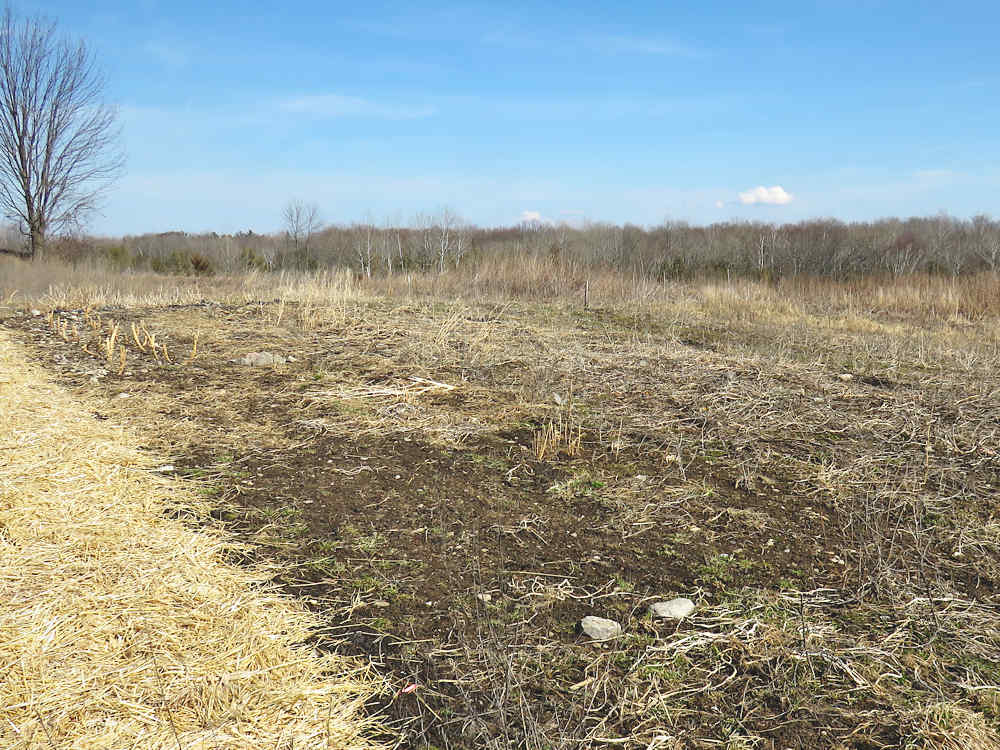
Today’s view of the field, my first since last fall! I’m about a mile (1.6 km) down the road, and I do sometimes pop by in the off-season. Usually, though, it’s out of sight, not out of mind for the whole winter. I’m still getting used to how much tinier the garden has been since I left the farmers’ market and the pandemic had its way. In any case, it’s looking fine. Most of it was cleared last fall. The straw-mulched garlic on the left seems cool, nothing poking up yet, I suppose not too early is good. And it’s really not wet, not the former usual dense, clinging, suck-you-down mud of the after winter melt-off (I’ve pulled my foot out of rubber boots trying to step forward in that stuff). Unless there’s a mini monsoon season coming up, I’ll be able to get out there pretty early, to set up the anti-deer-and-groundhog electric fence and prep beds. There’s still a broken rototiller to deal with on the tiny tractor, so that could slow things down. As always, we shall see!
tractor
Picking rocks
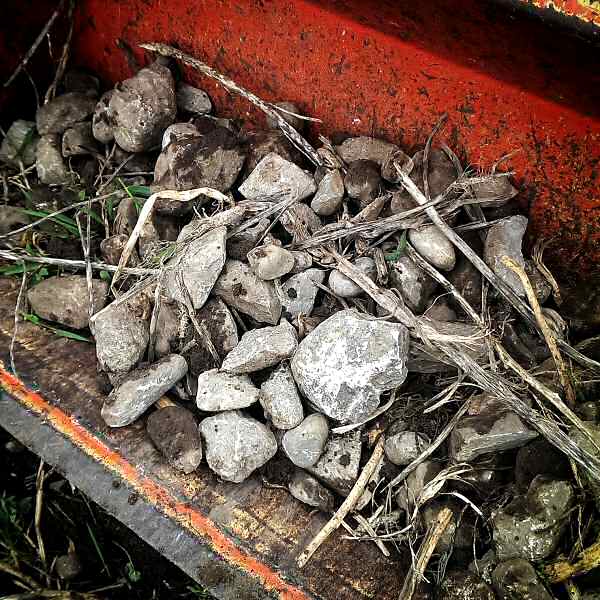
We have rocks, it’s not a big deal when you get used to them, although I suppose I’d really notice the difference if suddenly all the rocks vanished. As it is, little ones like these are usually ignored, but in one small area they were dense as cobblestones, so we picked them… The method: pick ’em up, toss ’em into the Kubota compact tractor bucket, when the bucket’s full, dump it on one of the rather large rock piles. With two or more people, you can spread out and toss rocks into piles from a convenient tossing radius, and travel around with the Kubota, loading the piles into the bucket. It’s really quite straightforward. And quite quick. Of course, there’s a mechanical alternative, with various tractor-run contraptions for removing rocks in large volume. It’s all about scale, and how many hands and rocks you have!
Ice storm
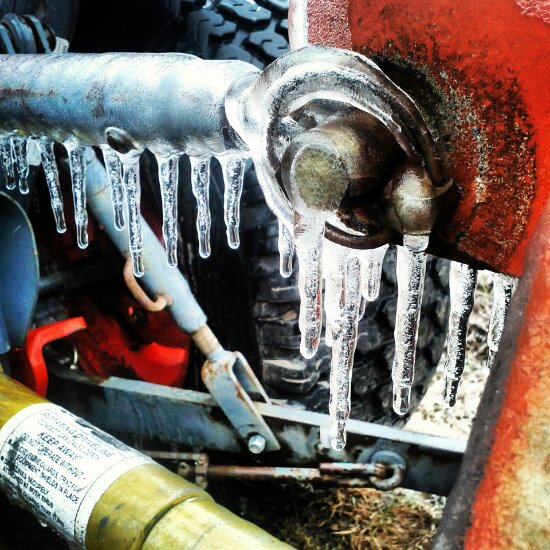
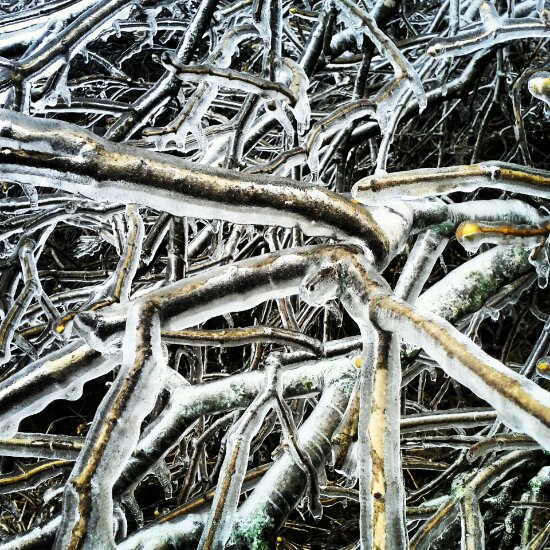
Ice storm. Some strange, quick mix of rain and freezing cold that puts a thick coating of ice on everything, and creates sturdy little icicles wherever water drips (like, above, from the 3-point hitch that’s attaching the rototiller to the tiny tractor). Quite amazing, and a little alarming as well when you pass under big trees drooping and sagging under the extra weight. Massive branches falling and whole trees toppling are taking out power lines all over, it’s already been out for 12 hours in places around here, and the radio’s saying it might not be restored for another 24 hours. Back to the Stone Age. The Ice Age. At least, the pre-Electric Era. No Internet at night? Light a candle, or use your long-lasting LED headlamp, and read a book!
Repairs
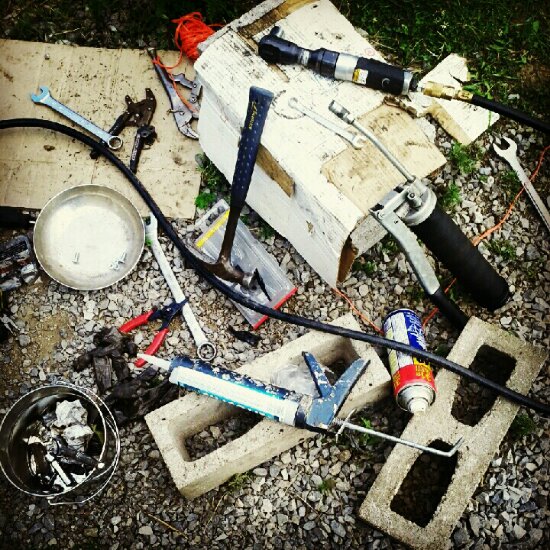
Tiny tractor: More rototiller repair, taking it apart to replace a bearing housing. These jobs either go fast or take exactly 5x as long as your worst case expectation because of little snags. (It would be quicker if I did this stuff all the time!) Here, I’m fixing the chain, a straightforward mission that involves lots of little nuts and bolts (remove and replace the housing) and a lot of grease. The caulking gun is for running a bead of silicone to between the two halves of the housing to seal it up. Concrete blocks and cardboard make a surprisingly workable instant workshop.
Fueling up
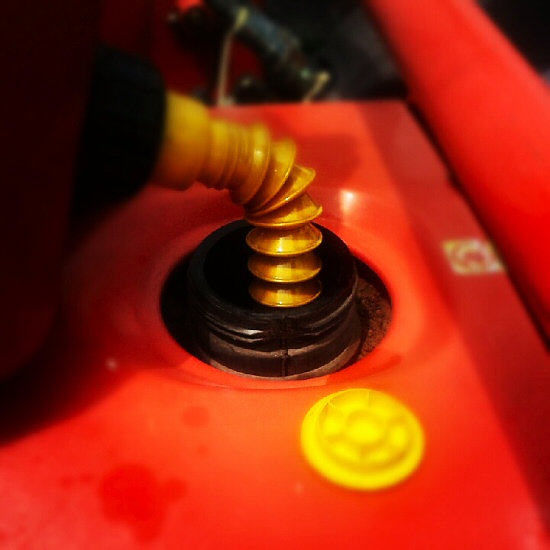
Always satisfying to fill up the Kubota compact tractor. A little under five gallons of diesel does the trick. It’s quite amazing what you can do on just one tank, like till up 2-3 acres with fuel to spare. Depending on what’s going on, I’ll use somewhere between three and six tanks in a season, so for the amount of work the tiny tractor does, the oil-reliant portion of the program is really kinda small.
Bucket loading
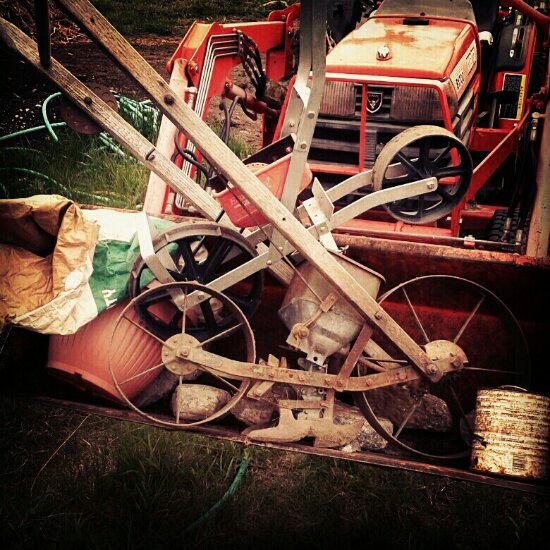
Especially in spring, with constant seeding and transplanting, moving gear around the field is a bigger deal than it may seem. Forget stuff, even little things like a hose fitting or a seed plate or some twine, and you’re heading back the equivalent of practically a city block to get it. A trailer of some sort is the ultimate for a 2-3 acre plot, but with decent packing skills, you can fit a lot into a tiny tractor bucket, too! This carefully balanced load includes everything needed for some direct seeding: the Planet Jr. and Earthway seeders (can’t forget the Earthway seed plates, they’re a perfect fit in that coffee can); seed, clipboard for notes, twine and stakes for row marking (all in that large flower pot); choice rocks for anchoring row cover (it’s never too early to protect brassicas from flea beetles!); and there’s the last of a 50lb bag of snap peas nestled in. It takes a practiced eye to fit everything you need so nothing falls out as you bump along—do it a few times and…easy peasy!
Global Village Construction Set: Watch This!
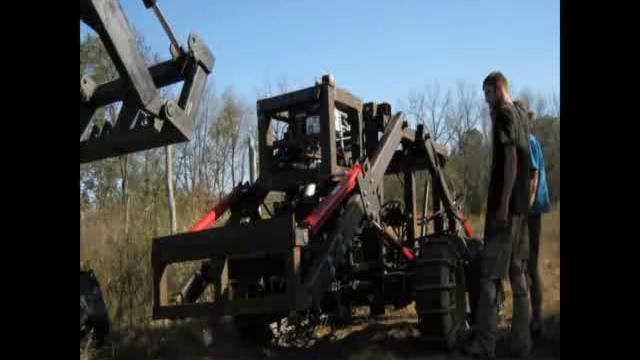
Watching this video made me smile! It wasn’t the kind of smile you do when you’ve seen something cute or funny. This was the deep, involuntary smile of wonder and appreciation and, um, joy, that happens when you see something really cool and admirable. When you see something that…rocks! :)
I’ve been following the adventure at Factor e Farm, through their blog, for maybe three years now, not always diligently, but what they’re up to is always somewhere on my mind. The mission they’re on is incredibly ambitious and fundamental and world-class. You have to read through their blog and wiki, and watch some of their other videos, to get a full feel for what Factor e is up to, but to try and summarize:
Using modern technological knowledge and methods, and very little cash, they are designing and building a set of machines and methods that are open source (plans are free for all), low cost, easy to replicate, highly efficient, simple to maintain, and sustainable to operate, called the Global Village Construction Set, just about everything you would need to build a community, from the house you live in to the food you eat, from scratch.
Or as their blog puts it: “We are farmer scientists – working to develop a world class research center for decentralization technologies using open source permaculture and technology to work together for providing basic needs and self replicating the entire operation at the cost of scrap metal.”
This video is their two-minute introduction:
You HAVE to check it out: Open Source Ecology.