Tender to the greenhouse

First tender seedlings in the greenhouse

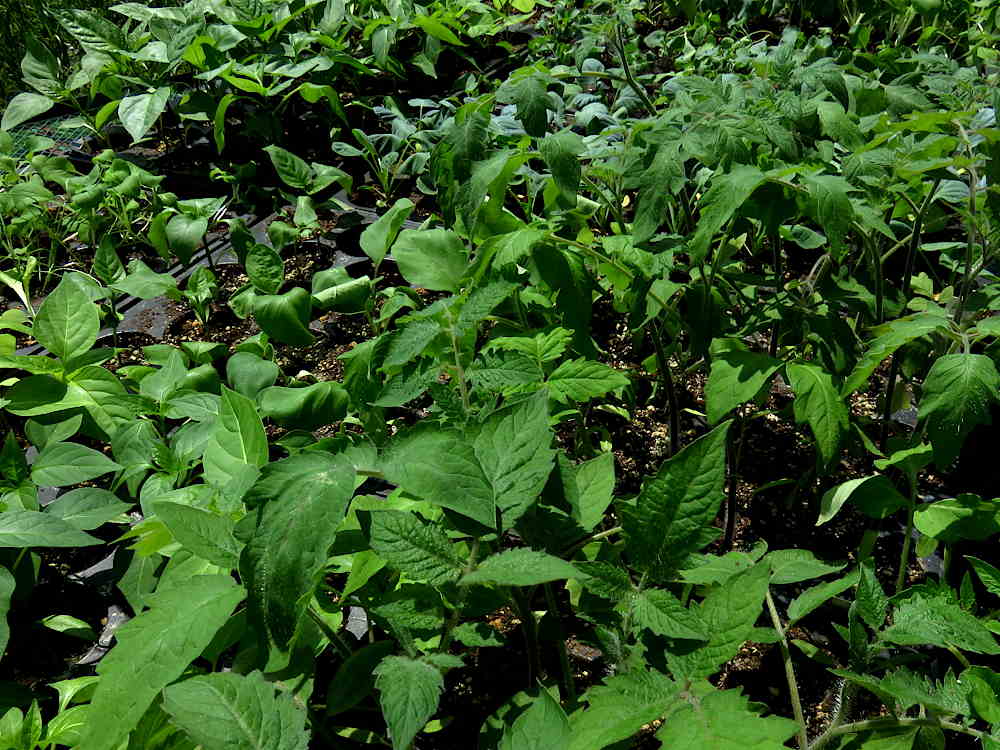
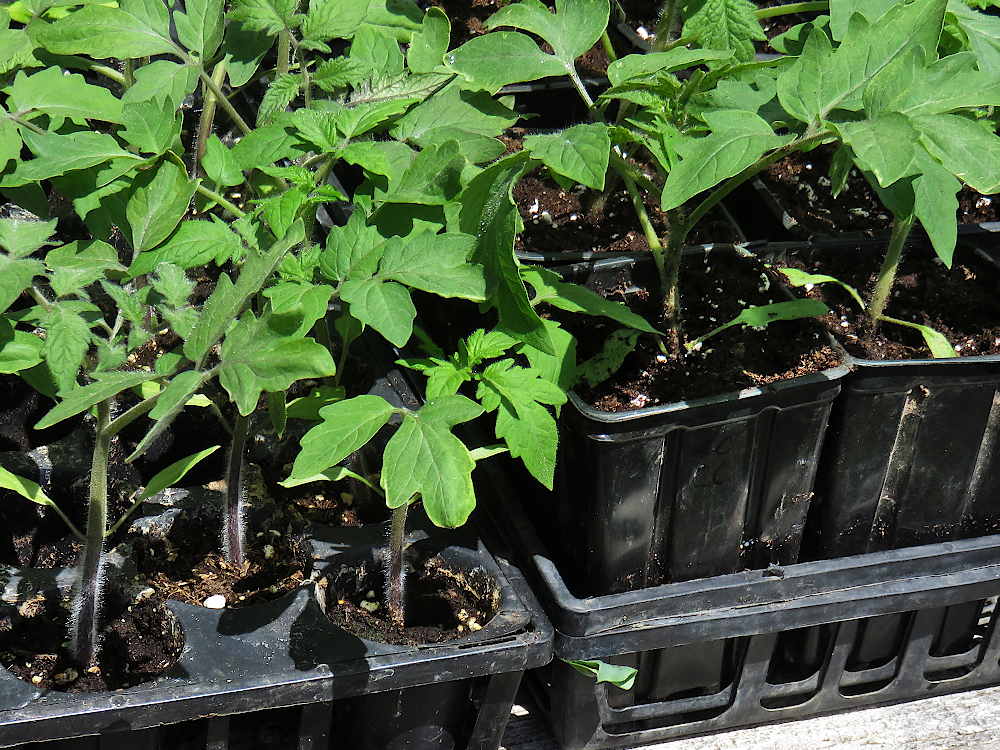
Moved the first wave of tender seedlings—100 tomatoes, plus eggplant and sweet peppers—to the greenhouse yesterday, with zero (32°F) predicted for the overnight. There’s just no more waiting, with all of the light space in the Milkhouse…taken. It’s a long way from the ambitious barely-heated greenhouse plan of February, but there’s row cover, and the new KeroWorld heater is ready for action (it’s the white box in the middle)… That’s how some plans go when you’re dealing with the WEATHER. Elsewhere in the hoophouse, I’ve let the early lettuce and mesclun blend with volunteer lettuce and arugula from last year’s early stuff going to seed. It’s unruly, tasty, and growing fast. I don’t know how much of it will make it to the farmers’ market: since there’s too much to do around here, I’m not aiming to go extra early this year (yesterday was the first market day), but one way or another, the greenhouse greens will get eaten!

Comments

Potting up

Big Beef tomatoes

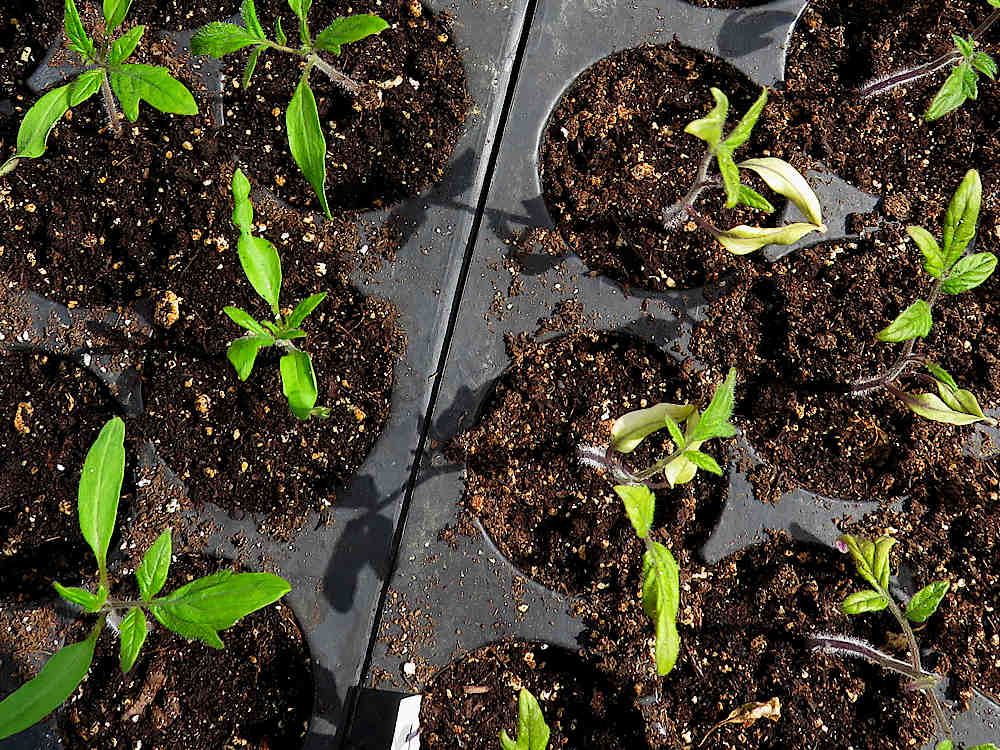
Many things are going on at once, and one of them is potting up seedlings and moving them out to the greenhouse. Already, onions, leek, parsley, lettuce, and the first trays of cauliflower and broccoli are out there, all of them hardy enough to take whatever cold comes along. What’s really going to use up space once they’re potted up are the tender tomatoes, peppers and eggplant. I’d like to’ve had them all done by now, BUT, there’s going to be a cold snap for 4-5 days starting early next week, a couple of nights may go down as low as -8°C (18°F), and I’m concerned that row cover and the kerosene heater may not be enough protection in the unheated greenhouse. So I’m waiting, potting up a few every day and finding room for them under the lights. I started with the Chosen 100, my earliest 100 tomato starts, 25 each of Big Beef (above), Juliet, Striped German and Stupice (in order, two hybrids and two open pollinated heirlooms). They’ve gone into 3″ peat pots, with a mix of peat, compost and soil, and I’m also hardening them off outside. The rest of the toms were started a couple of weeks later. They’ll move from 72- to 38-cell trays, all part of the spend-less-time-on-transplants experiments… Waiting on weather forecasts is a bit of a risky way to work, it’s really not a good idea to delay anything at this point in the year, I’ve found it’s generally better to get on with things and deal with problems as they come up, not try to second guess the future. But I have so much else to do, I’ll take the chance and wait a couple more days to finish them all…

Comments (3)

Seedlings everywhere!

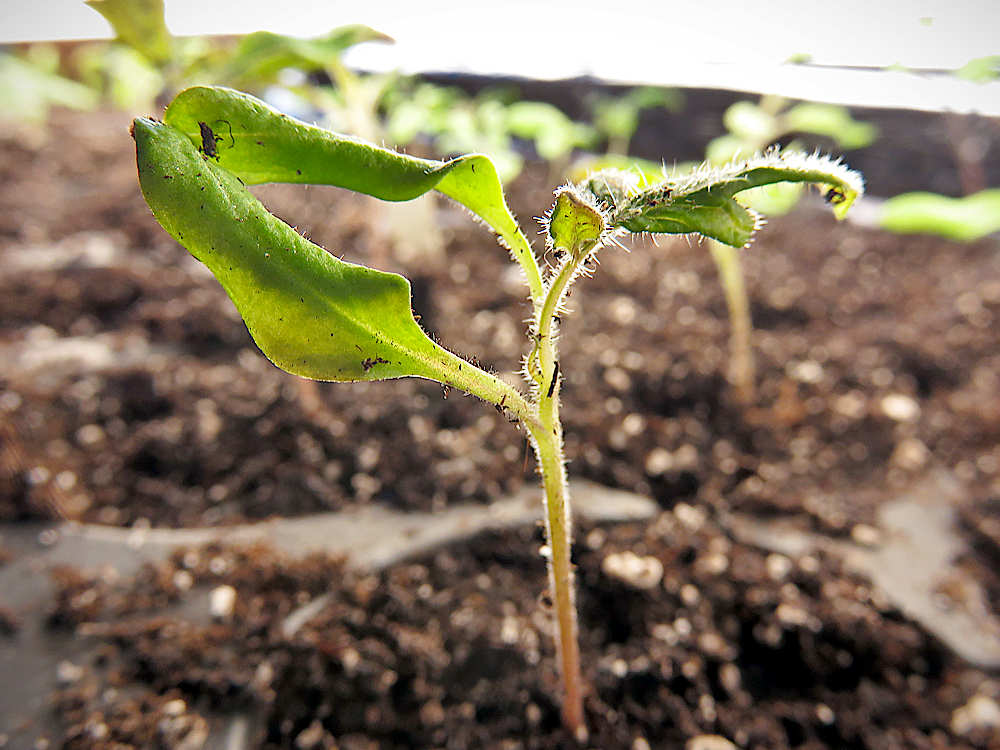
Striped German tomato seedling

Seedlings are everywhere. The first set of tomatoes is putting on its hairy true leaves: that’s a Striped German in the pic. With Lynn honing her new putting-seeds-in- plug-sheets skills today, the early seedling starts are just about done. From the top (the end of January), that includes lettuce, rosemary, leek, parsley, peppers, eggplant, onion, celery, celeriac, tomato, cauliflower, broccoli, cabbage, collards, tomatillo and Brussels sprouts. Between the Milkhouse and the greenhouse, there are about 40 trays of plug sheets going. Most have 72 cells, and there are a few 128’s and 200’s. The seedling grand total so far is somewhere around 3,000. Actually, that’s the cell total, and many have two or more seedlings per, some to be thinned or divided, or else transplanted together. So, maybe 3,500 seedlings. I’ll start a few more veggies tomorrow, another 500 seedlings on the way, and that’ll be it for now. The most ever, although the number is kinda meaningless, except as a measure of the space they take up, since one tomato will produce for the season, while a cauliflower is off with its head and it’s done… Timing wasn’t great on a bunch of the starts, I waited in some cases 2-3 weeks later than I could’ve, which means transplanting out smaller or…later. This wasn’t meticulously planned, I was just playing off the weather (cold April forecast…that doesn’t seem to be happening anymore) and not wanting to be stuck with lots of overgrown seedlings. And, I’m always trying to reduce overall seedling time by seeing how late I can go… Anyhow, it’s about five weeks to average last frost. In another week, I’ll start the last wave, the CUCURBITS: summer and winter squash, pumpkin, cucumber, melons. They go directly into 3″ pots, usually take 3-4 weeks to get to transplant stage, and absolutely want HEAT, especially, toasty soil, when they hit the field. OUTSIDE, it’s getting warm!!!!

Seedlings on plant racks

Comments (7)

Early spring rounds

spr08_lynn_seeding.jpg

A gray and gloomy, windy day…but WARM. Well, fairly above freezing for the most part, and with a little rain, yesterday’s speeded-up melting continued. But we’re still a ways off from actually doing any work in the field. So, another pretty laid-back day. Lynn came by for her weekly installment of tiny farming. Out in the greenhouse, moving tables around and some hand-watering (those barrels of snow water are coming in handy!). In the Milkhouse, more seed starting: 400 more tomatoes, and a tray of leeks (a little late for this batch, but still better than direct-seeding). For her very first time starting seedlings, Lynn seeded 19 varieties into a 200-cell plug tray (10 each, 20 of one). Clearly, I trust her…accuracy. Working in the tiny cells, changing seed every row, and keeping track of names requires a bit of concentration. A little wandering attention, and who knows what tomatoes would be growing where… Living on the edge! :)

spr08_lynn_watering.jpg

Comments (3)

First tomato: 2008

spr08_first_tomato.jpg

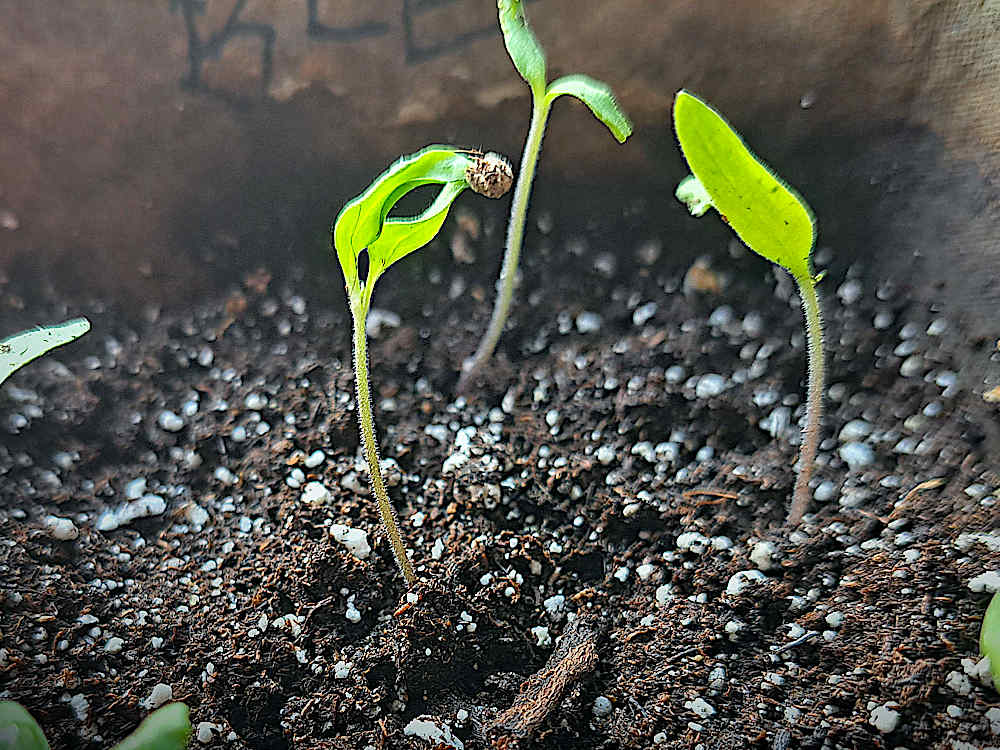
Here’s the very first tomato seedling to emerge and spread its seed leaves: a Striped German (a big, bi-color heirloom, one of my top 3-4 favorites over the last couple of years). This is six days after seeding. I don’t usually keep track THIS closely of the seedling action, but with the unusually slow, uneven emergence of most of the peppers and eggplant—new ones are still just breaking out, two weeks after seeding?I’m watching every little move right now with the toms as well. And there’s that fine MACRO feature on the new camera, always happy to take notes…

Comments (8)

Peppers!

Gypsy sweet peppers first to emerge

Another little new-season milestone: the first of the original veggie gang has appeared. These are Gypsy (hybrid) sweet peppers, seeded six days ago, along with other varieties of pepper and eggplant. They started to poke up in the last day or so, and by this morning, the first leaves had unfolded. Along with tomatoes (soon to be seeded), I think of these three—toms, eggplant, peppers—as my original crops. These are the veggies I started first (and way early) in Year 1: winter was storming along outside, while these brilliant little splashes of green were popping up in the warm, bright bubble of the first seedling room (a side room in the farmhouse). I was fascinated and kind of amazed. I used to come downstairs in the middle of the night to check ‘em out, make sure they were still alive and growing… Actually, it’s not so different even now! :)

Comments (6)

Tomato seed

Tomato seed collection

It’s sounds a little odd to call it that, but this is my tomato seed collection. A rough count says there are maybe 150 packets, with another 30 on the way with the just-completed all-heirloom tomato seed order. I’ll get a few more basics, like Juliet, in the last big general seed order, and that’ll be it for the season. Most of these are different cultivars, there are only a few…doubles. The brown envelopes are heirlooms from a small seed company. The printed packets are mostly hybrids, from my two main seed suppliers. The plastic pouches and plainer white envelopes are various seed given to me to try (I’ll generally only accept seed from trusted sources, people who actually garden and seed-save, to avoid…disease). Why so much, so many? I dunno. I don’t think of any other veggies in my seed supply as “collections” (like trading cards or tiny action figures). I do clearly remember closely looking at a fuzzy little tomato seed back in Year 1, about to start my first transplants, and thinking, “No way is this little thing going to turn into a massive tomato plant and yield 20lbs or more of big, fat tomatoes?!” (At that point, all I knew was what I’d read and seen in pictures.) It wasn’t so much disbelief in the powers of the seed, but in my ability to actually manage this obviously intense process—what a tiny seed!—to a reliable, predictable harvest. Of course, once you see it happen, it becomes…normal: clear the way a bit, and the plants do most of the work! I guess, having imprinted themselves on my consciousness FIRST, right at my gardening start, tomatoes have a mild hold on me, and I obsessively plant a few more different varieties every year. This year, there may be a more manageable 40 varieties (down from over 60 a couple years back). I haven’t finished the starting line-up yet.

Comments (10)

Stakes vs cages

Stakes and tomato cages

Every year so far, there’ve been two or three major projects that I’m sure just HAVE to be done. They’re usually EXPENSIVE (at least, expensive in the world of tiny farm finances!), which means, they take some thought. We’ve had the seedling greenhouse, excavating the pond, the Milkhouse Extension, the tiny tractor, the first full-time field hand (Conall!), and a few other steps… So far, so good. For the coming year, I have in mind a few more…important upgrades. I was reminded of one of them in the drive shed today, where the stakes used for my semi-effective semi-sprawl method of tomato support are stored, along with some of the couple hundred (largely useless) home-style tomato cages. For a while, I was dreaming of moving up to the basket-weave method—lots of twine and…weaving—although I have a hard time picturing all of that suckering getting done. What I REALLY want is BIG CAGES made from concrete reinforcing mesh…but it seems so expensive. Rough pricing: about $7 a cage times 500 cages, plus a fair bit of labor setting them up and taking them down. I know the method works well, but will it work well HERE, this year? Is it worth the money? For the same cash, I could almost build a second, production-size greenhouse. Or put more into drip irrigation. Or build a cooler for better short-term storage. Come to think of it, does growing dozens of varieties of tomato really make sense, couldn’t I just sprawl two or three big, round red varieties that would be easiest to sell…? In fact, I could grow a lot more of a lot less, cut out many varieties and entire crops, concentrate on the trendy best sellers, and get on the waiting list for an upscale farmers’ market in the big city. Top dollar! Maybe try for a bank loan for a bigger tractor (hey, there’s more acres in the garden field!) and a refrigerated truck?! If this is a (tiny) farm business, that seems to make sense: GROW! Yet somehow I’m heading in the OTHER DIRECTION. Stopping the city CSA to go local. Trying more crops and varieties every year and figuring out ways to buy stuff for them, like big tomato cages… It seems so…contrary. Which, in tiny farming, is something I guess you gotta like!!

Comments (7)

The seed…

Seed stock: Dec 2007

Keeping up with the early start, I got out the seed from its storage chest to take a look. With the tiny farm’s growing HISTORY (hey, Year 6, coming up!), keeping the seeds sorted for freshness is an ever more…serious consideration. Old seed won’t work, and there’s always lots of carryover from year to year. For this garden’s veggie selection, seed life in cool, dry storage conditions falls into three categories: nice and long (around 5 years, for brassicas, cucumber/squash family, lettuce, tomatoes,…), medium (around 3 years: beans, peas, carrots,…), and SHORT (1-2 years, for onions, corn, parsnip, parsley,…not too many here). Luckily, this is all book info, not gathered from painful personal experience! But I listen closely, ’cause one of my biggest garden nightmares is THINGS NOT GERMINATING… There are enough reasons why gazing happily on those newly seeded, semi-straight rows might be the greatest satisfaction they ever offer, and dead seed shouldn’t be one of ‘em. My first germination test last year seemed to bear out the wisdom of others: normally-stored seed is not forever… So, it’s checking packs and taking dates!

Comments (4)

« Previous entries

TFB & the Web

Locations of visitors to this page

Best Green Blogs

Home and Garden Blogs - Blog Catalog Blog Directory

Add to Technorati Favorites

Foxkeh banners for Firefox 2