
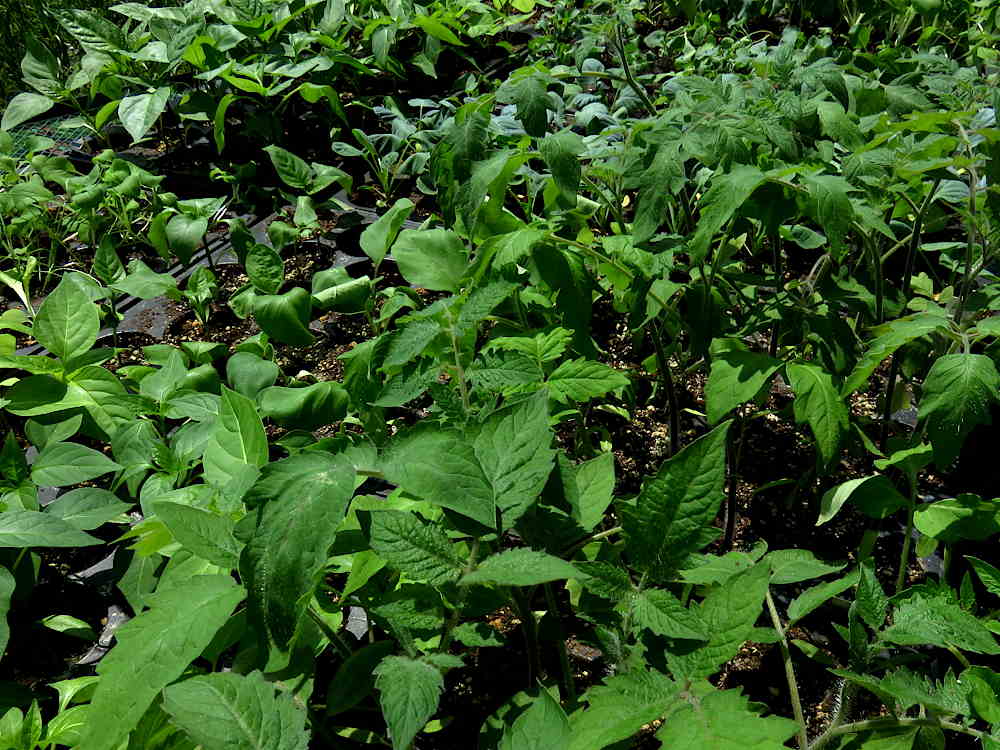
Hardening off seedlings on a mainly sunshiny day. I can see tomatoes, peppers, eggplant, Brussels sprouts, and bok choi. Some are for now, some a little down the line. I’ve been transplanting steadily bit by bit, rather than all out at one time, as a hedge against erratic weather changes. Same with direct seeding. It’s another experiment, and given our short season and the generally unpredictable weather, it’s risky. Then again, depending on the crop, I’ve seen plantings a week or two apart more or less even out. It’s always a gamble!
Brussels sprouts
Kale under cover
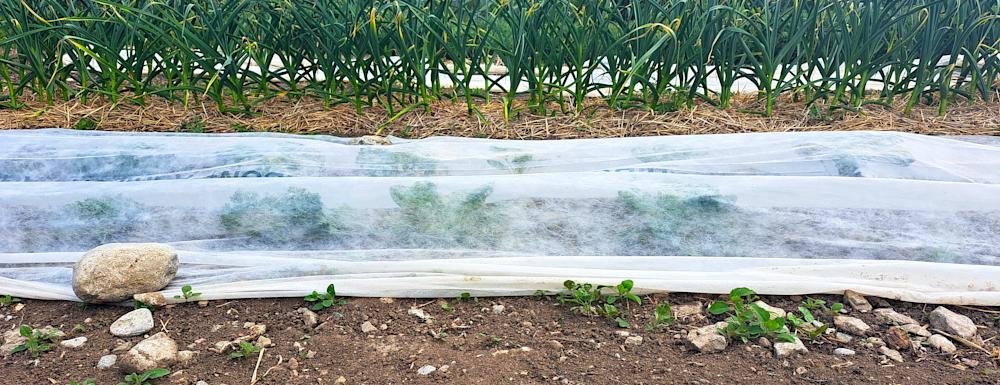
Kale and Brussels sprouts are tucked away under floating row cover (with straw-mulched garlic in the back). This is usually to protect them from flea beetles that can devour the seedlings. This year, unfortunately, it’s also a deterrent to the sudden invasion of groundhogs. Invasion isn’t the right word if we’re talking about numbers, as my best guess is that there are only two doing the damage. Their work, though, is so far somewhat alarming. They have a particular taste for lettuce; they’ve already gone under and through the cover to get a it. But in the last couple of weeks, it seems they’re out to at least sample just about everything. Since last year, and especially this spring, I’ve seen several groundhogs in the general area, which is new and a lot. Last season, there was a little veggie munching, but nothing out of hand. So, to a point, live and let live. This time around, seems like it could get more serious. As far as pests and disease, from year to year, if it’s not one thing, it’s another…
Bare root Brussels sprouts
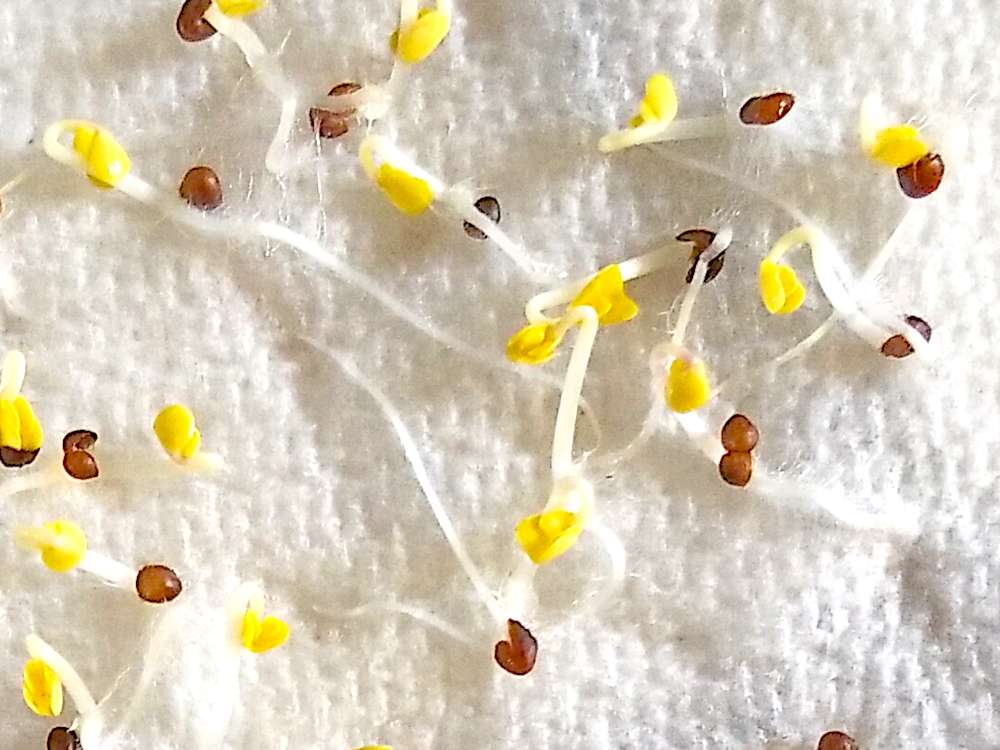
Yep, a wonder of Nature, up close. Three days or so after folding up the pinhead-sized seed in a damp paper towel, we have Brussels sprouts! Of course, this is only step one of many before we get to the deliciousness of actual Brussel sprouts. (Halved, tossed in corn meal and sautéed in butter is one way to go!)
Bare root germination like this is good for at least two things. It’s a useful germination test to see if old seed is still good. It’s also a way to start seedlings: transfer the sprouted seeds to a plug tray or pot, wait a few more days, and up they’ll pop. Let the greening begin.
The bare root approach adds an extra step compared to putting the seed directly in the plug or pot. It’s a little more work. It can be good with hard-to-germinate crops. Or if the seed is old, with a low germination rate, and you want to be sure that every plug has a plant. That it’s fun to see what’s going on is also a fine reason!
Brussels sprouts for Christmas?
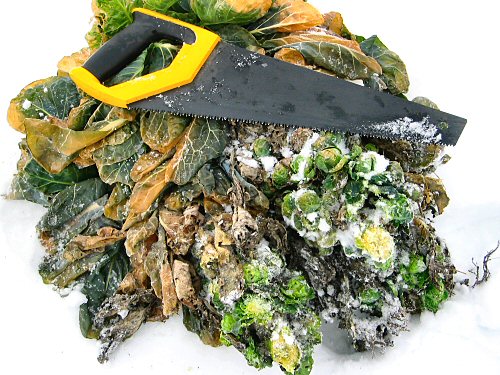
Got the idea this morning to get something REALLY FRESH onto the Christmas dinner menu. A fat local turkey, plus squash, potatoes, carrots, beets and onions from storage (in addition to a ham and industrial veggies from the supermarket) didn’t seem quite enough. But what could I find? The bed of Brussels sprouts left standing when the snow hit was…still there, not fully buried, and possibly perfectly preserved in a frozen state. Remembering a harvesting lesson of the past, I headed up the field with short, stiff saw in hand and bagged three (once again, the saw did its stuff!). Unfortunately, between the snow and the leaves, the sprouts were too well-mulched and probably never really got frozen solid, or at least, froze and partially thawed a few times. Many were damaged and discolored, but some were definitely…fine (I tasted a few raw on the spot). In the end, between the rather unappetizing, damp mass in a bucket waiting outside the kitchen, and all the other cooking to do, this time around, the good sprouts never got sorted, and it’s on to the frozen compost heap for the lot. But there’s more out there for another try… This is not exactly part of the Professional Market Garden side of tiny farming, more like my personal garden-addicted behavior, but it’s all part of learning!
Harvesting Brussels sprouts
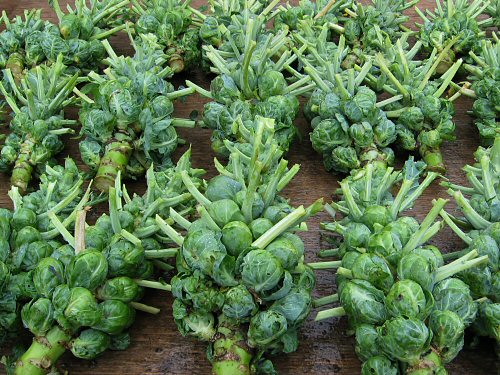
That was interesting! I’ve harvested Brussels sprouts by picking the individual heads, but for our first bigger harvest of about 60 plants, to speed things up, I decided to take the whole thing.
First try: chopping the base of the stem with the machete-like harvest knife was like hitting a piece of hardwood. Wow! Tough and cut-resistant… Next up, a sharp hatchet fared no better: a solid whack hardly penetrated.
So, we pulled ’em up, roots and all. They set in pretty good, but the main roots are shallow, so even with knocking off the clumped soil, this went quickly.
Next, we discovered that removing the roots is easily accomplished with a short, fairly rigid hand saw. Once we figured out the right starting angle, one and half strokes cut through the stems like butter: zip-zip!
Then to the harvest knife: swipe off the head, and then, holding the base of the stem, about four downward lopping strokes, rotating after each, to shear off the leaves. Kinda odd looking results, but efficient all around.
The sprouts, catching up from the summer drought, haven’t all filled out, still, a healthy yield of full-size to tiny heads from each one.
It was a completely novel, different harvest process than for all the other veggies. All the chopping and cutting was…fun!
UPDATE: The kind of odd presentation was loved at the farmer’s market—certainly said, “Fresh!”
Brussels sprouts
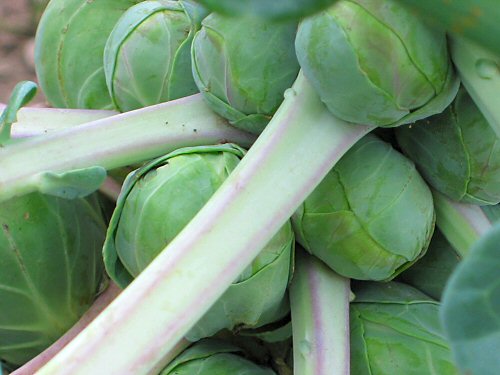
A pleasant fall surprise, at least one of two beds of Brussels sprouts (planted over five months ago) has come through! A bed each of Oliver and Jade Cross (hybrids both) received no water and looked mighty stressed and strained for all of the droughtish summer. The recent rains brought ’em back—well, mainly the Oliver, although the JC has some smallish…sprouts. A tiny harvest, still, the first Brussels sprouts for this market garden!
More hands on deck
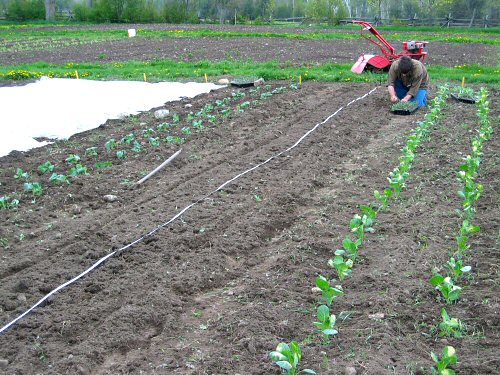
Conall, the all-new organic grower, is back after being unexpectedly called away two and a half weeks ago. That happened after we’d worked together for seven days straight. For me, making the transition from essentially solo tiny farming to having regular help was that quick. Having everything bouncing around in your head, with little need to explain it, is a luxury and efficiency of sorts. On the other hand, if you have people who you can sync with, sharing the gardening in an ongoing way seems like even more fun. And you can grow MORE STUFF with LESS WEEDS!! :) It’s a really welcome return. FREAK FROST: Three nights ago, according to the min/max thermometer, the temperature bottomed at a little below 0°C (and there was no reported cold snap or hard killing frost), but some of the brassicas (Brussels sprouts—see the whitish spots on the leaves on the right of the pic, bok choi, cauliflower) and two out of three varieties of peas got fairly toasted, burnt by the cold. Many of the pea leaves were totally killed off. I only noticed the extent of the brassica damage when we took off the row cover today. This is something I’ve never seen, and Bob, with 40 years of farming, hadn’t either, especially with peas, which can grow in the snow. The additionally odd thing is that some varieties (one of the peas, broccoli) weren’t affected at all. These are all plants that can normally take an overnight freezing and bounce back no problem—temperatures around zero should be nothing. Weird. My random theory: a very rapid temperature drop, many degrees in a few minutes, that didn’t give the plants enough time to adjust…? Anyhow, everything’s recovering just fine! The crazy weather effects continue…