
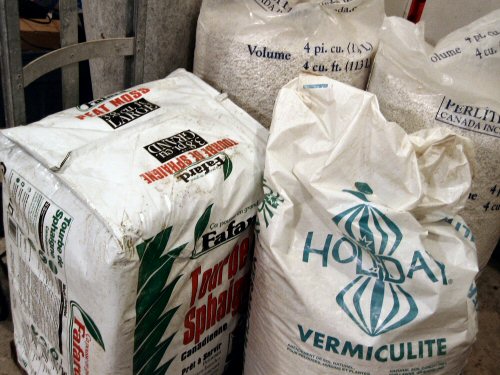
My late winter farming friends: perlite, vermiculite and peat moss, the raw ingredients for a standard seed starting mix. For most veggies and herbs, I mix all three in equal parts, although a combination of any two would likely do as well. It’s soilless (no bacteria, sterile), holds water well and allows oxygen to get around…all a seed really needs in the way of ground to get started.
Year: 2007
As winter as it gets…
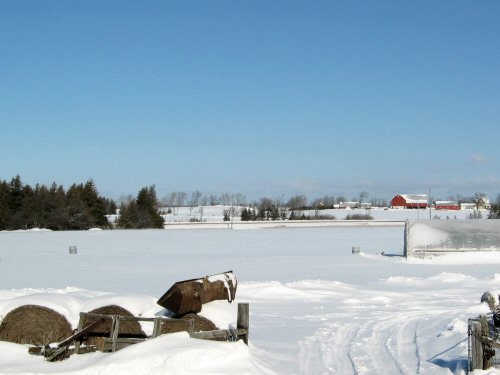
This is, I guess, the new look of winter. The barrels in the field are barely half covered, compared to the three or four feet of snow that accumulated by this time only a few years ago.
Roof is working out
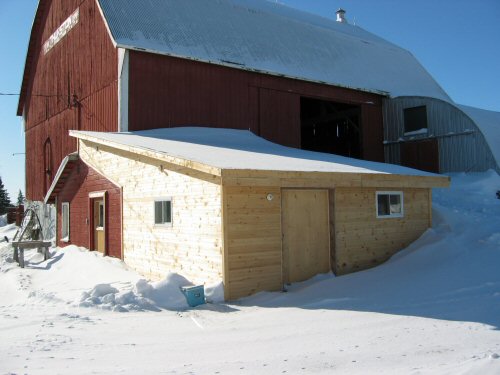
Here’s the barn with the new milkhouse extension, doing fine. We were slightly concerned that the slope of the new roof might be too shallow for snow to slide off, particularly with roll-off from the roof of the barn. The starting point was determined by an existing heavy cross beam in the barn, while the next beam is halfway up the wall – sloping the roof from there would’ve required tons of extra work and materials. As it is, it seems to be working out. Not having much snow or much of a winter at all helps. I doubt the sky will be falling in!
Rosemary revival
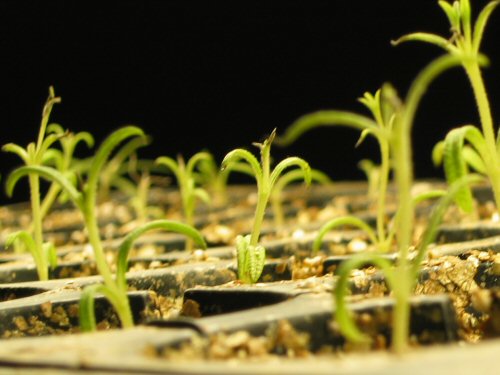
A little experiment in vegetative propagation—replicating rosemary from tiny, stressed cuttings. Most of the potted rosemary taken up from the herb garden last season got toasted after too many -20°C nights in the unheated greenhouse (a bit of a random how-cold-can-they-go experiment). These tiny cuttings came from one that was taken indoors earlier. They’re kinda frail and stretched from relatively low light (etiolated is the typically uncommon technical term). They’ve already been three days in the tray, let’s see how they do. (Fast forward to…results!)
Lettuce begins
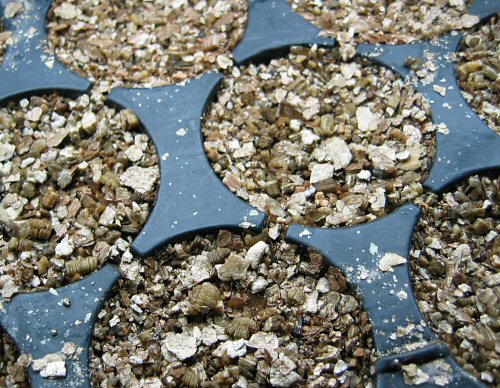
This is what lettuce looks like when it’s just getting started. It’s the standard seed starting mix in action! Yet another off-season image from the microfarm. :)
Lettuce overnight
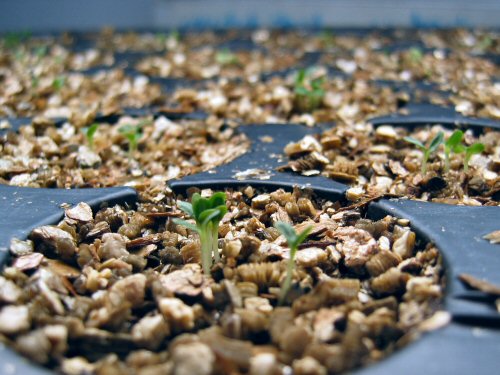
The first lettuce pushed up overnight! Here, lovely red Granada, an Oakleaf-type leaf lettuce that intensifies into a deep burgundy as it matures. Also in trays, Sierra, Simpson Elite, Two Stars and Red Salad Bowl. Now, how early will they be ready for market (the farmers’ market kicks off the first Saturday in May…)?
Tiny Farm Bookshelf, Part 1
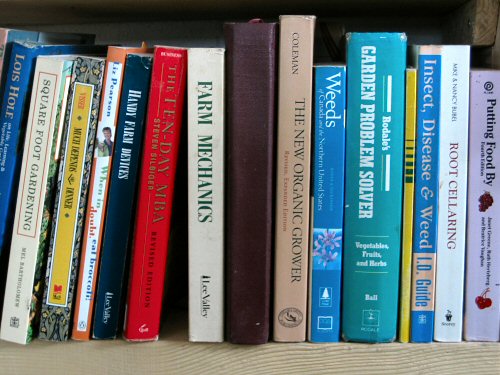
This is about a quarter of my farming bookshelf. I get a ton of info from the Web, particularly in winter when I have more time to cruise around online, but books I’m still most fond of. Let’s see what we have…
For one-stop shopping, you could take Rodale’s Garden Problem Solver and a bunch of seeds and that’s all you’d need to get started. This book wasn’t an early acquisition, I think I got somewhere into my first year, but it’s turned out able to answer just about every organic production question I’ve had, from cultivation to irrigation. It’s a little sun-bleached from trips to the field. And then, The New Organic Grower is probably required reading if you’re selling what you grow: practical and also kinda inspiring on the microfarm marketing side.