
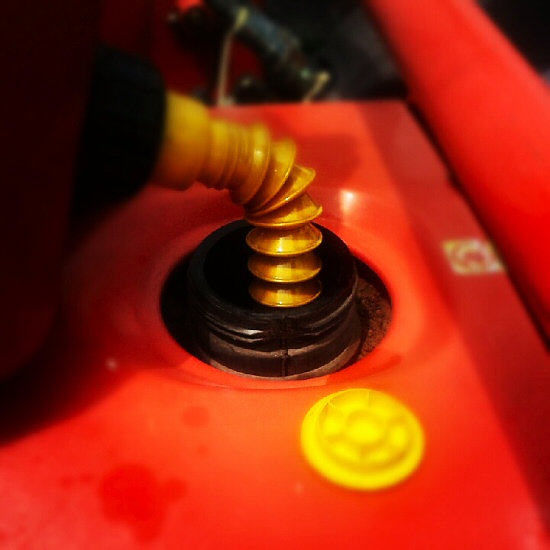
Always satisfying to fill up the Kubota compact tractor. A little under five gallons of diesel does the trick. It’s quite amazing what you can do on just one tank, like till up 2-3 acres with fuel to spare. Depending on what’s going on, I’ll use somewhere between three and six tanks in a season, so for the amount of work the tiny tractor does, the oil-reliant portion of the program is really kinda small.
fuel
Bus stop
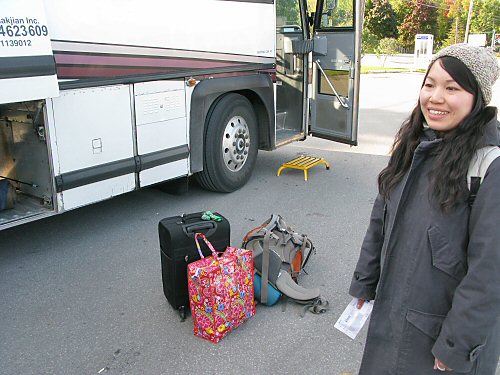
We drove Toshiko to the bus stop in town this evening. After her two weeks on the farm, trimming garlic, digging sweet potato, slinging veggies at the farmers’ market, she’s heading out again, first to Toronto and then Montreal for a few days of sightseeing, then on to the southern US and Mexico for the winter. After that, she plans to continue studying English in Vancouver for an extended period, before heading back to Japan. With the WWOOFers of the last couple of seasons—from Japan, Germany, Spain—there’s definitely been an international flavor on this very local, tiny farm. It’s fascinating to think about how far these hands have come, to do simple tasks in a field for a while, then vanish down the road. As a non-driver, growing veggies full-time for sale very nearby, I have minimal direct involvement with travel. But its effects are all around and often on my mind. I find myself calculating the distance people drive to get to the farm or the farmers’ market. I’m alert to the increasing number of Mennonites clop-clopping by with horse-and-buggy. I think about the routes traveled by the tools and supplies I pick up at the big chain stores in town. I sometimes imagine leaving the farm, on my own and without driving, catching the once daily bus that would plug me back into the world of cities (at least two-thirds of the PLANET now lives in cities!), where travel is condensed to nothing. Standing with Toshiko at the bus stop today kicked up a lifetime of memories of big city living, the oddness of flying across an entire ocean in a few hours, sometimes with hardly a day’s notice and not a second thought, and then the last few YEARS spent tending a tiny patch of FIELD, barely moving beyond a single line of sight. Hmmm… What a wiggly world. :)
Measuring peak oil by the can
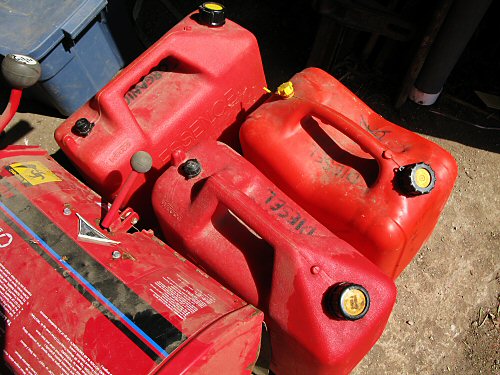
This tiny farm’s entire direct connection with the world of oil is simple: six red, 20-liter gas cans, three for gasoline, three for diesel. It’s a really stark way to watch spiralling gas prices and the so far bubbling-under peak oil panic, made more so for me because I don’t drive (never bothered to get a license), and I’ve lived 100% in big city cores until the farm—North America’s deep-set gas station culture had been a spectator thing for me. And now, gas is suddenly connected in a very straight-flowing line, from pump to a handful of tiny farming tools that perform clear and specific tasks. On the gas side, there’s the riding mower (mowing, mulch collecting, hauling stuff in trailer, used a lot), a walking rototiller (only moderately used since the wheel hoe last year), the pond irrigation pump (with so much RAIN, not used at all this year!), a weed eater (used only moderately), and another weed eater converted into a mini-cultivator (seldom used). On diesel: the Kubota compact tractor (rototilling, moving stuff with the front-end loader, quite used). That’s it! I filled three cans in mid-April, two diesel, one gas (above), today, two months later and all out, I filled two more, one of each. In my five years of tiny farm experience, cost has gone from $15 a can of gas (and quite a bit less for diesel), to about $30-35 a can (with diesel more expensive?!). It’s worrisome, but I don’t get too agitated, probably because the containers are so few and so relatively SMALL. But every time I’m tilling on the Kubota, or driving the length of the field loaded down with harvest and gear, I’m increasingly, acutely aware of the amount of work that comes out of a little gas, and what the manual labor alternative would be like. It’s like a little calculator program running in the back of my mind: how long would it take me to do this by hand? How about with help? What would it be like to do without? I feel great satisfaction when the six cans are filled and set in the drive shed all in a row: supplied for…a while! Of course, gas figures big in getting to the market and getting to town, and I pay my share there (I have an arrangement with Bob for the market season, and for the rest, I get lifts when others are going where I need to). And I also never forget how all those store shelves get filled. And how people get to market, pick up CSA shares, get to the farm. And I’ve started calculating highway mileage to reimburse everyone who volunteers here for their travel. Not to mention all the flying and driving it takes WWOOFers to get here from far and wide. And so on… Oil is everywhere, not easy to avoid or make sense of. At this point, for me, it still comes back to the cans: the color of oil is RED… :)
Global as gas
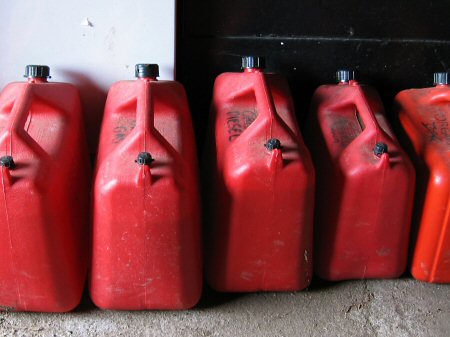
Red plastic gas cans connect the Tiny Farm to the global economy! Some for gas and some for diesel, take care not to mix ’em up.