
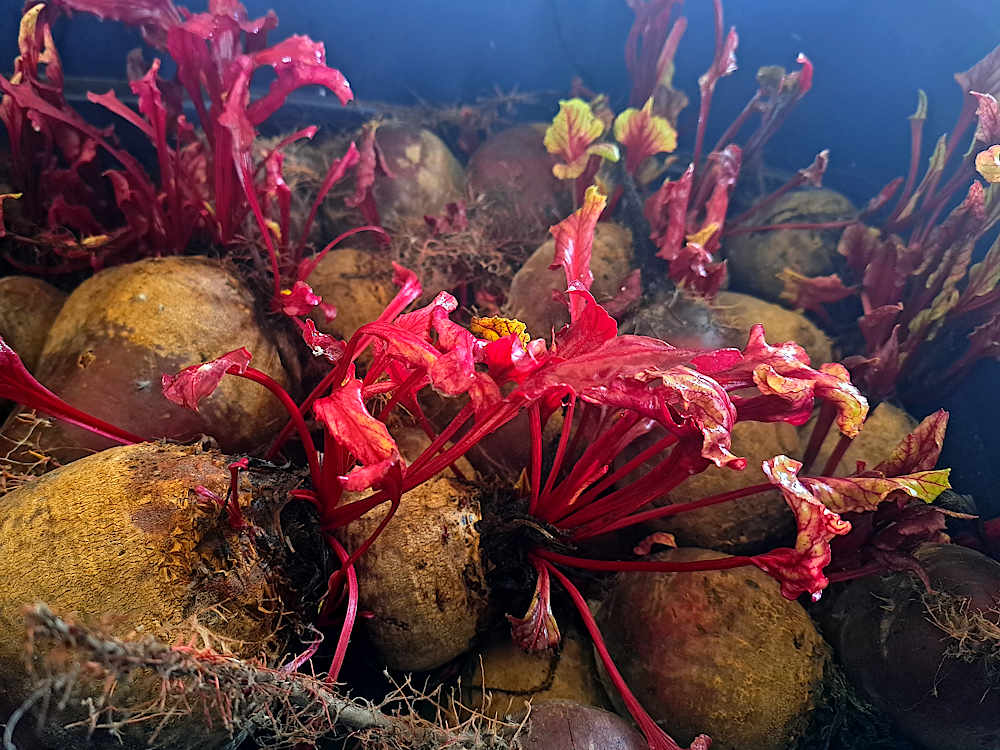
Beets, harvested last fall, stored for six months in a covered bin in a cool room, have been busy growing in the dark. This is a familiar early season sight, there are always leftover beets from last year. They’re still firm and tasty, though a lot less sweet. The new growth has a nice crisp texture and a slightly sweet, beet-y taste, what you might expect! They’re headed to the compost heap, part of the spring clean-up. You could call it wasted food, but I think of it as recycling.
storage
Stored carrots for stew
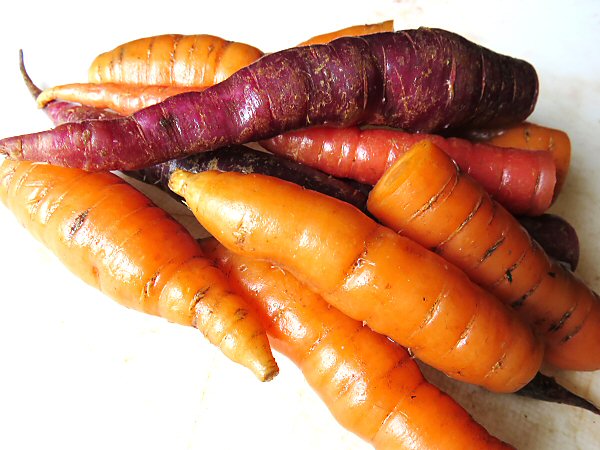
Long-term veggie storage can get fairly involved, with root cellars, sticking things in piles of sand, adjusting humidity, spotting and culling the spoiled, that sort of thing, or it can be as simple as tossing a plastic bag of small carrots, little guys that wound up at the bottom of an empty market bin, into the fridge’s crisper drawer, and forgetting about them until they’re found four months later while rooting around for ingredients for stew. These carrots represent exactly the latter, a few handfuls of Nelson (orange), Red Samurai, and Purple Sun. They’re in perfect shape, crunchy and tasty—the plastic bag maintains the humidity that keeps them hard—so a quick rinse, chop-chop, and in they go. (They’re partly cut because I’d already started slicing them when I decided to take a pic.) Another whatever-veg-is-around beef stew. What could be simpler?!
Seed store
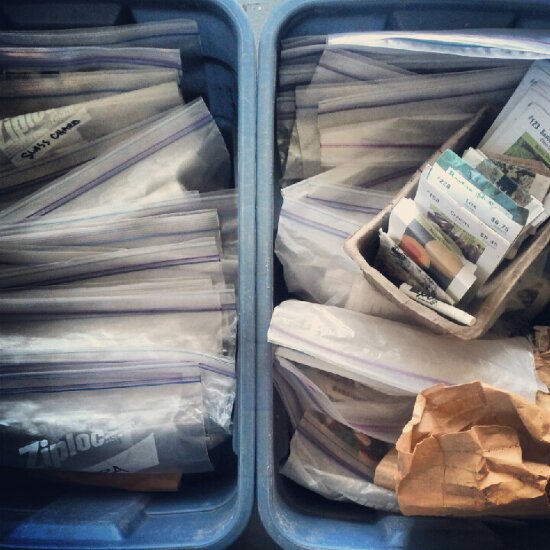
My current seed bank is around 60 Ziploc freezer bags. In alphabetical order. I haven’t been as careful lately with storage conditions as at times in the past, these plastic bins with lids (there is third one with bigger bags of larger seed, like beans and peas) are kept out of sunlight and away from heat. I could do a lot more, but I’m not going for long term storage, and most of the time there seems to be no critical difference in germination time and rate for seed 1-2 years old, which is the longest I keep anything in any sort of quantity. Fresh seed may pop up a little quicker, but with the many other variables based mainly on the weather, it all seems to even out by the time harvest day rolls around!
After market
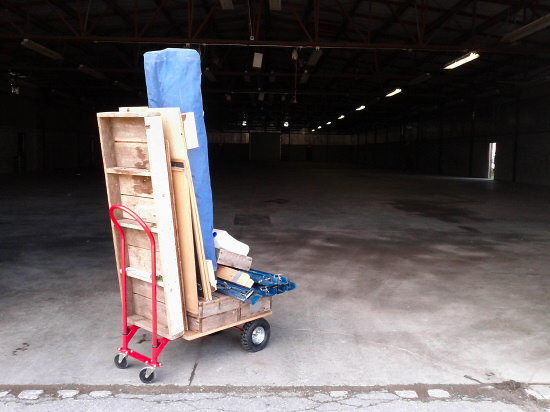
Around 1:25 p.m. and it’s just about time to head out from the farmers’ market, which officially ends at 1. This season, we’ve been storing the entire farm stand in the communal cage where vendors can leave stuff from Saturday to Saturday. The stand is quite the compact set-up, once it’s torn down and stowed away…efficiently. On the dolly, there’s the 10’x10′ E-Z UP canopy, half a dozen folding metal sawhorses and the plywood boards that turn them into tables, a pair of chalkboards, rough cut cedar display trays (a strip of four, and singles), pieces of 2×4 used to prop up the trays, and a plastic water jug used as a canopy weight (we normally have four, but this year we’ve been lashing the canopy legs to one of our neighbors, so weighting the four corners isn’t necessary). The only thing missing, besides the veg, of course, is our market box, which is a bin containing scales, bags, signage and so forth. Most farms come to market stand and all, as we did until last season’s start of…commuter farming—living off-farm—when logistics made leaving this gear at market a lot simpler. Anyhow, this huge exhibition hall houses the indoor market on Saturdays, November through April, and the big parking lot outside is where the summer outdoor market is located. The cage, a chain link fenced corner, is out of sight to the right. And that’s just about ALL the details. :)
Winter storage
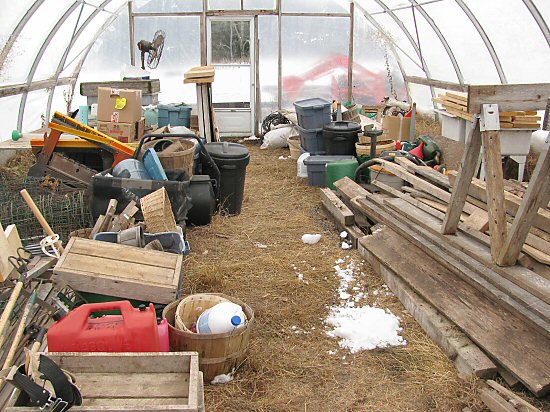
Snow’s here—it’s definitely overwinter storage time! Winter storage is a little different every year, as needs, facilities, and plans change. This time around, a fair bit of gear is in the 20’x32′ (~6×10 m) hoophouse, with its full sun exposure and fairly extreme temperature spread (from double-digit subzero at night, to 80-100°F/25-38°C on a sunny day!). Sooo, you don’t want to be storing just anything in there. Anything that’s damaged by freezing isn’t a good idea. And plastics that aren’t UV-resistant will break down, fading and weakening (really, most plastics not meant for constant outdoor use should probably be kept out of the sun whenever possible). Here, it’s mostly wood—extra rough cut cedar from a project a couple of years back, tomato stakes, tables, farmers’ market display trays—which is OK, and I’ll get the plastic items under cover. Except for checking the snow load on the hoophouse after big storms, that’s all she wrote until early spring. The outdoor part of veggie farming in our growing zone will now take a bit of a snooze…
Chickens, frozen
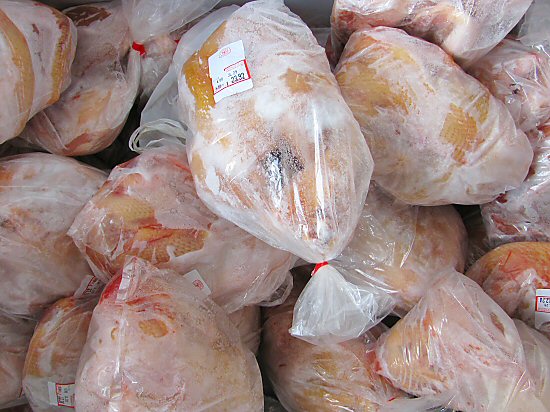
There they are: 38 newly processed chickens, freezing solid in the chest freezer (39 minus the one we took to roast fresh). It’s the last stop before the table on what was a pretty fine meat bird run.
Like everything else on the tiny farm (and in life in general!), when you get down to freezing chickens, there are the details. What I noticed this year is the amount time it takes to actually freeze chickens solid. This wasn’t quite as apparent last year, when we started with under 20 processed birds. Here, checking out the new freezer’s manual, I loosely followed the advice against freezing too much at once. I put in half, around 20 chickens, for a few hours, then added the rest. I’ve also been rotating them—they freeze faster when they’re exposed—but after a day, they’re not all rock hard.
I have it in mind that the faster you freeze stuff, the better it is when you thaw it out: firmer, not mushy. Something about smaller ice crystals doing less cellular damage. Sounds plausible to me!
Luckily, the chickens came heavily pre-chilled from the processing house. Processing your own in any sort of quantity, I imagine you need a fair bit of refrigerator space to cool them down, or a walk-in cooler, or lots of chest freezers. Another thing to look into for…the future!
Of course, the whole freezing thing is another puzzle. It’s quick and easy, and works really well for all kinds of food. Newer chest freezers seem quite energy efficient: this 15 cu ft one uses 400 kWh a year, which is like keeping a 60W lightbulb on for 9 months (at current electricity rates around here, that’s about $50). Doesn’t sound so bad, and there’s room for lots more in there. Still, we’re trusting a lot to yet another plug…
FINALLY, there’s the sticker, another fine feature of commercially-processed chicken. The meat is Ontario government-inspected (a provincial inspector is always on-site, that’s the law), which is indicated by a little logo on the label. Plus you get the date, weight down to two decimal places of precision, AND a price-per-pound of your choice. I picked $4. These birds are for our own use—not for sale—but it’s always fun pulling out an EXPENSIVE farm chicken for dinner, as long as it’s priced kinda within reason…
Drive shed clean-up continues
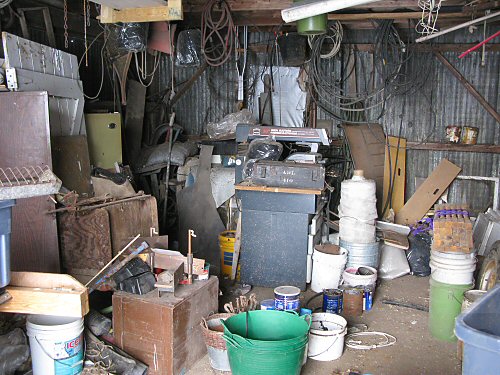
You can see the back wall! The fairly massive, once-in-a-century farm clean-up continues, and the two-floor drive shed, home of a million parts and pieces of not-junk, is an action center. I can’t imagine how one could capture a real feel for all of the stuff that was in there, you had to poke around and experience it first-hand. It was literally packed to the rafters with EVERYTHING. There were all sorts of shelves, racks, parts drawers, crates, boxes, a couple of decommissioned fridges used as storage, stuff hanging off endless nails and hooks, and much of it in murky half-darkness. All of that is being slowly and carefully peeled away. The superficial mess of tiny farming gear from a couple of weeks back is long sorted out. And as cluttered as this one corner still looks, that’s nothing compared to what was there even a few days ago. What impresses me now is not seeing, but FEELING the amount of life and time it’s taken to accumulate all of this, through having built and fixed so many things, with unexpected parts and tools that’ve magically appeared out of there. This is the history of a generations-old family farm recorded in its spare parts, methodically being unravelled… The whole clean-up is fascinating and kinda awesome to observe, in a low-key, mildly melancholy, wheels-keep-turning way… Life on a farm!