
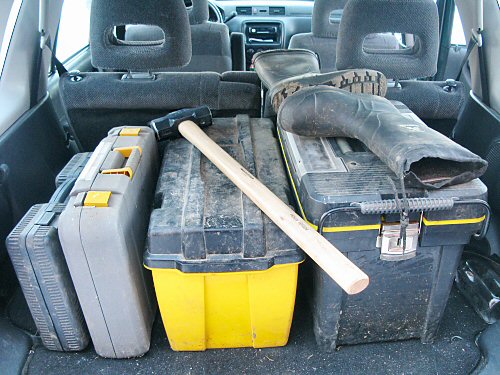
The plan was to spend tomorrow at a nearby, soon-to-be tiny farm, helping build a winterized seedling room in the barn. Day 1: a little demolition and clean-up. This didn’t work out because of a snow storm warning, so after an overnight visit to a nearby town, we returned and I unpacked. False start. Still, this was another mini milestone for me, a first, loading up my tools for an off-farm job! This is all gear assembled bit by bit while working on projects here on the farm, guided by the tools I’d borrowed from Bob. Every purchase, I knew exactly what it was for and how it would come in handy again. Although I’m far from an experienced rough carpenter/farm fixer, choosing tools yesterday made me realize how much I’ve learned. The feeling of place and context really struck me, how the little memories of using each tool tied into the overall tiny farming fabric. It may seem ODD to be celebrating such basic stuff, but it reminded me how unsettlingly disconnected things can get: the job you go to every day, the weekend shop project at home, the weekly grocery run, endless other routines that have no real connection to each other, except in your head. Not like on the tiny farm, where one thing leads another… Hmm. :)
travel
Bus stop
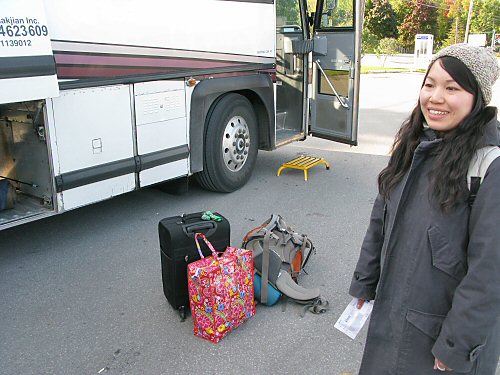
We drove Toshiko to the bus stop in town this evening. After her two weeks on the farm, trimming garlic, digging sweet potato, slinging veggies at the farmers’ market, she’s heading out again, first to Toronto and then Montreal for a few days of sightseeing, then on to the southern US and Mexico for the winter. After that, she plans to continue studying English in Vancouver for an extended period, before heading back to Japan. With the WWOOFers of the last couple of seasons—from Japan, Germany, Spain—there’s definitely been an international flavor on this very local, tiny farm. It’s fascinating to think about how far these hands have come, to do simple tasks in a field for a while, then vanish down the road. As a non-driver, growing veggies full-time for sale very nearby, I have minimal direct involvement with travel. But its effects are all around and often on my mind. I find myself calculating the distance people drive to get to the farm or the farmers’ market. I’m alert to the increasing number of Mennonites clop-clopping by with horse-and-buggy. I think about the routes traveled by the tools and supplies I pick up at the big chain stores in town. I sometimes imagine leaving the farm, on my own and without driving, catching the once daily bus that would plug me back into the world of cities (at least two-thirds of the PLANET now lives in cities!), where travel is condensed to nothing. Standing with Toshiko at the bus stop today kicked up a lifetime of memories of big city living, the oddness of flying across an entire ocean in a few hours, sometimes with hardly a day’s notice and not a second thought, and then the last few YEARS spent tending a tiny patch of FIELD, barely moving beyond a single line of sight. Hmmm… What a wiggly world. :)
Measuring peak oil by the can
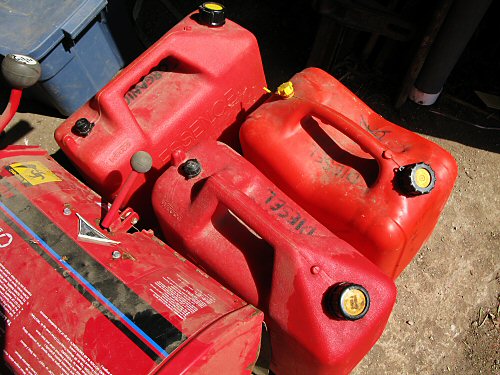
This tiny farm’s entire direct connection with the world of oil is simple: six red, 20-liter gas cans, three for gasoline, three for diesel. It’s a really stark way to watch spiralling gas prices and the so far bubbling-under peak oil panic, made more so for me because I don’t drive (never bothered to get a license), and I’ve lived 100% in big city cores until the farm—North America’s deep-set gas station culture had been a spectator thing for me. And now, gas is suddenly connected in a very straight-flowing line, from pump to a handful of tiny farming tools that perform clear and specific tasks. On the gas side, there’s the riding mower (mowing, mulch collecting, hauling stuff in trailer, used a lot), a walking rototiller (only moderately used since the wheel hoe last year), the pond irrigation pump (with so much RAIN, not used at all this year!), a weed eater (used only moderately), and another weed eater converted into a mini-cultivator (seldom used). On diesel: the Kubota compact tractor (rototilling, moving stuff with the front-end loader, quite used). That’s it! I filled three cans in mid-April, two diesel, one gas (above), today, two months later and all out, I filled two more, one of each. In my five years of tiny farm experience, cost has gone from $15 a can of gas (and quite a bit less for diesel), to about $30-35 a can (with diesel more expensive?!). It’s worrisome, but I don’t get too agitated, probably because the containers are so few and so relatively SMALL. But every time I’m tilling on the Kubota, or driving the length of the field loaded down with harvest and gear, I’m increasingly, acutely aware of the amount of work that comes out of a little gas, and what the manual labor alternative would be like. It’s like a little calculator program running in the back of my mind: how long would it take me to do this by hand? How about with help? What would it be like to do without? I feel great satisfaction when the six cans are filled and set in the drive shed all in a row: supplied for…a while! Of course, gas figures big in getting to the market and getting to town, and I pay my share there (I have an arrangement with Bob for the market season, and for the rest, I get lifts when others are going where I need to). And I also never forget how all those store shelves get filled. And how people get to market, pick up CSA shares, get to the farm. And I’ve started calculating highway mileage to reimburse everyone who volunteers here for their travel. Not to mention all the flying and driving it takes WWOOFers to get here from far and wide. And so on… Oil is everywhere, not easy to avoid or make sense of. At this point, for me, it still comes back to the cans: the color of oil is RED… :)
Not THAT cold…
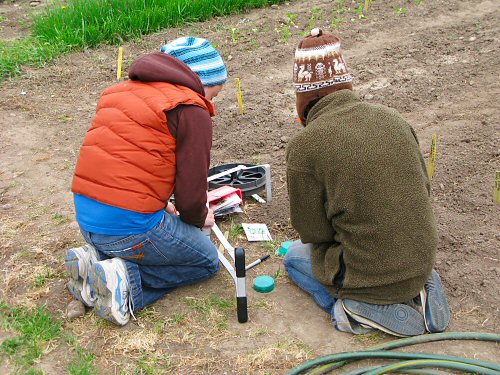
It’s not really as cold as the picture might make it look, but May continues to be an overall chilly one. The hats and extra layers are more a personal preference, but I’ve been wearing a lined flannel workshirt over my regular clothes much of the time. Here, as Lynn and Shannon sort seed for numerous smaller plantings in the herb garden, it’s about 60°F (15°C), cloudy and the kinda damp that can give you a shiver if you’re not a little bundled up. Shannon, sporting an illustrated, ear-flapped cap brought from her travels (it gets cold, especially at higher altitudes, even near the equator), has been back in Canada for less than a month after spending two years on farms in Central and South America, and is still getting used to the local weather. Lynn, in hoodie, vest and classic Canadian cold-weather headgear, was just…chilly! The slowdown in both crop and weed growth from the cold is quite noticeable, still, things are definitely moving along now… Weed watch, and the start of serious WEEDING, is on…
Chickens arrive!
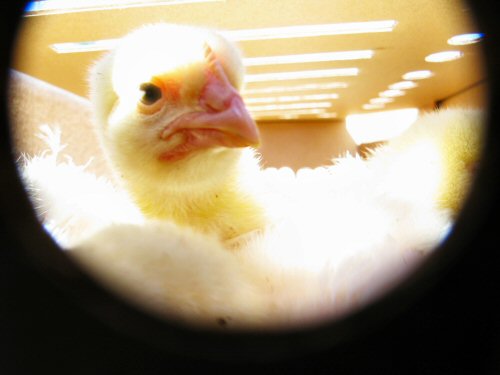
That was fun! Picked up the CHICKENS, wood shavings, and starter feed mix at the feed store. On this beautiful, sunny day, the airy, skylighted boxes looked like a deluxe place to be for a traveling chicken. Back on the farm, wood shavings were spread and waterers filled, and then the two-week old chicks were let loose. I lifted around 20 out by hand, a start on getting to know the guys. There are 50 in all (though I forgot to do the official count while unpacking), 40 White Rock Cornish X and 10 Frey’s Special Dual Purpose cockerels, all healthy, energetic, pretty much same-sized and apparently happy, running around like maniacs, jamming themselves into intense corner huddles, and PECKING AWAY at the feed and everything else in sight…
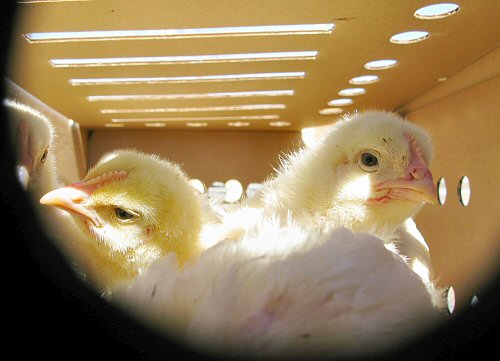
Yes, right from the airhole view, they’re definitely entertainment! I could watch ’em for hours (and, sorta, did…could’ve been tilling…). Chickens…
Off to market…
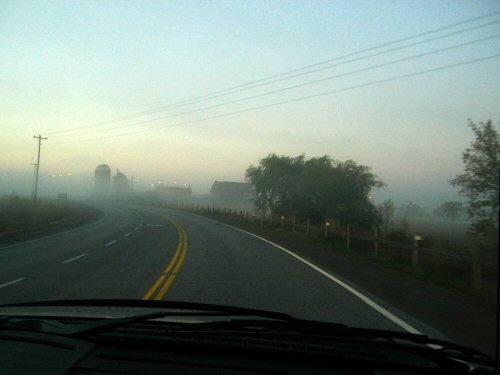
Early Saturday from May through October, just before 7 a.m., I’m heading down the road with Bob, making the quick 12 mile (19 km) hop to the farmers’ market in the center of town. Up at 5:30 after only three or four hours sleep, I’m generally a little groggy, and the drive is a pleasantly dreamy trip through peaceful farm country. Once in a while, though, a sharper awareness breaks through. We pass a farm that’d been turned into a seniors retirement home as a way to survive. We travel through a rapidly increasing number of adjoining farms, thousands of acres of them, bought out in the last couple of years by the Mennonite community—the continued farming is great, the seemingly monolithic takeover somewhat unsettling because it’s to me an unknown. The last farm on the way in to town is owned by the municipality and waiting for demolition. You can see the silos and buildings outlined in the fog ahead, right beside the lights of the new, low profile, high tech superprison that’s probably a bigger full-time employer and overall economic force than all of the farms on the drive put together. In the wrong frame of mind, I can really feel the decline-of-farming statistics I read about, and everything seems totally out of balance and more than a little surreal… Luckily, the farmers’ market is always fun!