
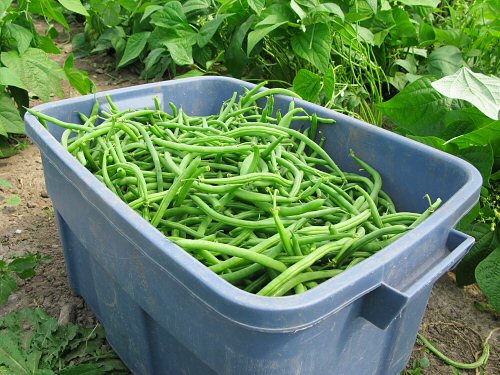
Just a few sunny days and the new planting of snap beans have sized up perfectly for the Friday harvest. They’re the crop of the week, a shade on the young side, maybe 2-3 days from being fully filled out, super-long and slender, with firm, thin pods (compared to the sturdier skins of the slower-growing first set), and only a hint of the actual bean inside. Cool! Because everything is fresh-picked on Fridays, regardless of when the “perfect” picking day may’ve been, it’s interesting to see what the luck of the draw brings to certain crops. These beans are an example. By being a little early, I lose a bit of yield, maybe 10-15%, but the beans are at that elusive, slightly young stage. Mesclun may reach that perfect first cut, when the leaves are still mild-tasting and almost melt-in-your-mouth, on, say, a Monday or Tuesday, and, especially if there’s sunny weather, grow past it by the Friday—still excellent, but a little firmer and stronger-tasting. Same for some of the fastest growing summer squash, like the zucchinis, which can practically double in size in 4-5 days. I’ve found the picking window for tasty veggies is usually quite forgiving for even the fastest growers, at least a week in summer and longer in the fall. As always, it’s mainly about the weather: how much heat, sun, and moisture they get. Since I’m not harvesting or sorting for uniformity—I don’t NEED carrots of a certain length and diameter and so forth—there are no worries on this front, and it’s fun to see and eat the variations of each crop and planting at each harvest all through the season….
yield
Seed ordering sanity
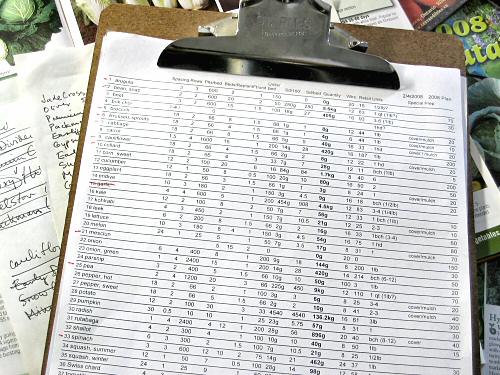
The first main seed order is finally done. There will be one more in a week or two, and then I’ll be set for the season. Working out the order was relatively painless, it does get easier every year, but without this handy Seed Quantity Calculator, my head would still be spinning. There are at least 65 different veggies, herbs, and flowers, and must be well over 200 varieties overall (wow, hard to believe when you add ’em up). It’s a lot to piece together.
Of course, I could REDUCE. That’s a whole other story (and then there’s the hybrids/seed-saving issue), but basically, I think variety is a great thing on all levels, so instead of reducing, I resist the urge to add more. For mainstay crops like green snap beans, I’ll try at least 2 or 3 similar varieties to see how they perform in this particular field (depending on conditions, the differences can be quite big). And you’ve gotta Try New Things, grow a little okra, some Jerusalem artichoke, LOVAGE, a row of tomatillos, and…lots more—even if a crop’s not exactly popular (self included), we can all learn! Crops, cultivars, there’s a lot of seed to choose from… And it gets more complicated.
On this tiny farm, where plantings are measured in multiples of 50 row feet, not in acres, the catalog price breaks are a maze of temptations and false economies. Seed for many crops becomes tantalizingly less expensive right after the first “bulk” quantity. For example, if 5g of something is $6, and 25g is $18, how can you pass up savings like that, especially when the difference is “only” 12 bucks? Freeze the extra and it’ll be good for years! But those extra 10 and 20 dollars add up real quick, and there are always lots more varieties to try.
So it goes, crop by crop, variety by variety, at ordering time. It could get real messy if I hadn’t long ago (Year 1!) worked out my seed quantity order sheet, which at least allows me to instantly check on how much space I really have, how much seed I really need, what the yield might be like… That helps!