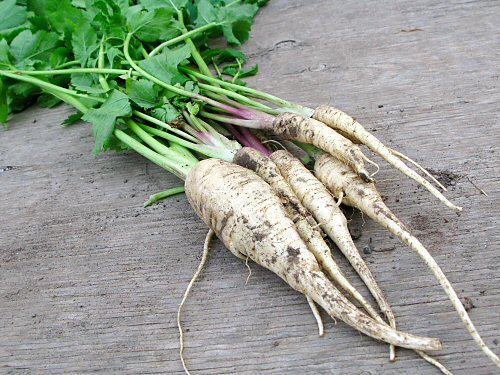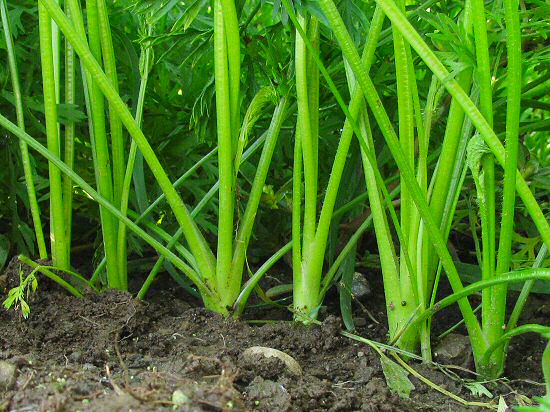
Checking in on the fairly massive time investment we made in thinning 800′ of late-planted Touchon carrots—and it’s paying off! Not that there was any doubt that thinning works, it’s just so…tedious. After laying down carrot seed thick (in other words, after using the Earthway seeder), we spent hours removing thousands of extra seedlings. Because these guys went in so late, I wanted to give ’em every shot at making the best of good weather and sizing up while they could. Now, the effect of 1″ (2.5 cm) spacing really shows. We still kept them pretty tight, thinning a few short stretches to 2″ (5 cm) for comparison, but mostly did them like this, aiming/hoping for a big yield of fairly slender full-size carrots towards the end of October. You can see, second from right, a little one that escaped. It may seem obvious, I’ve found appropriate spacing is easy to overlook or downplay. When you’ve actually seen the massive difference it usually makes, it’s hard to ignore! Think better seeder. :)
yield
Last of the chokes
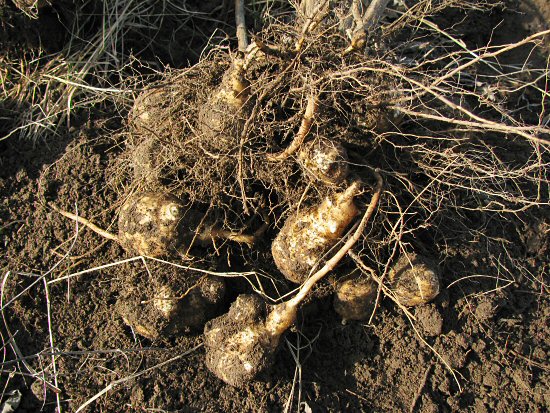
Digging up the very last of the Jerusalem artichoke, this is pretty much the final harvest of the year, besides a little kale and maybe a last few tiny cauliflower and cabbage. The few remaining feet of the original 50′ (15m) double row yielded about half a bushel. Not bad. Plenty for spring planting, and some to experiment with in the winter kitchen (I still haven’t fully figured out the eating part of chokes, I’ve steamed and roasted, the texture is nice, the taste mild, but the JA’s true culinary delights have yet to be revealed to me).
Anyhow, despite many freezing nights, the ground is still perfectly soft, and the harvest is all just pulling chokes, with the digging fork around only to turn the nearby soil in search of tubers that strayed from the conveniently compact root ball. Quick and easy, and the season in this field is suddenly…done!
Potato digging party
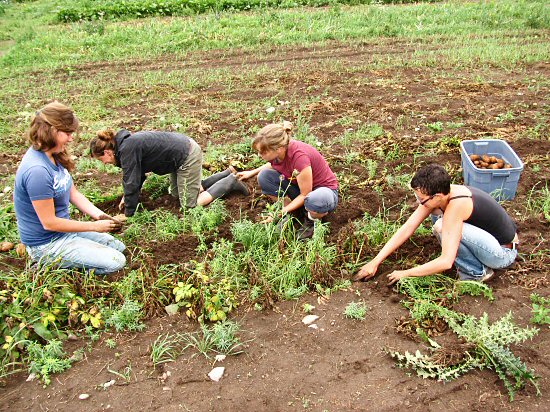
It’ll be hard to top THIS one for extremely labor-intensive tiny farming involving lots of peeps! Here, Libby, Lynn, Andie, and Mel hand-dig potatoes for tomorrow’s farmers’ market. The taters happen to be Gold Rush russets, and they’re in fine form, with a little wireworm damage (surface blemishes or tiny holes) to only a few. We’re right at the end of the first (of three) potato areas of this year, 600′ (183 m), evenly divided between Penta, Chieftan and Gold Rush.
So, what’s with all these people, digging together in a cluster, with just one bin? A little inefficient, pehaps? Well, not really. When there’s a lot of folks happy to mix it up with the dirt, tackling a single task all together can work out! We only needed about 70 lbs of each variety (that blue bin full). With the moist-but-not-mucky soil, pulling plants and scrabbling around was quick and easy. BIG POTATOES helped. Working close together wasn’t a problem because we had so little area to cover. Each bin got filled in maybe 15 minutes. Satisfying!
In the photo, you can also see how relatively good shape we’re in with weeds. The bit of grass growing back is in separate clumps, all the runners haven’t started to reach out and hook up. Further up is a section of more heavily overgrown onions. But that’s actually doing well as well: the onions were thoroughly weeded twice, and hoed a couple more times, so what you see is mainly grass from the last three weeks (without much shading out from the onion plants, everything else grows fast!).
Anyhow, when we tackle the main potato patch, around 2,000′ (609 m), methods will change. But we’ll still be digging in the dirt…!
Working the new potatoes
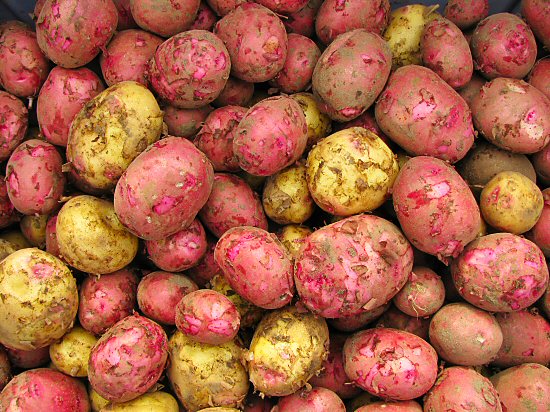
Another installment in the crazily labor-intensive tiny farming techniques series: Andie and Jordan in action, hand-digging for new potatoes without uprooting the plants! This one is hard to top for stunningly low hours-to-yield ratio. It makes picking peas and beans seem like something that goes by quick. Of course, for all its slowness, it has its rewards: beautiful little, amazingly fresh and tasty, new potatoes…and the plants still get to grow some more! Plus, if you don’t have to do it forever, it’s a lot of fun…
The “technique” is simple (and well-suited to the home veggie garden, but not too scalable). Gently feel around the base of the plant for anything that’s golf ball-sized or bigger (this batch is golf ball to XL egg). Stick to the surface, don’t dig too deep, and try not to break the single roots connected to other, littler, potatoes (you’ll easily feel the stringy roots). When you’re done, hill up the earth you’ve moved aside, and it’s on to the next one. That’s our method. ;)
Yield today was pretty good, about 2-3 per plant, and about 40 lbs (18kg) in all. Won’t go into the time per plant and the weight per tater…because I didn’t. Maybe a peaceful hour or so, with three people. We only did this for a CSA share treat, because today it worked out that we had the time. There are red skin/white flesh Chieftan, and yellow-flesh, Yukon Gold-like Penta.
The only downside to the hand scrabbling method: the delicious, delicate skins get quite roughed up. We’ll soon start pulling whole plants for young potatoes, and that tends to leave the skins in better shape (and goes MUCH faster).
Anyhow, slow food, for sure. Tasty!
The incredible shrinking harvest!
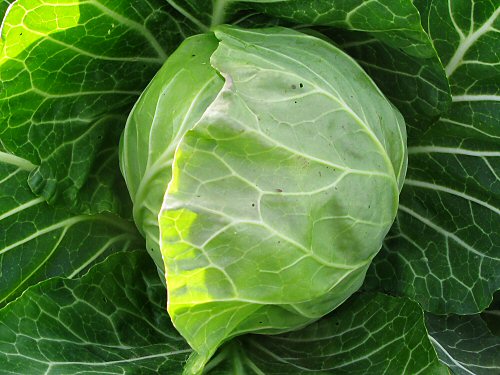
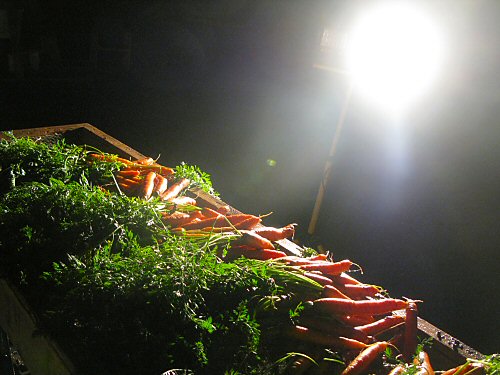
The Friday harvest is shrinking. This is the second to last of the year, and the last for CSA members, and we’re down to mainly root veggies. Some of the last cabbage planting has firmed up, and we’re picking them as “baby,” about 1-2 lbs (450-900g) each (multiplanted, the yield is good, the size really convenient for cooking, and the taste quite fantastic). And there are beets, carrots, parsnips, plus onions, garlic and other storage crops. And some lettuce… As the harvest gets shorter, so do the days, and I’m out rinsing beets and carrots after dark once again. Try not to get wet when it’s COLD…!
Trimming garlic
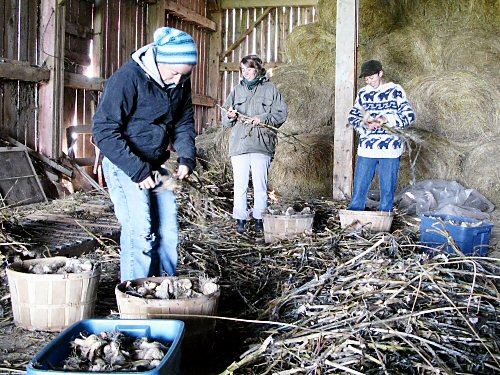
From the long stack of garlic drying in the barn, we’ve been taking out about a bushel a week since harvest began in late July. Today, we finished preparing the rest of the harvest. Lynn, Raechelle and Mel snipped the stems and sorted at the same time. (The roots weren’t trimmed; that can be done for some as we go through the bins and baskets each week for CSA shares and the farmers’ market.) In past years, the sorting was for size: dividing the mostly medium and large bulbs, and putting aside the very few tiny and damaged ones. Garlic does best with a dry final month of growth—this time, coming out of ground that had remained quite wet all summer, the harvest wasn’t in as good shape…
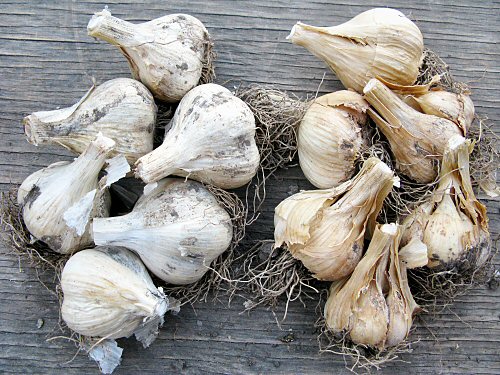
Sizing evened out, with most bulbs about what I call “medium” (this is the most useful size for cooking, but the big ones are so…impressive, everyone loves ’em). A little over half dried not to the usual tight, white skin, instead, to a tan color, wrinkled and split. So, we sorted into “good” and “not so good”… There was also a much higher proportion of really damaged bulbs, maybe 10% compared to a usual couple per hundred. Still, the taste is great, and the cloves themselves are fine. Only appearance and storage life are affected. We’re selling the less pretty, less storable bulbs at a couple of dollars less per pound. They’re good for immediate use (within 3-4 weeks, maybe a little longer) and as seed garlic for fall planting. Overall yield was great, although I’m not sure whether the hugely reduced number of large bulbs was due to weather, or to the more intensive 5-across planting we tried for the first time. As usual, more to observe and learn from. All in all, given the poor garlic weather, it all worked out quite well!
Parsnip surprise
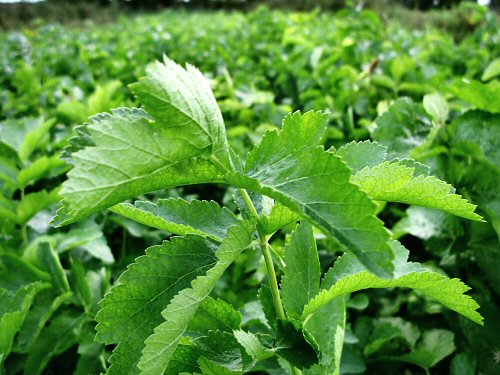
Parsnips, at last! This is a crop I’ve tried to grow almost every year, but until this season, it’ hasn’t come through. Parsnips take a while to germinate, a couple of weeks or more, right in the middle of the spring planting-out rush. Weeds would start to take over, parsnips weren’t a priority, and I’d never find the time to save them. This year’s warm, wet spring made a difference. Germination was quick and the seedlings surged ahead of the weeds! Nearly four months later and, even in dense, unthinned rows, the parsnips are thriving. Yay! Today, I dug up about 6″ (15cm) of a row to check ’em out. With the crowding, there’s a motley assortment of sizes, but overall yield looks good. Another month in the ground, a little post-harvest sorting, and it’ll be parsnips for all!