Seed catalog, 2016

Seed catalog 2016

Here’s my main seed catalog for this year. Once again, unlike several seasons ago, when I’d receive a dozen catalogs, order from two main suppliers, and pick up a few things from two or three others, lately, I’ve simplified and get everything in one place. This year, though, and for the second year in a row, there was a crop failure on a variety of mustard that I grow, and no close substitute, so I had to look elsewhere. Which, of course, opened up a world I’d kinda forgotten, the wonderful world of price comparison shopping.

The puzzling thing about pricing is the seemingly bizarre differences in price for the same items between different sources (it’s the same in seed as everywhere else). Some suppliers are clearly overall more expensive than others, so if quality and service are fine, it’s easy to go with the savings. But then, on any one item, prices can vary quite dramatically either way.  For example, I found the same variety of mustard at $10 and $17 a pound, and something similar at $50, at three different places, and  that’s expected. Less so is that, for just one common variety of lettuce, it’s $33 at my usual place, where the same amount is only $19 at a usually more expensive other supplier.

Yep, I could’ve gone on and on like this, with multiple lists and endless tabs of online catalog pages, like a full-on coupon clipper, looking for the ultimate bottom line big score. Instead, though, I ordered my mustard and stopped! Maybe not the best every-last-penny business thinking for a tiny farm, and tiny farm definitely does not equal big budget, but sometimes at least, for a few bucks, life is too short! :)
This year’s catalog!

Seed catalog 2013

For the record, this year’s seed catalog! It arrived in late December, and I’ve been thumbing through, but it’s still not well-worn—I pretty much know what I’m ordering. It’s as exciting as always to get the new catalogs, but a bit more symbolic now, start of a new season and all that, than it used to be at the beginning, when I pored over it for hours. Like anything else, do it for a while and it becomes…easier. Also once again for recent years, almost all of my seed will come from just this one place, William Dam, a family owned company not too far from here, that carries only untreated seed. Selection does the trick, service is great, and I like talking to them on the phone. High Mowing and, of course, Johnny’s, both relatively close (Maine and Vermont, to my Ontario), have a lot more in general, and High Mowing is 100% organic seed, but at the moment, I’m fine with Dam! Everyone’s farming has its flow!

First seed catalog of the year!

First seed catalog to arrive

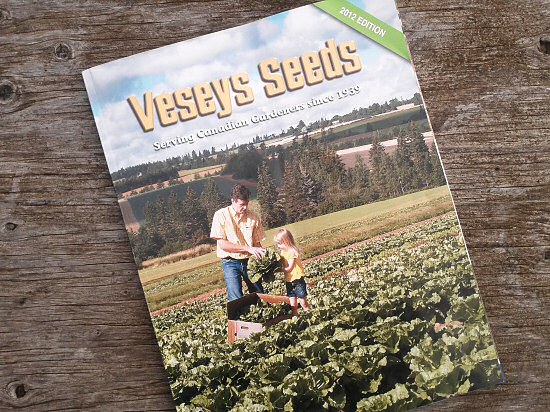
Well ahead of the pack, Veseys takes first new seed catalog of the year. They’re a pretty marketing-oriented company, they get their stuff out early—this actually arrived a while ago, but I only got my hands on it now! Which is fine by me. I haven’t been this, well, EXCITED with that new-catalog feeling in a couple of years. That’s good. There is a lot of proper, well-ahead-of-time planning to do, expectations for 2012 run high! Whatever the weather!!

Main order done!

Five hours and done! This year’s main seed order was a first: finished in one session! Usually, it takes two. My head was starting to spin a little, but I felt COMPELLED by the late date to keep going (although I don’t think I’ve ever been much earlier, I always just plan to be). Guess I’m getting…better. A small order went in a while ago, for early starters like onions. This is all the rest!

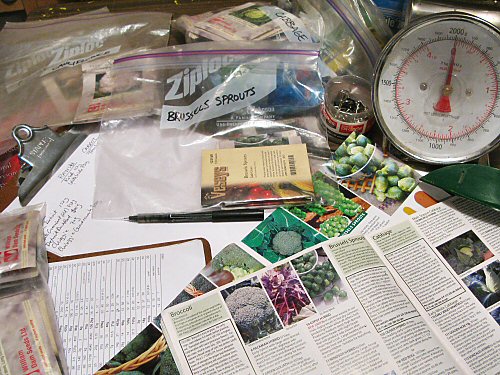
It’s a comfortably familiar routine. I cleared an end of a work table and set things out. A couple of clipboards, one with the always-handy, slightly magical  seed calculator sheet. Catalogs from the main two seed houses I use. A scale for weighing heavier seed, and seed in larger quantities. A seed scoop for checking what’s left in packets (pour out, pour back!). Tiny (3/4″/19mm) bulldog clips, great for clipping together packets. And sitting by the table, three Rubbermaid bins that hold the precious seed inventory in freezer-weight ziploc storage bags.

First, I weighed the bulkier stuff: beans, peas, larger quantites of beets, radish, and so on, stored in their own bags. Then, I settled in, going through ziplocs, more or less alphabetically, from arugula to tomatoes. See what’s left, decide what more I need. Check the catalogs, try not to go wild with extra packets of stuff, “just to try”—the amount of seed needed per veggie is already worked out on that calculator sheet. A few of the ziploc bags have only a couple of packets of seed, each a different variety, like the Brussels sprouts in the pic. Most have 10-20. Tomatoes are getting near 200. It’s a lot to go through, but it’s like hooking up again with old friends. Easy. Fun. And I’m done!

Hitting the books

The first new seed catalog came in three weeks ago, but the first from the two seed companies I mostly use arrived on Friday. Today, I took a quick look, checking to see what’s new, but mainly making sure that reliable stand-bys are still around. Dusky eggplant, that manages to come through in the craziest conditions. Rich, earthy Bloomsdale spinach (open pollinated!). Earlivee sweet corn for its speed and it’s more-corn-less-sugar, not-overly-sweet taste (it’s…gone!). Early Dividend broccoli and First Crop beets, planted in spring for their reliably extreme earliness. The shortlist goes on. Most of ’em are still there! The ones that fall off tend to be open-pollinated varieties, as they make way for “better” hybrids… These catalogs are convenient, but I wonder when I’ll get around to seed-saving for real. Progress!