To provide the best browsing experience, this site uses technologies like cookies to store and/or access device information. Consenting to these technologies will allow us to process data such as browsing behavior or unique IDs on this site. Not consenting or withdrawing consent, may adversely affect certain features and functions.
The technical storage or access is strictly necessary for the legitimate purpose of enabling the use of a specific service explicitly requested by the subscriber or user, or for the sole purpose of carrying out the transmission of a communication over an electronic communications network.
The technical storage or access is necessary for the legitimate purpose of storing preferences that are not requested by the subscriber or user.
The technical storage or access that is used exclusively for statistical purposes. The technical storage or access that is used exclusively for anonymous statistical purposes. Without a subpoena, voluntary compliance on the part of your Internet Service Provider, or additional records from a third party, information stored or retrieved for this purpose alone cannot usually be used to identify you.
The technical storage or access is required to create user profiles to send advertising, or to track the user on a website or across several websites for similar marketing purposes.
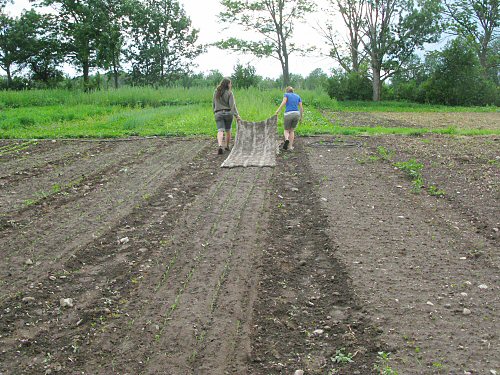

Hi, enjoying your blog. What was your burlap method for the carrots?
Yes, ditto on mike. I’m curious about the burlap. Would you please share?
and a third – what is burlap?
Mike will, of course, chime in, but to answer Deborah, here is a picture of burlap:
It’s a natural fiber with little holes in it. Depending on the weave, the holes can be tighter or wider.
My guess is that he covers the seeds with burlap so they don’t get eaten by birds, and then the burlap helps prevent wind-borne weed seed distribution and germination. Carrots make skinny little greens when they’re just sprouting, so the burlap comes up right off the beds without ripping out the baby plants.
I added a link in the post to an explanation of the burlap method!
Thanks for that Mike and Nat. Burlap is what I would call Hessian or sack cloth although I would guess in this case it would be a very coarse weave to let the plants pull through safely when you lift it.