
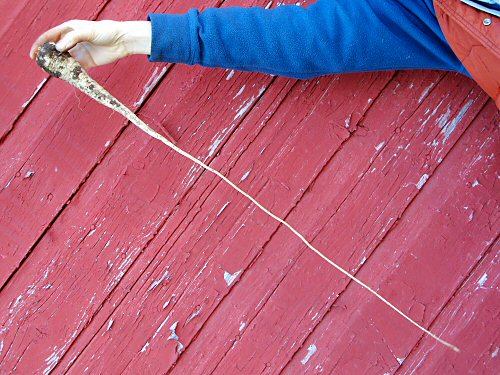
This harvested parsnip root only hints at the massive root systems that plants have down there. Mature parsnips can root down to 9 feet (2.7m), and spread up to 3′ (0.9m) in the top 10″ (25cm) of soil. Other garden veggies are generally as impressive in the root department. When we harvest, most of the delicate root network is torn off, and we only get to see the bigger, tougher parts, the taproot or the root ball. This pic is from an old post I ran into, a flashback to Oct. 2008: there’s more words and another long-rooted-parsnip pic at Root love! (The arm-and-hand model is Lynn.)
Lynn
Harvesting Jerusalem artichoke
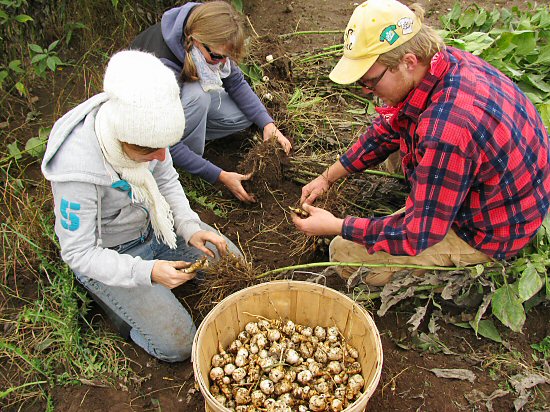
For tomorrow’s farmers’ market, Lynn, Andie and Jordan harvested more of this year’s Jerusalem artichoke. The tubers have gotten noticeably bigger since pulling some just a couple of weeks ago… Chokes are a really simple, satisfying harvest, at least, when you pull up the plants in their first year. These guys are spaced at 12″ (30cm), so we just grab the usually multiple stems at each spot and tug. The main root ball is shallow and contains most of the tubers: pull ’em off, and bang the root clump a bit to get at the ones in the middle. You also have to scrabble around for maybe a hand’s width or two past the little root crater to find a few extra outlying tubers—guess that’s where the “invasive” part of choke lore begins, they do try to spread. Overall, though, it’s quick and easy, especially when the fall weather is mild like today. Nice!
Potato digging party
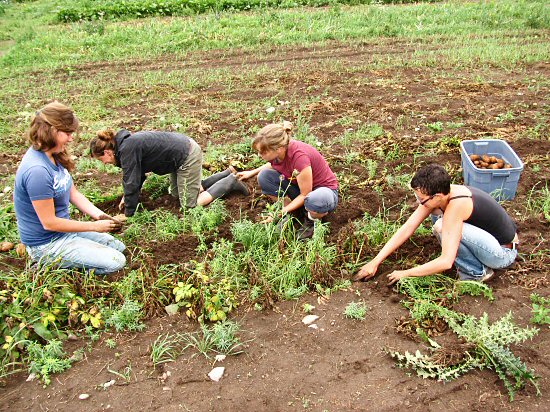
It’ll be hard to top THIS one for extremely labor-intensive tiny farming involving lots of peeps! Here, Libby, Lynn, Andie, and Mel hand-dig potatoes for tomorrow’s farmers’ market. The taters happen to be Gold Rush russets, and they’re in fine form, with a little wireworm damage (surface blemishes or tiny holes) to only a few. We’re right at the end of the first (of three) potato areas of this year, 600′ (183 m), evenly divided between Penta, Chieftan and Gold Rush.
So, what’s with all these people, digging together in a cluster, with just one bin? A little inefficient, pehaps? Well, not really. When there’s a lot of folks happy to mix it up with the dirt, tackling a single task all together can work out! We only needed about 70 lbs of each variety (that blue bin full). With the moist-but-not-mucky soil, pulling plants and scrabbling around was quick and easy. BIG POTATOES helped. Working close together wasn’t a problem because we had so little area to cover. Each bin got filled in maybe 15 minutes. Satisfying!
In the photo, you can also see how relatively good shape we’re in with weeds. The bit of grass growing back is in separate clumps, all the runners haven’t started to reach out and hook up. Further up is a section of more heavily overgrown onions. But that’s actually doing well as well: the onions were thoroughly weeded twice, and hoed a couple more times, so what you see is mainly grass from the last three weeks (without much shading out from the onion plants, everything else grows fast!).
Anyhow, when we tackle the main potato patch, around 2,000′ (609 m), methods will change. But we’ll still be digging in the dirt…!
Dog days of summer (a few)
The muggy wave continues, the sixth day or so of bright, swelteringly humid heat. Today was only 21°C (72°F), but the Humidex (or whatever exactly They call it) says it’s the equivalent to us humans of 40°C (110°F). It does feel that way. I can’t recall ever hearing a spread that big—quite weird, or maybe the Humidex got more accurate…
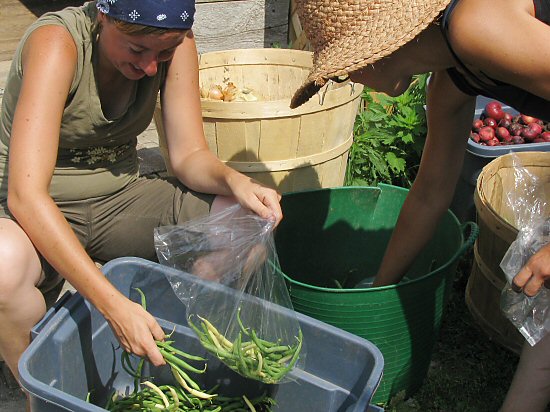
A smaller crew than usual this Monday morning as we harvested for CSA shares. Lynn and Mel (above) were out earlier, hitting the field at 7 am, partly to get a jump on the heat, partly because they both had to leave earlier as well. Michelle arrived around 8:30. Tara was tied up preparing for a short trip. Jordan, another Monday regular, is away for a couple of weeks, on various visits around the north-east.
People in the field. I still find it mildly unlikely and extremely cool each time one of our tiny field crews assembles for a day. Sometimes it’s a crew of two, other times, usually harvest Fridays and Mondays, the numbers swell (big for a tiny farm!).
We all head to the field for different reasons and different returns. The work is never endlessly tedious, we don’t go out and, say, pick beans for 8 hours, but we do get a lot done, and everyone does a bit of everything. You can find a little instant closure, where the start and end of a thing are all right at hand. You can learn to small-scale farm. You can chill out, take time to think—garden meditation while breathing some relatively fresh, country air and dabbling in the dirt. Chatting while veggie gardening can be great. It’s whatever you want it to be…
Today, it was hot. The shares were done by noon as planned. It’s all good! :)
Drizzly days
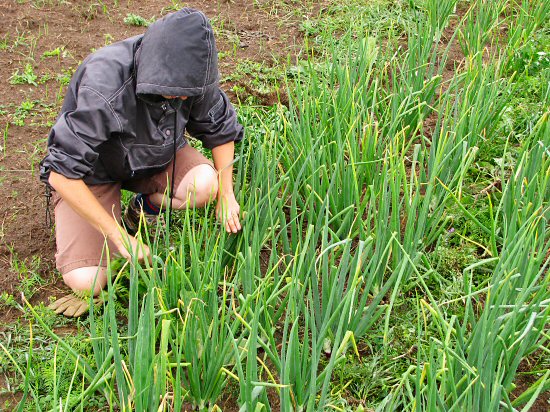
It’s been cloudy a lot this season, but the rain has kept pretty much to a reasonable number of rainy days and single downpours—it hasn’t been too WET. So, not that much fieldwork called for rain. Today was an exception, with a steady on-and-off drizzle from early morning that kept things watered down.
Lynn came out around 8:30 am to weed. Since it didn’t look like the sun would be showing up to dry things out, she finished a bed of onions (these are the last-planted onion seedlings, a fair bit behind the rest) and we called it a day for weeding.
In general, we try not to handle plants when they’re wet so as not to spread any sort of disease. This is a common caution for, for example, beans, and I’m not sure how it applies across the board to all garden veggies. Still, since wet work in the field is seldom fun anyway, it seems like a good rule in general: No weeding when wet!
Last of the spring planting
It’s another week till the start of CSA shares and the first picking of peas, and at least 3 weeks until some of the heavier crops—broccoli, cauliflower, summer squash—are ready, so Friday’s are still about general fieldwork, not HARVEST. Just ahead of the end of spring, Lynn, Libby and Jordan planted out a last wave of winter squash and some fast-maturing (80-90) Neon pumpkins. That brings the spring planting to a close, a little later than usual, overall, but considering the first-year, start-up situation, really good!
We also put in one bed of melons under infrared-transmitting (IRT) plastic mulch (above). For a couple of years, I planted 5-10 50′ beds under IRT mulch (more heat to the soil), but yield wasn’t worth the effort, including the extra watering (didn’t use drip tape under the plastic). This year, with one bed to focus on, it’s an experiment—we’ll try to give them extra special care!
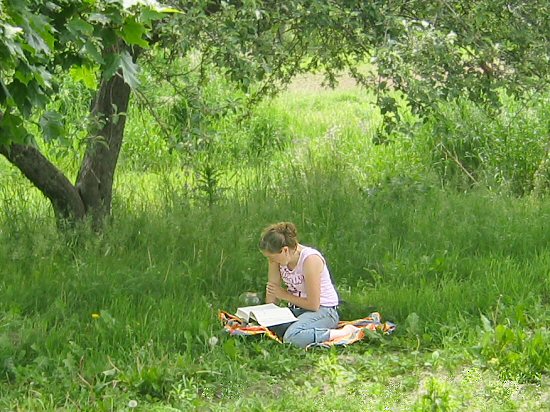
Lynn vanished early from lunch, only to be found reading her new herb book under a tree. This photo (below) doesn’t nearly capture the scene: it looked like an impossibly peaceful countryscape, from a simple, carefree world—fit for a postcard. We were laughing, and Jordan spontaneously got out his camera and took photos, too. I asked her if she’d scouted the location for the setting (joking, but I can also be a bit of a cynic! :), she said it was just the best spot she could find for shade!
Planet Jr. rising
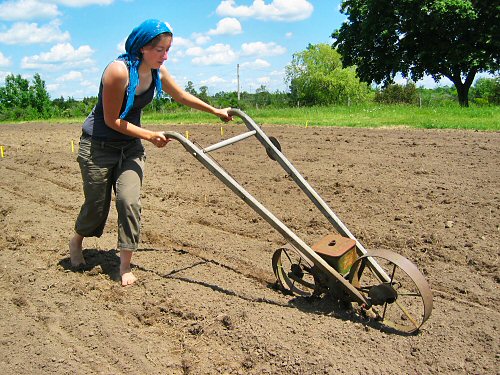
This year the antique Planet Jr. seeder finally took over from the Earthway, to handle most of the direct seeding. We’ve been using it for everything but tiny carrot and lettuce seed, where the lighter Earthway is easier to maneuver for closely spaced rows. Here, Lynn rolls out a third planting of beets, no problem. The PJ is heavy and initially hard to handle, but also more precise, uses way less seed than the Earthway, and lays down a well-packed row. And the choice of 60 or so seed holes, at first a pain, turns out to be a great way to appreciate variations in seed between varieties and fine tune seeding rates—we used three different openings to best fit three types of beet (Golden Detroit, Chioggia, Kestrel). It’s great. With this well-aged Planet Jr, old turns out to be our new and improved!