
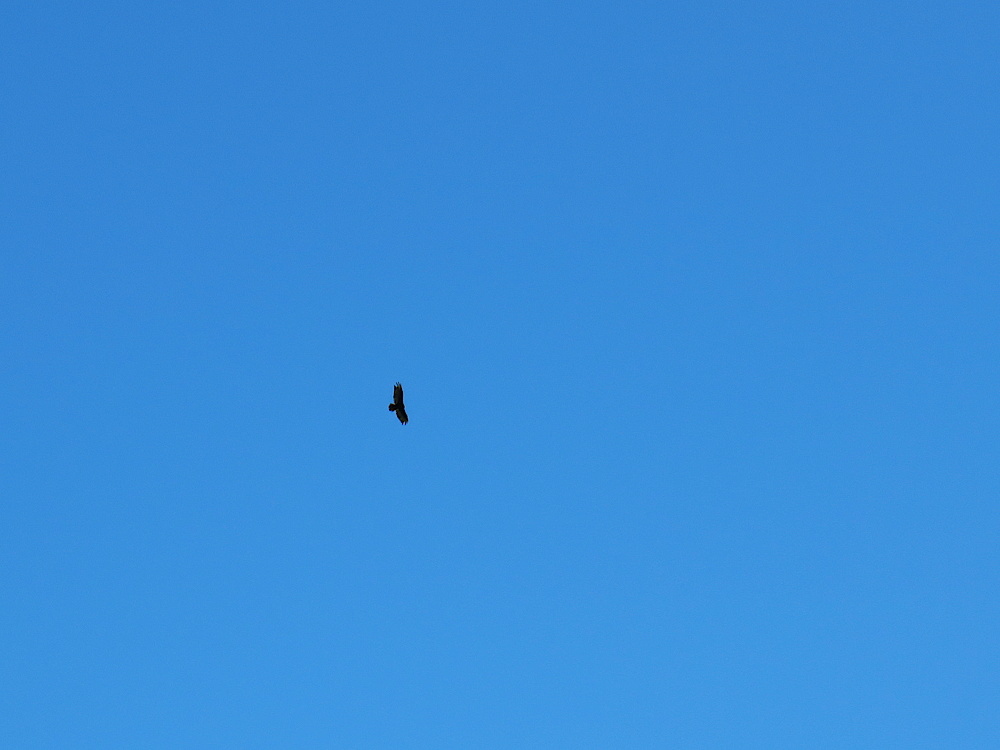
A turkey vulture lazily circling way up, looking for dead flesh. I’m not entirely sure of my bird ID, but pretty sure. These guys circle all the time, barely moving their wings. I used to happily imagine they were some kind of hawk, on patrol over the vegetable patch, the clear, weeded rows a perfect background for spotting rabbits, maybe even zeroing in on seedling-munching field mice and voles. It was a pleasant thought bubble, burst when I eventually looked into it. The overall boxy shape, the fingered wingtip feathers, the patient gliding loops with little flapping, all seemed to say, “Vulture! Turkey vulture!”
Wondering
Food for thought?! :)
Bigger gear…
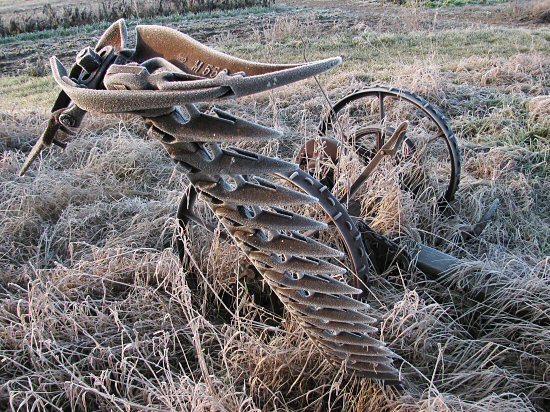
Thanks to the comments on yesterday’s blog post, this piece of old farm gear, lying abandoned in the field for who knows how long, has been ID-ed as a sickle bar mower. Yet another in a long line of bigger equipment I’ve seen but not used in my tiny farming career. I suppose the main job of this mower was in making hay, something I’ve barely considered. Why? Because it belongs to “another scale” of farming. There’s small-scale—tiny farming, on one or two or three acres—and then there’s mid-size, and then, BIG.
This idea of SCALE has been on my mind quite a bit, lately. More and more people these days seem to want to get back to the land and start farming, and the farming they want to do is usually of the tiny variety. Like what’s pictured on this blog. Small-plot growing is understandable, accessible, hard work, economically tough, genuinely community-building, fun…all of that stuff. Big tractors and combines and other imposing (and EXPENSIVE) machinery don’t figure into the picture. In my few years of market gardening, I’ve only ever driven my Kubota compact tractor, and I know nothing practical about larger scale growing gear.
This is interesting for the simple reason that, if “we” (referring, at least, to Canada and the US) are going to change what we eat, where it comes from, on any sort of large scale, it’s difficult to imagine our part of the world, with its convenient supermarkets and complex food chain, suddenly fed mainly by hundreds of thousands or MILLIONS of postcard tiny farms. Gathering food for tens and hundreds of millions of people from all those tiny farms would be…complicated. So it seems to me, there’s tiny farming and mid-size farming, and figuring out how they fit together. Hmm…
The joy of decay…

During the growing season, decay is the last thing you want to see, let alone observe over time. In the off-season, what with culling veggies from cool storage, I’m a little more thoughtful about…decomposition.
This miniature butternut caught my eye as it slowly returns to its essence in the Milkhouse. I’ve watched it instead of tossing it out. I like it! It’s soft, but seems to be drying faster than it’s rotting… Those little amber crystals, the product of ooze, are interesting: hard, translucent, sort of brittle, almost tasteless… I wonder what they are? I’m sure chemistry and biology would give me great, detailed explanations of the entire process of winter squash decay. But is that…good? Is that what I want?
I used to think that understanding how EVERYTHING worked was kinda the goal, you’d learn and learn and learn stuff and become…better. But tiny farming doesn’t seem to lead that way. You watch and you do learn lots of things when they’re useful, but simply tearing everything apart into little chunks of measurement and description, just for the sake of it, isn’t as appealing as it once seemed to be. I think I want to know LESS. Demand simplicity! Let the squash rot in peace… (Of course, things don’t really work that way, do they…)