
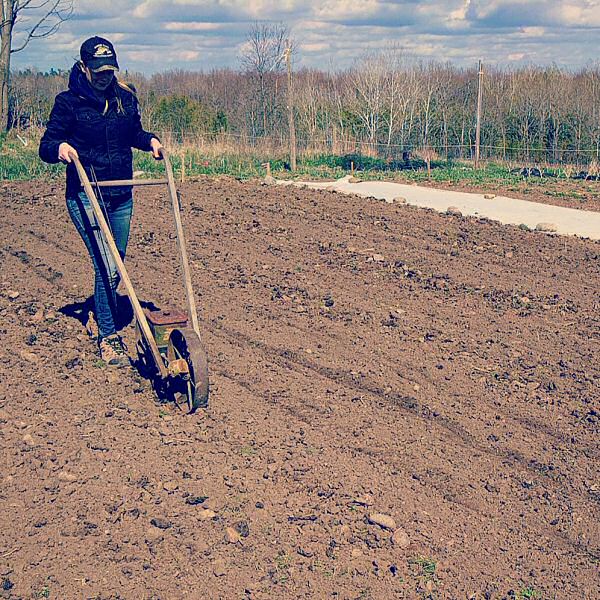
The Planet Jr. rides again. Clara learns the way of the antique seeder, having just laid down three rows of Kestrel beets. This old seeder continues to serve well!
antique
Bigger gear…
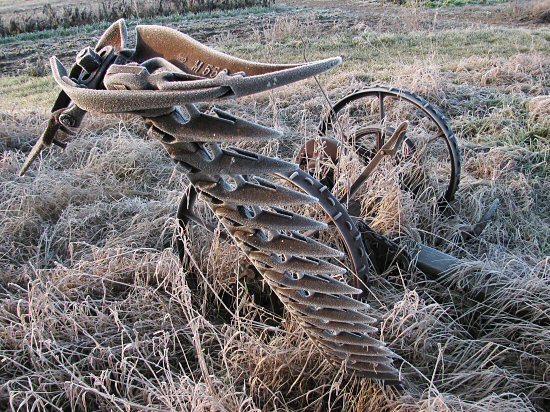
Thanks to the comments on yesterday’s blog post, this piece of old farm gear, lying abandoned in the field for who knows how long, has been ID-ed as a sickle bar mower. Yet another in a long line of bigger equipment I’ve seen but not used in my tiny farming career. I suppose the main job of this mower was in making hay, something I’ve barely considered. Why? Because it belongs to “another scale” of farming. There’s small-scale—tiny farming, on one or two or three acres—and then there’s mid-size, and then, BIG.
This idea of SCALE has been on my mind quite a bit, lately. More and more people these days seem to want to get back to the land and start farming, and the farming they want to do is usually of the tiny variety. Like what’s pictured on this blog. Small-plot growing is understandable, accessible, hard work, economically tough, genuinely community-building, fun…all of that stuff. Big tractors and combines and other imposing (and EXPENSIVE) machinery don’t figure into the picture. In my few years of market gardening, I’ve only ever driven my Kubota compact tractor, and I know nothing practical about larger scale growing gear.
This is interesting for the simple reason that, if “we” (referring, at least, to Canada and the US) are going to change what we eat, where it comes from, on any sort of large scale, it’s difficult to imagine our part of the world, with its convenient supermarkets and complex food chain, suddenly fed mainly by hundreds of thousands or MILLIONS of postcard tiny farms. Gathering food for tens and hundreds of millions of people from all those tiny farms would be…complicated. So it seems to me, there’s tiny farming and mid-size farming, and figuring out how they fit together. Hmm…
Second snow, 2009
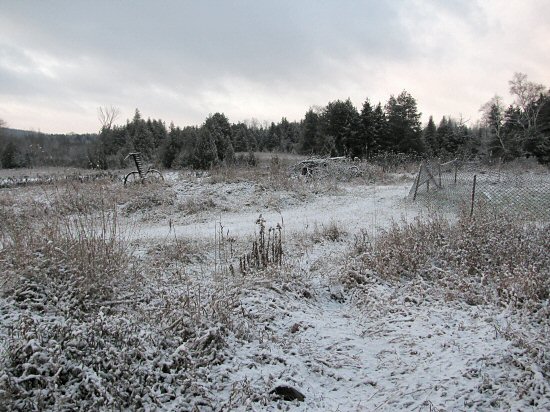
Around 8 am, just getting light, and it’s the second snow that’s sticking around for a while. Here, I’m standing in a weedy area right beside the barn, looking south-west over the south-facing slope, with the chickenhouse just out of sight to the right. (That’s a so-far unidentified piece of antique iron farm gear with wheels, sticking up on the left.)
Winter isn’t coming in as hard and early as it has in the last couple of years, the temperature is supposed to stay above zero for the next few days at least. We shall see!
Every year, the feeling on first seeing veggie production land disappearing under snow I find kinda cool and interesting. It’s not really sad or anything like that, but there’s definitely an “it’s really over now”, wiped-out thought-sensation-emotion thing going on. When you’re growing stuff, the snow and the cold really send a message. This is obvious, but still…worth noting. :)
Planet Jr. rising
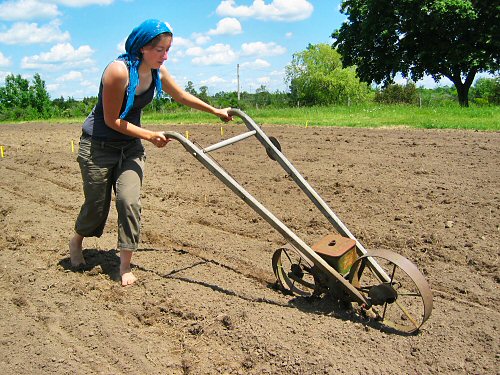
This year the antique Planet Jr. seeder finally took over from the Earthway, to handle most of the direct seeding. We’ve been using it for everything but tiny carrot and lettuce seed, where the lighter Earthway is easier to maneuver for closely spaced rows. Here, Lynn rolls out a third planting of beets, no problem. The PJ is heavy and initially hard to handle, but also more precise, uses way less seed than the Earthway, and lays down a well-packed row. And the choice of 60 or so seed holes, at first a pain, turns out to be a great way to appreciate variations in seed between varieties and fine tune seeding rates—we used three different openings to best fit three types of beet (Golden Detroit, Chioggia, Kestrel). It’s great. With this well-aged Planet Jr, old turns out to be our new and improved!
Direct-seeding peas
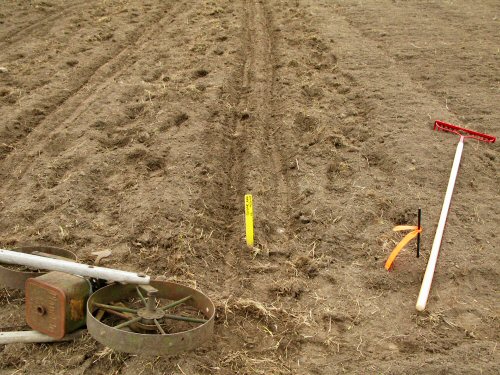
The first direct-seeded crop went in today: Sugar Ann snap peas. As usual, the peas were inoculated with Rhizobium bacteria: dampen the seed with a little water, sprinkle with inoculant powder, and shake.
Rhizobium bacteria enter legume roots and form a symbiotic relationship with their hosts, producing plant-usable nitrogen in exchange for carbohydrates and other nutritious goodies from the plants. The net result is…more nitrogen for all! Or as the inoculant package says: “bigger yields and better quality”!
Sounds great. I take it on faith (in the science, I guess), since I haven’t actually observed the with-and-without inoculation difference. I have a couple of times planted without, but I wasn’t taking measurements…
Each legume (peas, beans, clover, etc) needs its own species or strain of Rhizobia. Luckily, there are packets of premixed assortments that cover the common veggie legumes. What I’ve been using, called simply enough, Garden Inoculant, is good for beans, peas, lima beans and sweet peas.
The bacteria do establish in the soil so that they’re available from year to year, but I’m not sure how long and in what quantities it takes to get set up with the strains you need—until I find out, I’ll inoculate every time…
Then it’s on to the seeder. I’m using the older, heavier, probably-antique Planet Jr. over the usual Earthway.
And minutes later, 3oo’ (91m) done. It’s an almost painfully small start for April 20, but I’m figuring that every few days I leave the broken up sod to break down more, the better off we’ll be. Soon, though, all the rest of the early direct seeded crops will just have to go in!
Old broadcast seeder
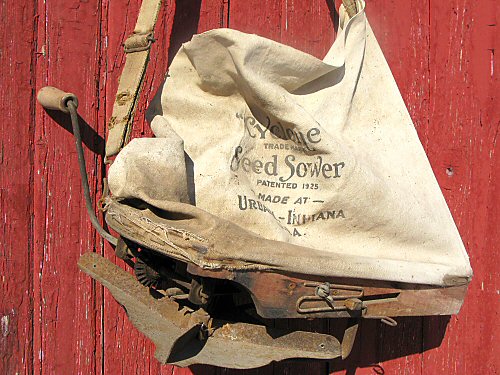
Found this antique broadcast seeder hanging on a nail in the drive shed, the Cyclone Seed Sower, made in Urbana, Indiana, sometime way back when (patented 1925). The canvas is torn, but it’s otherwise in good working order. Dunno exactly when it was last used, in the last decade or two. With a little patching—in a hurry, even duct tape would work—and a few drops of oil, it’d be good to go. In this case, time hasn’t improved on design: this seeder is essentially identical to the modern version I use, except the cloth and wood and most of the metal have been replaced by plastic. Operation is simple: fill the bag with seed, adjust the size of the opening, and start walking while cranking the handle—seed hits the plate and gets flung out by the ribs (here’s a more detailed description). Simple, then and now!
Farm gothic?
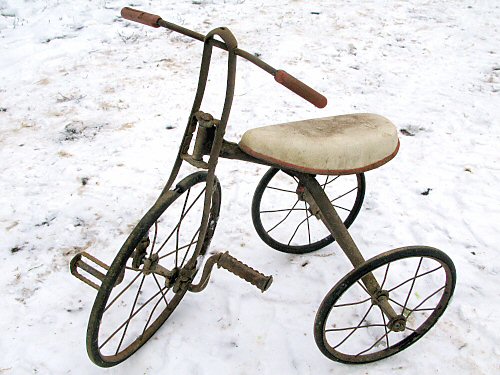
All sorts of old things are being unearthed as the entire farm gets a thorough, top-to-bottom, no-drawer-unpulled going through, something that probably hasn’t been done in a century. There are all kinds of finds, like horse-drawn plows and a farm-built chicken defeathering machine. Today’s most intriguing item for me: an old, iron tricycle (with an upgrade, a much newer seat). No-one here is sure, but the guess is that it’s gotta be a good hundred years old. Except for the plastic seat, which looks more like the last 30-50 years. It’s cool because the design and construction are soothingly simple (and easily fixable), although it looks like it delivers a bumpy ride on those solid rubber tires, especially on gravel in the barnyard. For some reason, though, I also find it mildly creepy… Imagining the squeakily-pedaling ghosts of farm children past, I guess. Yikes… :)