Bigger gear…

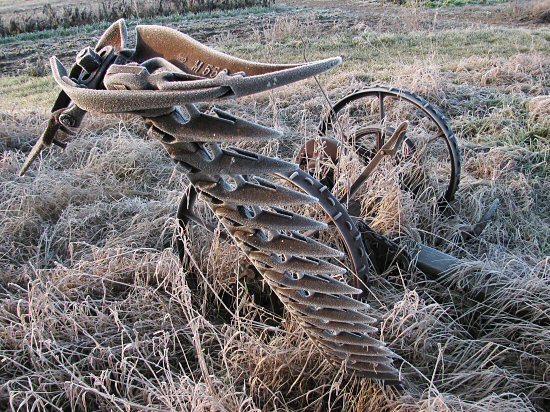
Thanks to the comments on yesterday’s blog post, this piece of old farm gear, lying abandoned in the field for who knows how long, has been ID-ed as a sickle bar mower. Yet another in a long line of bigger equipment I’ve seen but not used in my tiny farming career. I suppose the main job of this mower was in making hay, something I’ve barely considered. Why? Because it belongs to “another scale” of farming. There’s small-scale—tiny farming, on one or two or three acres—and then there’s mid-size, and then, BIG.

This idea of SCALE has been on my mind quite a bit, lately. More and more people these days seem to want to get back to the land and start farming, and the farming they want to do is usually of the tiny variety. Like what’s pictured on this blog. Small-plot growing is understandable, accessible, hard work, economically tough, genuinely community-building, fun…all of that stuff. Big tractors and combines and other imposing (and EXPENSIVE) machinery don’t figure into the picture. In my few years of market gardening, I’ve only ever driven my Kubota compact tractor, and I know nothing practical about larger scale growing gear.

This is interesting for the simple reason that, if  “we” (referring, at least, to Canada and the US) are going to change what we eat, where it comes from, on any sort of large scale, it’s difficult to imagine our part of the world, with its convenient supermarkets and complex food chain, suddenly fed mainly by hundreds of thousands or MILLIONS of postcard tiny farms. Gathering food for tens and hundreds of millions of people from all those tiny farms would be…complicated. So it seems to me, there’s tiny farming and mid-size farming, and figuring out how they fit together. Hmm…
The goats

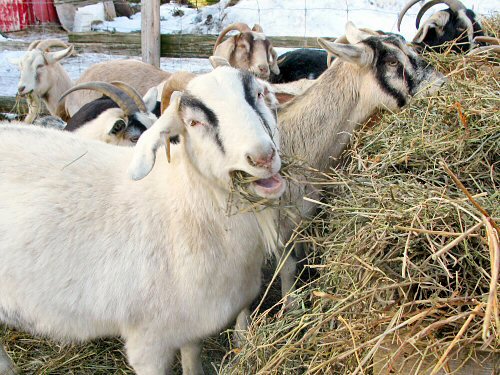
Haven’t been paying much attention to the goats lately, so I checked ’em out for a while this morning. They have absolutely no problem with the cold, eating hay and hanging out pretty much as usual. Of course, serving them is a lot more work when it’s freezing, lugging buckets of hot water from the main barn, since the pipe to the convenient goat barn tap is frozen. I did goat chores for a winter, but right now, it’s Bob’s thing. Oh, well. :) This gang of girls has had the same line-up for the last couple of years, and some I’ve known since birth… Familiar faces. A couple even have names…

New farm revisited

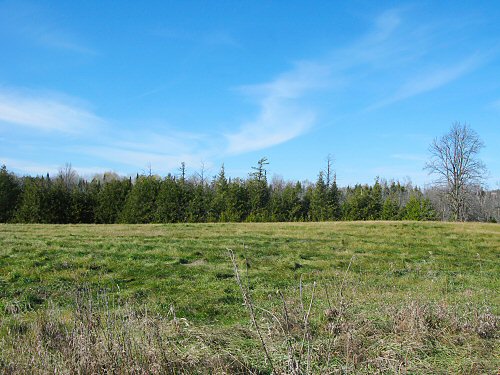
Spent the day at Tara & Michael’s farm, my second visit, and a beautiful day it was. I took the time to walk around alone, checking out the fields for veggie garden locations. It was a great feeling, deeply exciting, to look out over new farmland, and start to apply all of the things I’ve learned from six seasons of tiny farming in one place to another. The field in the pic has about two acres of fairly flat land that looks good. There’s also a south-facing slope that looks perfect for a small, early spring garden to take advantage of the faster post-snow drainage and quicker soil warming that a southern incline provides. I checked for twitchgrasss (nope!), and signs of other invasive weeds (it’s all hay that’s grown out to mainly grass). From a couple of samples, the soil seems like a clayey loam, similar to what I’ve been working, but it’ll be easier to see when it’s plowed up. Looks good so far, clean and ready for tiny farming action! Nothing like a fresh challenge to force you to review your thoughts and experiences, and discover conclusions you may not even know you’d come to. At least, that’s how it feels for me. Change is in the air! It’s excellent!!

Making mulch

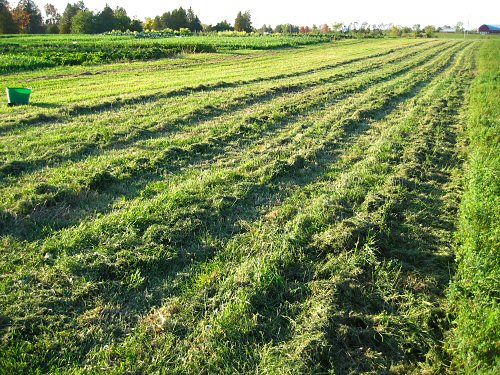
Yet another experiment: making mulch from some of the hay that grows alongside the garden. The hay, originally alfalfa and red clover, is dying out, and what’s left is mainly grass and alfalfa, currently around 10″ (25cm) high. I cut it with the riding mower, which instead of scattering the clippings, leaves a convenient tiny windrow. A couple of days drying in this year’s hot October sun, and it should be good to go. I tried thoroughly dried grass clippings as mulch a couple of years ago on a few tomato plants, and it worked out well, so on to a larger scale. This crop will be used on the garlic, to be planted in a month or so. The mower is sadly in need of new blades, so the cut is rough, but it should work out fine.

The hay around us

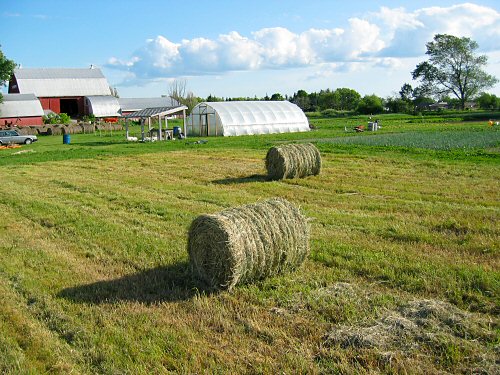
The garden, approaching 2.5 acres with this year’s addition, floats near one corner of a 9 acre field of hay. I could fairly easily expand into much more of the field, and ride around all day, machine seeding and cultivating. This is definitely not the plan. Instead, it’s stay small in area and add people—I’m somehow attached to the idea that, in a pinch, I could still (with help!) manage the whole thing without gas-powered machines…more or less. So, twice a season, Bob cuts and bales the hay that’s all around, using 30-year-old big tractor gear, carefully kept up over the decades. Since the whole farm is certified organic, I suppose we could find a specialty market for “organic hay”, but that seems a little precious—this stuff gets fed to the half dozen cows, couple of dozen goats, and single miniature donkey, who live to eat and loaf on other parts of the tiny farm (I call ’em 10,000 lbs of pet…they’re Bob and Karen’s, it’s not I who takes care of ’em!). This field is overdue for reseeding, the hay has lots of grass that’s grown into the diminishing clover and alfalfa. Oh, you can also see Conall’s old Volvo station wagon, in the parking circle mowed out of the hay in front of the stand—it’s rapidly become part of the season’s local errand routine (it will lose some character when he gets that rear bumper reattached). And that’s the hay story.