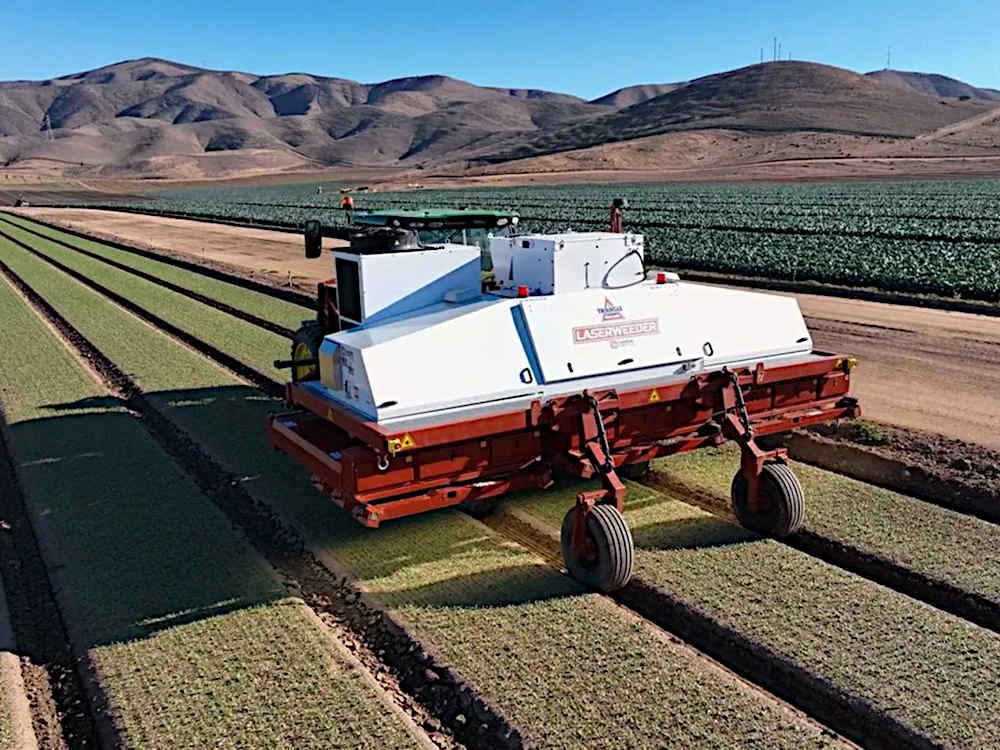
The future of weeding!

LaserWeeder

This 40-second LaserWeeder video I think speaks for itself. What more could I say? Wow, technology! The madness continues? Imagine the efficiency! What are we thinking? AI, of course. Hendrix (for some generations, shades of a jungle war on weeds)!

Here’s what’s under the hood: “AI-powered precision weed control. Featuring high-resolution cameras and cutting-edge computing, LaserWeeder can instantly differentiate between weeds and crops, targeting and eliminating weeds with precision lasers. This chemical-free solution operates 24/7, boosting crop yields, lowering farming expenses, and supporting sustainable agriculture.”

It can identify 4.7 million images an hour—sounds…frantic, processing all those images, ID-ing the weeds, passing coordinates on to the lasers, or whatever exactly the AI has it doing. LED lighting four times brighter than the sun. Sub-millimeter laser accuracy. Targets 5,000 weeds a minute.

Smart miniature laser cannons, deployed to the farming field. What will they think of next?!

No doubt the LaserWeeder will come to mind now and then when I’m crawling around hand-pulling weeds. Either that or the song.… Read the rest
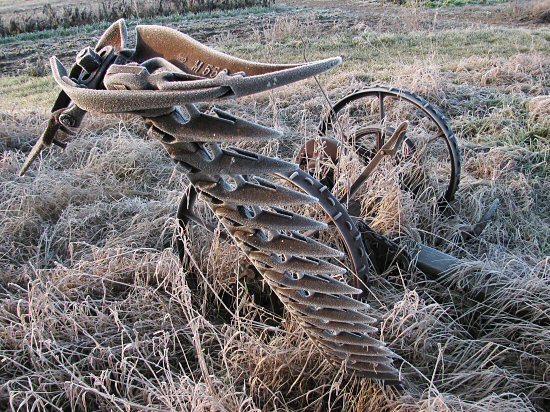
Bigger gear…

Thanks to the comments on yesterday’s blog post, this piece of old farm gear, lying abandoned in the field for who knows how long, has been ID-ed as a sickle bar mower. Yet another in a long line of bigger equipment I’ve seen but not used in my tiny farming career. I suppose the main job of this mower was in making hay, something I’ve barely considered. Why? Because it belongs to “another scale” of farming. There’s small-scale—tiny farming, on one or two or three acres—and then there’s mid-size, and then, BIG.

This idea of SCALE has been on my mind quite a bit, lately. More and more people these days seem to want to get back to the land and start farming, and the farming they want to do is usually of the tiny variety. Like what’s pictured on this blog. Small-plot growing is understandable, accessible, hard work, economically tough, genuinely community-building, fun…all of that stuff. Big tractors and combines and other imposing (and EXPENSIVE) machinery don’t figure into the picture. In my few years of market gardening, I’ve only ever driven my Kubota compact tractor, and I know nothing practical about larger scale growing gear.

This is interesting for the simple reason that, if  “we” (referring, at least, to Canada and the US) are going to change what we eat, where it comes from, on any sort of large scale, it’s difficult to imagine our part of the world, with its convenient supermarkets and complex food chain, suddenly fed mainly by hundreds of thousands or MILLIONS of postcard tiny farms. Gathering food for tens and hundreds of millions of people from all those tiny farms would be…complicated. So it seems to me, there’s tiny farming and mid-size farming, and figuring out how they fit together. Hmm…

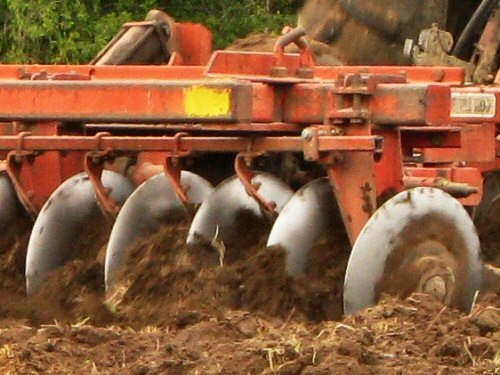
Disc action

It’s steel in the field… Big machine work was the tiny farm highlight today, not the machinery itself but the intense and much-needed sod-busting action. Peter, a (certified organic) beef and grain farmer on the next two (much bigger) farms down the road,  dropped by just ahead of a bit of a rainstorm, to disc the fields he’d moldboarded in the fall. There was time for two passes on the south field, then the weather hit, bringing plowing to a sudden stop as the ground almost instantly got too slippery and soft.

My experience with big tractor work is limited. Maybe someday I’ll get more involved with heavy machinery—to watch, at least, big machines are fascinating and…cool. Or perhaps I’ll go the other way, d/evolving all the way to Fukuoka-like farming with little more than an intricate method and a stick… Probably stay somewhere in between… :)

In any case, this is all one-time stuff. The double row of discs do some serious pizza-cutter work on the dense, moldboarded strips, so we’ll be able to rototill more easily and effectively, without tearing the little tiller apart. And then, the soil food web can rebuild.

Elsewhere, earlier, I direct seeded the first spinach, beets and radish. Following their progress in the new garden ground will be interesting…

Tiny farming: it’s a garden party!?

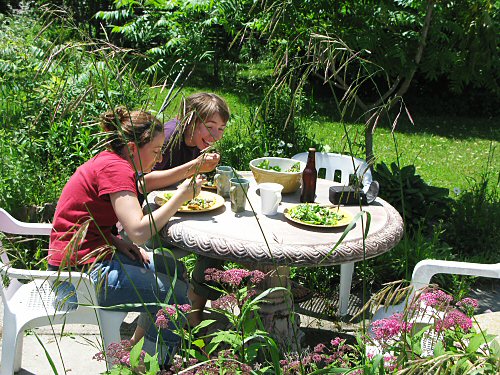
For the month of June, after Shannon, who’d been in the field just about every day in May, and while waiting for Lynn to start full-time for the rest of the season (July 1st!), I’ve been back working in solo mode, which has been, surprisingly to me, a little strange and…unfamiliar. Right now, there are several great people sharing the tiny farm experience (TFE ;) each week, but coming on single days. Here, with Lynn and Raechelle (Tuesdays!), we take an extended Endless Salad lunch break in the backyard. It’s as relaxed and fun as it looks. This, I think, is how it SHOULD BE, a laid back mix of fieldwork and practical leisure. It’s a lot different than the 10-12-hour, garden-obsessed days of the first 3-4 start-up years, when I worked largely alone. After working with Conall right through the season last year, I realized that my original solo mission, one-farmer-one-field mode had…changed. Evolved. To continue to grow on this tiny farm, it seems I’ve taken the path that needs not more production acreage or machinery or straight, head-down hours of labor, but simply more happily committed PEOPLE. Hmmm… Not a brand new discovery, but driven home over the last month. An interesting twist on tiny!

Greenhouse upgrades

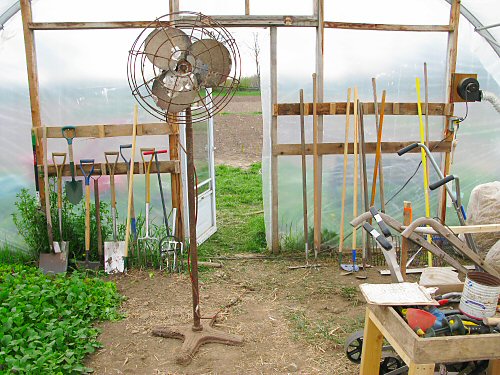
Another cloudy, cool, kinda chilly day. There’s always fieldwork to do, but this type of weather is also good for building, fixing, organizing…indoors. Today, some long-planned greenhouse upgrades. They may not look like much, but it’s a pretty big bunch of improvements! As part of Shannon’s kinda intensive “this is what I do around here,” hands-on experience (with full narration!) on this tiny farm, I showed her how to use a couple of basic power tools—cordless drill, chop saw—and she built simple legs for a wooden tray that I use for various small, often-used bits of gear (the tray’s shallowness is an automatic organizer: things can’t get really buried!). Really simple, rough carpentry, but if you haven’t used tools much or at all, and then you build something that’s immediately used in the course of the farming day…it all makes more sense! At the other end of the hoophouse, I put up another wooden crosspiece for leaning long-handled tools, and we separated the most-used and put the least used at the other end. Again, by avoiding a pile of stuff, everything’s easy to grab and put away. And then, we pounded a couple of 2×2 wooden stakes into the ground (pounding with a mini-sledgehammer was also on the farm experience menu today, I pound a lot of stakes for tomatoes every year as well…), and screwed another 2×2 as a crosspiece to make a leaning rack for the seeders and the wheel hoe (you can see one end on the right of the pic, one of the posts has orange tape on top). Finally, a machinery addition, a big, old, rusty, dangerous-looking high-volume fan on a really heavy iron stand. I’ve been meaning to work on greenhouse ventilation for ages…but always ended up using much smaller home-type fans. This one, which was actually being stored in the chickenhouse, I hadn’t noticed till now. It moves a ton of air, and reduces the temperature a full 10-15°F in the middle of a hot day. Cool! To look at, these little building projects are absolutely basic and kinda primitive, but they’re quick, easy, solid cheap, and really make a huge difference when you actually use them… (I just noticed in the pic how the right side of the end wall seems to be sagging, it doesn’t look that way at glance, I should check it out and see what’s up…)

Trip to town

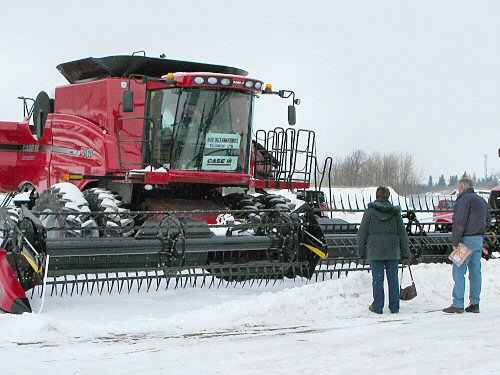
Took a trip to town today. During the winter, I get in once every 3-4 weeks, so it’s a bit of a novelty. This time in, we checked out an agricultural show, 28th year, filling the new fairground’s 45,000 sq ft of indoor exhibition space. It was quite busy, geared to the bigger conventional farmer, with aisles and aisles of heavy equipment, commercial seed, bank financing,… Outside, some even bigger machinery, like the combine harvester in the pic—it’s set up for soy—that could run over my entire garden in about 10 minutes (although the wraparound view from that air conditioned cab looks mighty inviting for a hot summer’s day in the field!). Inside, it’s mostly men in and around their 60s, with some wives scattered in. These guys were here with their fathers three decades ago, discussing new gear as family farms passed from fathers to sons. Now, the sons are the old farmers, and the next generation is nowhere in sight. Quite odd… Oh well, on to the super-sized supermarket, a Loblaws’ Wal-Mart killer, a huge deal with a produce court half the size of my market garden (not literally, but it’s pretty big), bakery, meat and fish counters, endless aisles, automated mini-bank, wine shop, tobacconist, full pharmacy, a whole section of clothing and housewares, and acres of convenient parking outside. It’s the old General Store, scaled up! I seldom do the grocery shopping for the farm, so when I do hit a supermarket, I head straight for the veggies first (I still kinda laugh at myself doing a “professional” veggie appraisal, this is the LAST situation I would’ve imagined myself in not too long ago). I bought some groceries: a bit of “fresh meat”, “fresh-baked bread”, a tub of mixed baby salad greens (and mine so soon to come!)… Only $200! Then, a quick fast food stop at A&W, not a guilty pleasure, or even a pleasure, just an old habit, a town routine… And there it was, a trip through the OTHER local food chain, 12 miles (19km) and a whole world away from the tiny farm. It’s a little surreal. Back to the seedlings… ;)

Rototiller breakdown

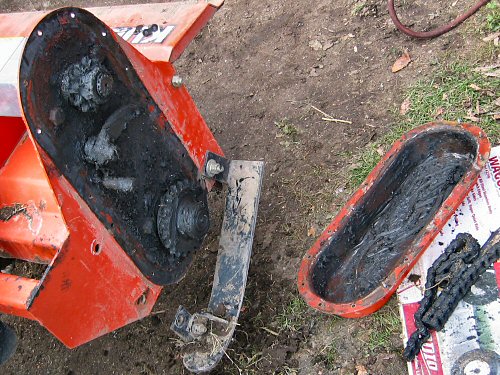
Like machinery everywhere, gear on the farm tends to break down just when you need it. This may be obvious, but it’s no less annoying for it!! Some breakdowns you know are coming sooner or later, like when you decide to let it wear out rather than fix it at the first signs of trouble. This you can avoid with regular maintenance including INSPECTION—checking things out for looseness and wear always eventually pays off—but often I, uh, don’t get around to it (as with, recently, the riding mower). Most breakdowns are, at least on the surface, sudden failures, like today, when in the midst of tilling with the 48″ rototiller on the back of the Kubota compact tractor, the tines suddenly stopped turning. This had happened once before, so the diagnosis was easy: broken chain. And that’s a good one. Every time something breaks and we fix it, I stock up on extras of whatever was used in the repair—DIY repair and a good selection of spare parts go hand in hand on the tiny farm! So, for the chain, there are parts: full links, offset links, master links. A replacement chain is also quite cheap and a good thing to have on hand. This particular repair job is dirty but extremely simple and straightforward, same as for a bicycle chain. Pop off the chain guard, scrape off the excess grease, bang out the rivets on the broken links and add new ones, or decide to replace the whole thing, put the chain back on…it’s about as simple as that, and you’re back in the saddle again!