
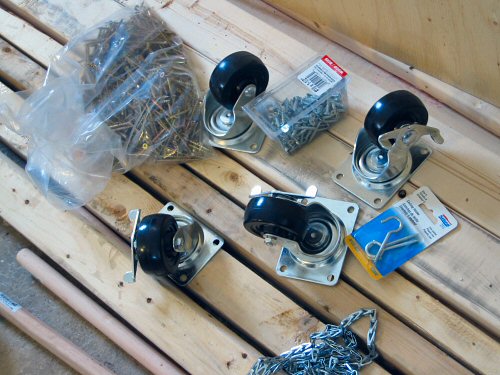
The materials for building a new grow rack just arrived. With this one, there’ll be three in all. It’s a bit a of milestone. I’ve used just two racks, built from ridiculously warped wood, to start literally thousands of seedlings over the last four years. Adding one more means a huge jump in production capacity. Well, 50% more, to be exact… Here we have wood, wheels (casters are a new addition this year for all racks), chain and dowels for hanging the lights. Cut up, screw together, add fluorescents…dead easy! And needed in the next few days when seed starting begins in earnest.
Lettuce under the lights
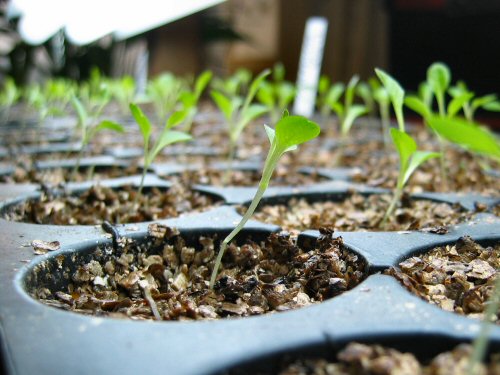
Checking in with the early lettuce. The seedlings are developing their first true leaves. Fluorescent lighting is inexpensive and does the trick, but it still bothers me how seedlings stretch and strain toward the available light, when what they really want is the Sun.
Valuable stuff!
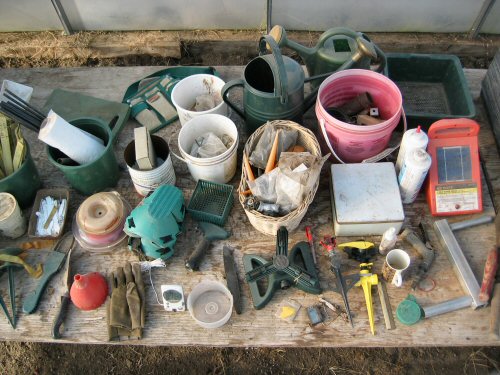
A tableful of useful gear, arrayed for further sorting after the greenhouse clean-up a couple of days ago. If you see this collection as probable junk, the remains of an uninspiring yard sale, anything less than EXCITING, then it may be hard to convey how much small farming involves an intimate, practically passionate, relationship with little tools and devices. At least, for me it does! I’m not into miracle gadgets, but I’ll try anything that looks cleverly useful, time-saving, labor-saving. Many don’t work out (at times because they’re scaled to TOO tiny a garden), but staying in a tight budget avoids much waste. Of course, first and foremost, there are basic tools that simply do what they’re intended to, work well, and don’t break, which is not that common. Each time you find one of those, it’s almost like falling in love! :)
A beautiful day
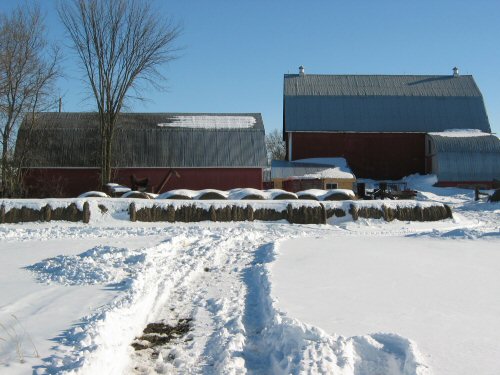
A beautiful day in the snowy field, looking back at the outbuildings from the greenhouse. I used the Kubota (the trusty compact tractor) to clear the path, more to take it out of the shed and give it a little run than because the snow’s too high to trudge through. The temperature’s around zero C, the sun is getting higher in the sky and warmer as she climbs, snow is melting at the edges and through the thin spots wherever you go… Is spring in the air? Sure feels like it!
Volunteers prep greenhouse!
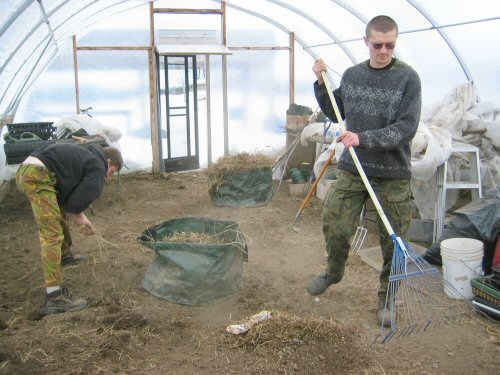
Looking a tad paramilitary, brothers I met at the market (they’re studying at the nearby environmental/forestry college) pitch in to clean out the greenhouse and loosen up the soil. The space, used for seedlings in spring and early summer, tends to fill up with odds and ends, and weeds, as the season progresses. Last spring, I tried growing early lettuce in here to get a jump on the weather. This year, an even earlier start is planned. Getting the place sorted and ready to go ahead of sked is great. On the tiny farm, nothing could be better for fieldwork than plentiful, like-minded labor. Especially, volunteers!
Tiny Farm Bookshelf, Part 1
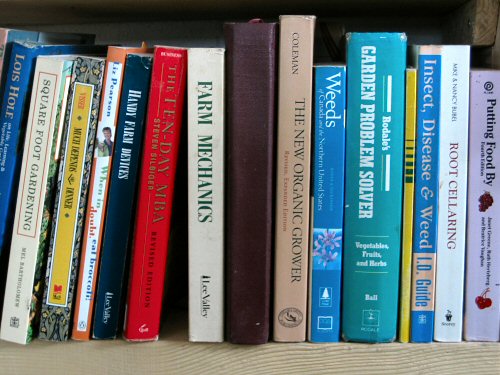
This is about a quarter of my farming bookshelf. I get a ton of info from the Web, particularly in winter when I have more time to cruise around online, but books I’m still most fond of. Let’s see what we have…
For one-stop shopping, you could take Rodale’s Garden Problem Solver and a bunch of seeds and that’s all you’d need to get started. This book wasn’t an early acquisition, I think I got somewhere into my first year, but it’s turned out able to answer just about every organic production question I’ve had, from cultivation to irrigation. It’s a little sun-bleached from trips to the field. And then, The New Organic Grower is probably required reading if you’re selling what you grow: practical and also kinda inspiring on the microfarm marketing side.
Lettuce overnight
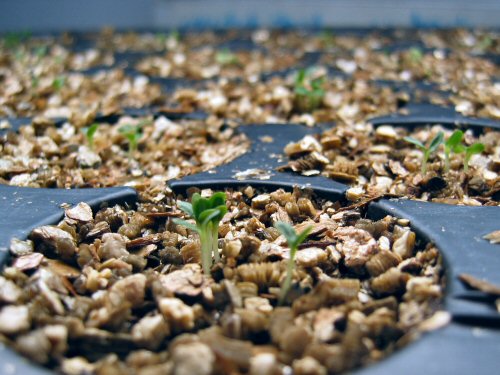
The first lettuce pushed up overnight! Here, lovely red Granada, an Oakleaf-type leaf lettuce that intensifies into a deep burgundy as it matures. Also in trays, Sierra, Simpson Elite, Two Stars and Red Salad Bowl. Now, how early will they be ready for market (the farmers’ market kicks off the first Saturday in May…)?