
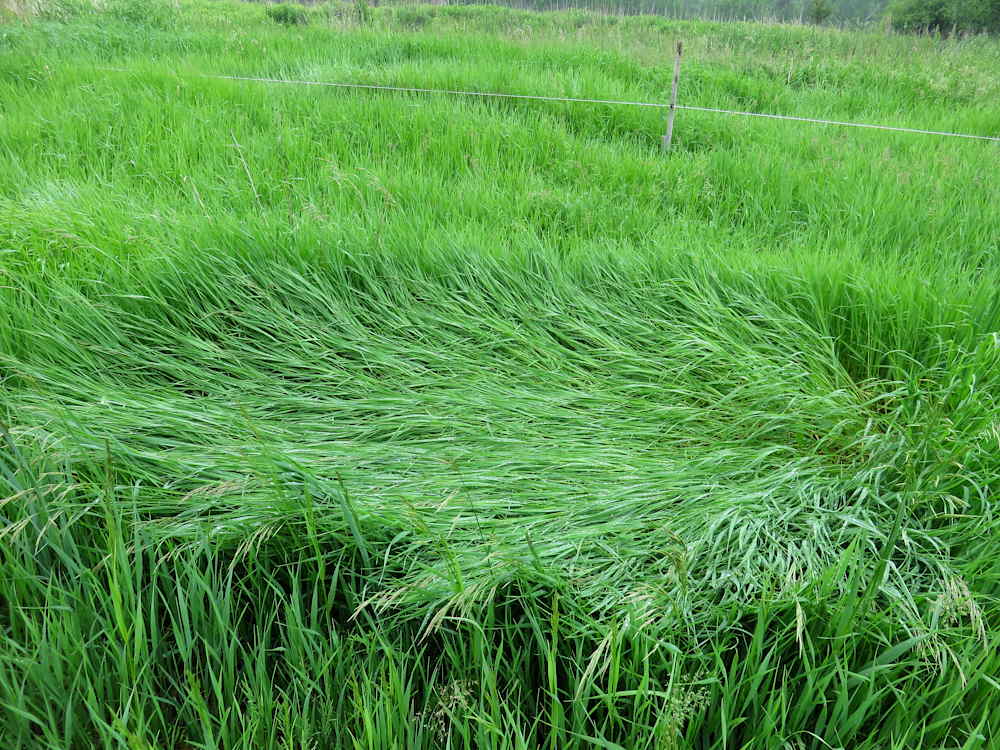
Wonder who spent the night here in the tall grass, so close to all those veggies. At least they stayed on the right side of the fence! It’s endlessly satisfying how that single white line and its steady pulse of intense electrical jolts have managed to keep the veg plot clear of deer. I can’t say for sure that’s what’s doing it, but deer are definitely all around, traveling through these fields, and they were a big garden forager before and during various lighter-weight fencing attempts. They only completely stopped devouring after that single line of defense went up. No electric fence guides I’ve read suggest just a single line, and yet, the plot’s been deer-free for years now. Can’t say the same for groundhogs, that extension of the electrical defense was a fair bit of work and a fail. But, still no deer!
electric fence
Boldly low-tech grass clearing method
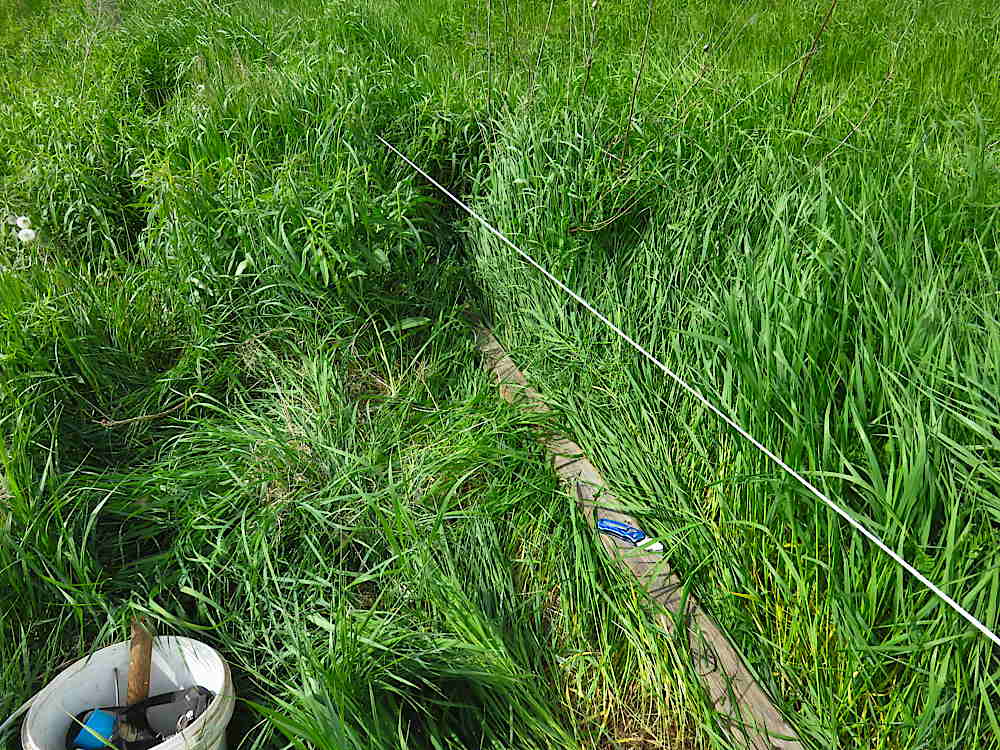
An experimental procedure, effectiveness so far unknown. In some spots, sections of tall grass are swallowing the single strand of electric fence that has so far protected the veggie patch from deer. To keep a nicely unpleasant jolt running smoothly, the grass must be cleared! I’ve used various methods in the past. There’s been the 48″ deck mower on the tiny tractor. Running over the strip under the fence line with the same tiny tractor. Or the handy string trimmer, aka weed whacker, that spits out microplastic particles as the nylon cutting line wears down. And the low tech large garden shears. This year, I’m doing things as manually as possible. If I had a scythe… Since I don’t, and the garden shears haven’t been at all as quick and efficient as I’d hoped, I had a new idea. Lay down a plank under the line—here it’s a 2x4x8—to bend the grass, slide it over a bit so the strip of bent bottoms under the plank is exposed, and slice through with a utility knife, using the plank like a ruler. It went pretty quickly, with only 60-70′ (18-21m) in total of sections to do. And the grass is gone! Whether this really works we’ll find out in how long it takes to grow back. Hopefully, the cut grass will dry into a mulch that helps block future growth. I’m modestly optimistic—the minimum expectation for me to try it at all. Stay tuned!
Thin white lines
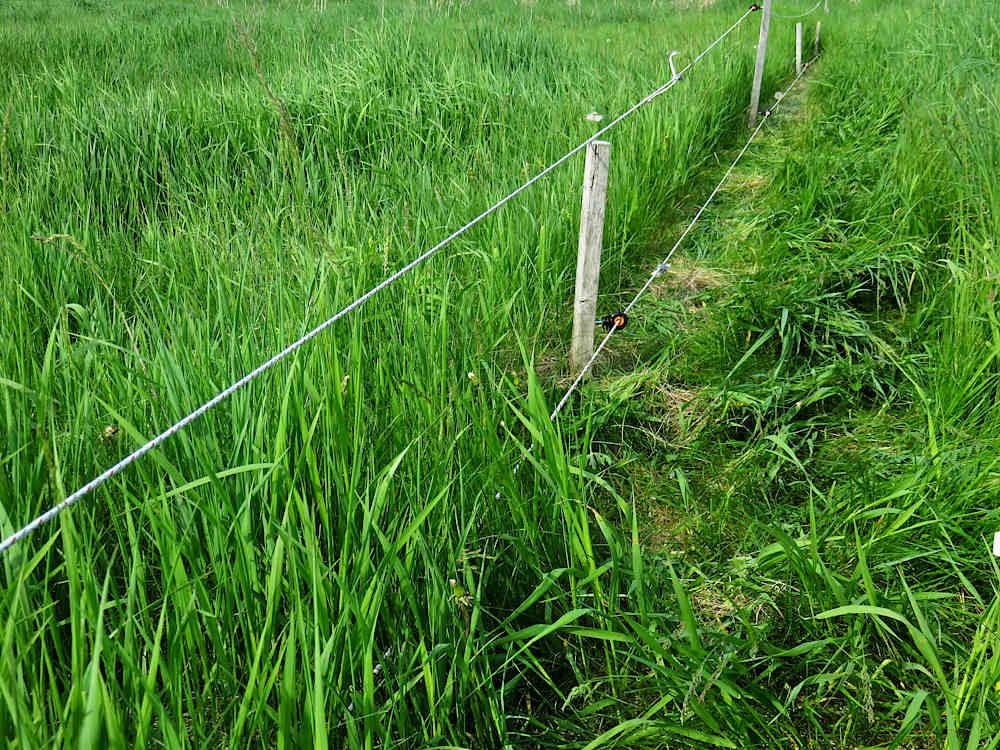
Two lines of electric fence rope, one for deer, one for groundhogs, running through the so-very-healthy grass, perfectly illustrates the nature of the war on weeds. Maybe I should use less militaristic terms, but that’s what comes naturally—guess it’s my cultural upbringing. And it does feel like a battle. On the ground, face to face, against a well-adapted indigenous…opponent. Spraying herbicides would be like an impersonal aerial war, bombing from on high. In this tiny farming, it’s hand pulling and snipping, and using the pulled weeds as mulch to hopefully smother reinforcements that are ready to spring up. Here, letting the grass swamp the fence lines would be bad for the system, draining the battery and reducing the strength of the all-important ZAP!
Groundhogs be zapped!
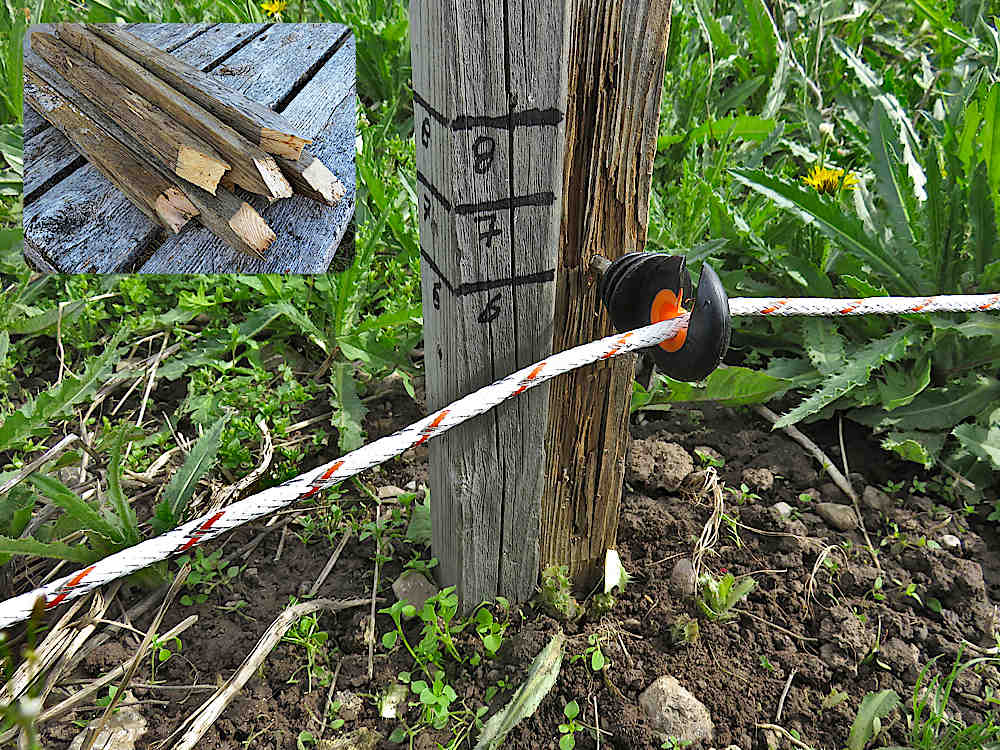
Big Agriculture has its genetic engineering and laserbeam weeding; on the tiny farm, sharpened wooden stakes and startling but harmless electric shocks are about as high tech as it gets. Today I laid out the groundhog electric fence line—poly rope with metal strands twisted in, strung at six inches (there’s another line at 28″ for the deer).
After last year’s first-time groundhog attack, this approach seemed to work. Still, that was later in the season, when the voracious little critters were already starting to get heavy and slow as they bulked up for hibernation. Maybe they were too lazy to put much energy into dealing with short, sharp shocks. This time around, they’re well-motivated, slimmed down, and hungry for the all-you-can-eat veggie buffet only a short waddle away. So…we’ll see! Weeds that touch the low line can draw off electricity—a new extra weeding job to add to the list…
Critical garden gear!
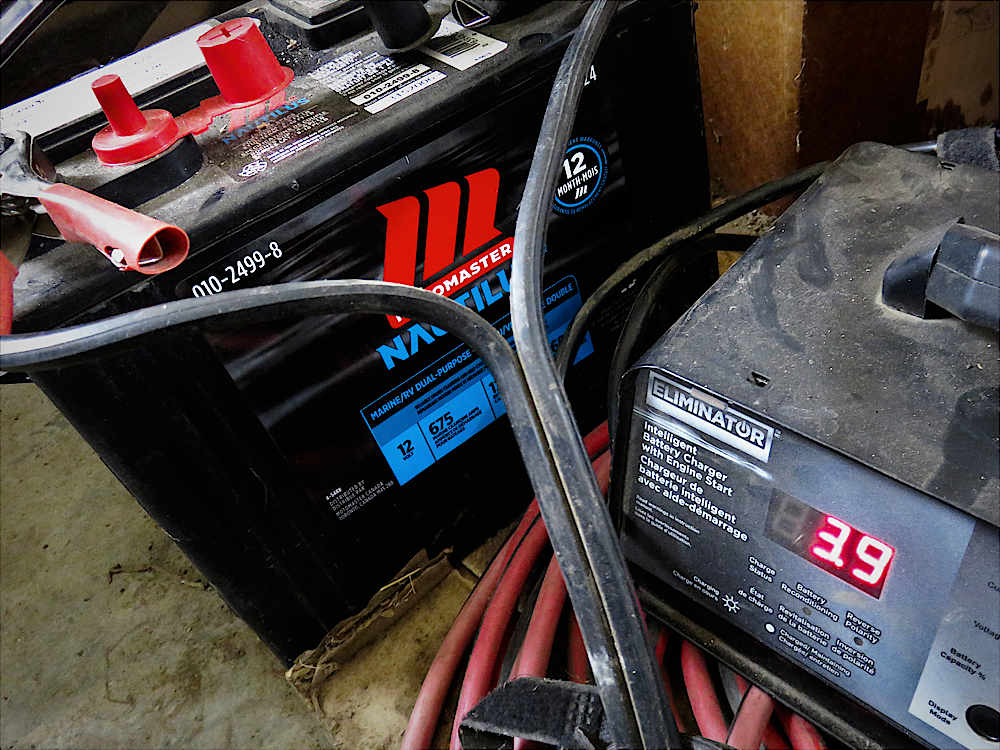
As important as any tool around here, the battery for the electric fence is absolutely critical: for several years now, it’s powered the first and last line of defense against…deer! As of last season, and the addition of a low-strung line only a few inches above the ground, it also gives a little jolt to the groundhogs that suddenly appeared in force. Without the e-fence, the market garden would eventually be munched into oblivion. Along with keeping the battery charged and checking that the fence line hasn’t gone down or gotten overrun by weeds, there’s also looking daily for animal tracks and signs of snacking. Doing the inspection rounds first thing every day is mix of low-level stress, anticipation of the worst, and general excitement, until it checks out as all-clear. Which, thankfully, is almost all of the time!