
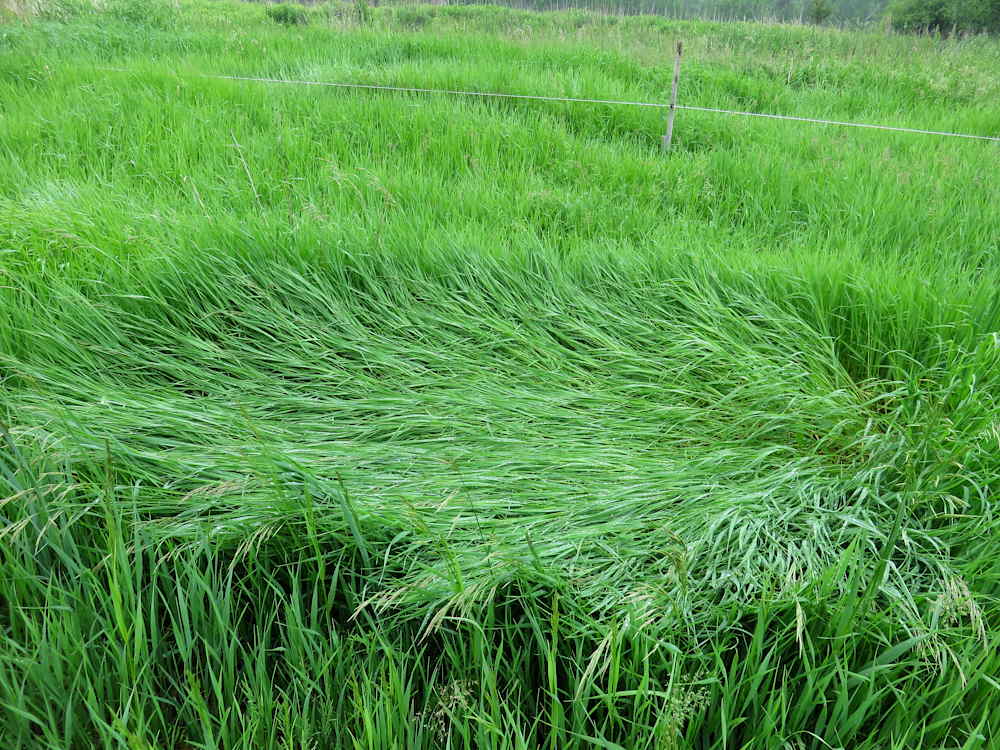
Wonder who spent the night here in the tall grass, so close to all those veggies. At least they stayed on the right side of the fence! It’s endlessly satisfying how that single white line and its steady pulse of intense electrical jolts have managed to keep the veg plot clear of deer. I can’t say for sure that’s what’s doing it, but deer are definitely all around, traveling through these fields, and they were a big garden forager before and during various lighter-weight fencing attempts. They only completely stopped devouring after that single line of defense went up. No electric fence guides I’ve read suggest just a single line, and yet, the plot’s been deer-free for years now. Can’t say the same for groundhogs, that extension of the electrical defense was a fair bit of work and a fail. But, still no deer!
groundhog
Thin white lines
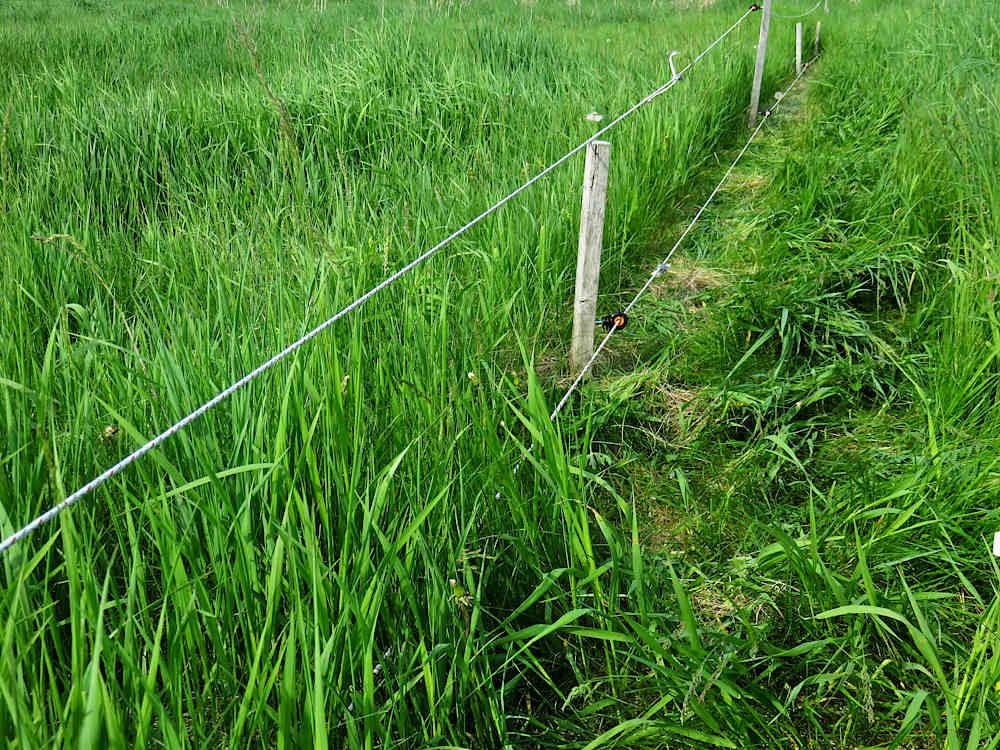
Two lines of electric fence rope, one for deer, one for groundhogs, running through the so-very-healthy grass, perfectly illustrates the nature of the war on weeds. Maybe I should use less militaristic terms, but that’s what comes naturally—guess it’s my cultural upbringing. And it does feel like a battle. On the ground, face to face, against a well-adapted indigenous…opponent. Spraying herbicides would be like an impersonal aerial war, bombing from on high. In this tiny farming, it’s hand pulling and snipping, and using the pulled weeds as mulch to hopefully smother reinforcements that are ready to spring up. Here, letting the grass swamp the fence lines would be bad for the system, draining the battery and reducing the strength of the all-important ZAP!
Groundhogs be zapped!
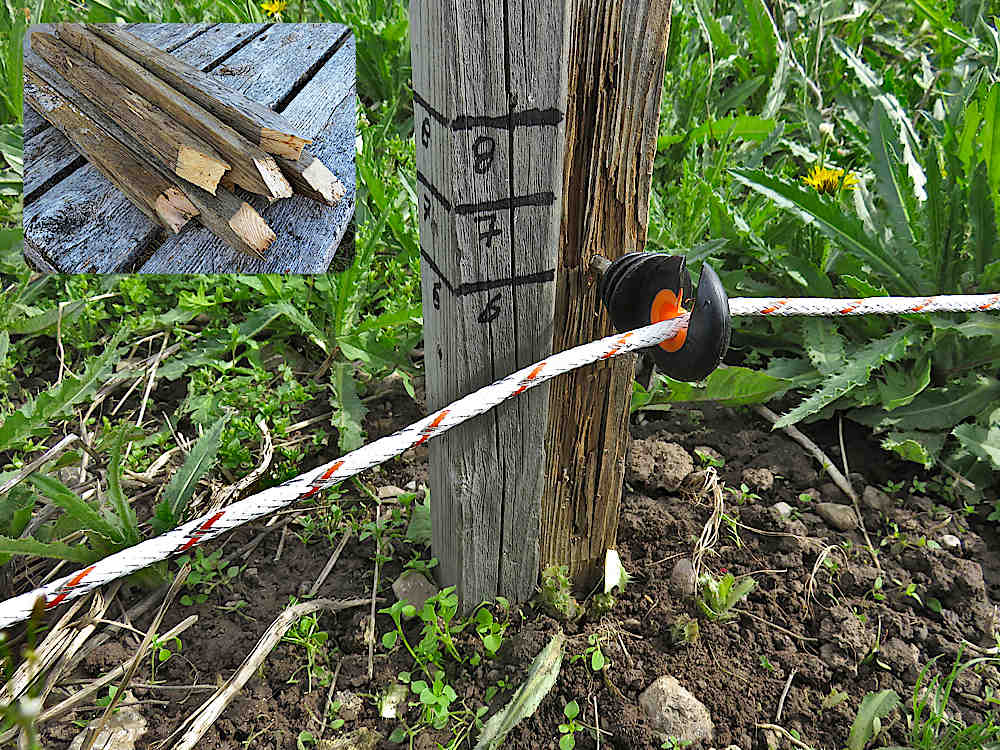
Big Agriculture has its genetic engineering and laserbeam weeding; on the tiny farm, sharpened wooden stakes and startling but harmless electric shocks are about as high tech as it gets. Today I laid out the groundhog electric fence line—poly rope with metal strands twisted in, strung at six inches (there’s another line at 28″ for the deer).
After last year’s first-time groundhog attack, this approach seemed to work. Still, that was later in the season, when the voracious little critters were already starting to get heavy and slow as they bulked up for hibernation. Maybe they were too lazy to put much energy into dealing with short, sharp shocks. This time around, they’re well-motivated, slimmed down, and hungry for the all-you-can-eat veggie buffet only a short waddle away. So…we’ll see! Weeds that touch the low line can draw off electricity—a new extra weeding job to add to the list…
Scratching the zuke
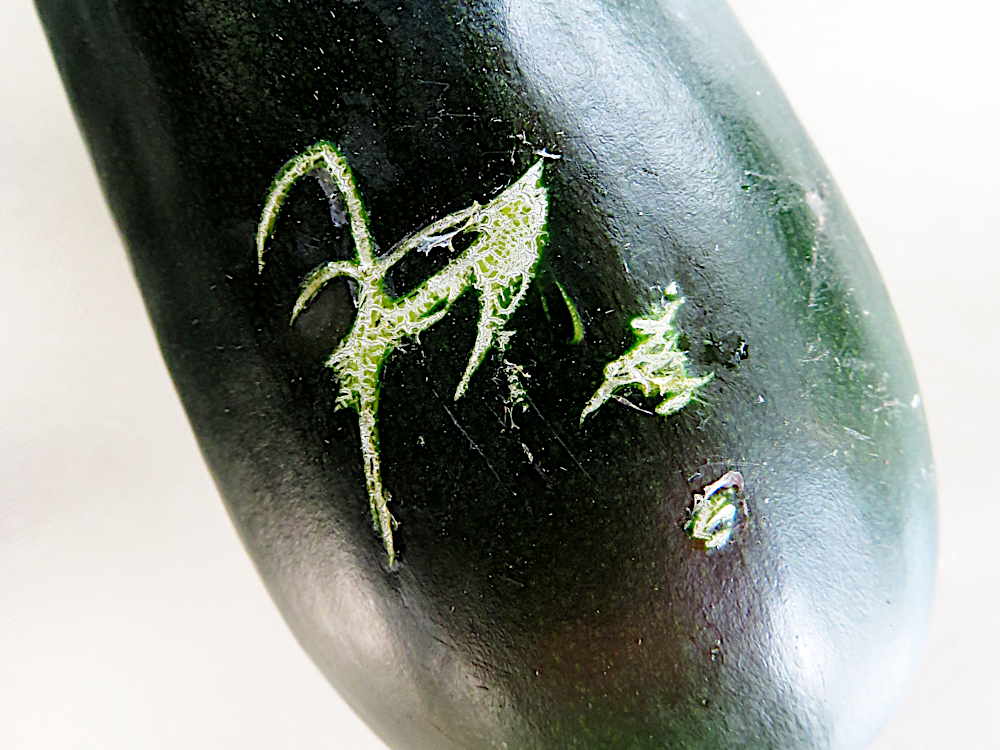
Groundhogs are back again, and they seem to be more active than last year. I’m checking everything out every day to see how far they might go. It comes down to what they turn their beady little eyes and big sharp teeth to next. My garden ravager experience has been for the most part with deer. When a veg garden is new to them, they tend to explore crop by crop. A night or two of nibbling on a new one, then, full-on devouring, and off to the next. So far, the over-sized rodents have focused on lettuce and brassicas. Today, I noticed what look like scratch marks on a single zucchini. I’m no wildlife biologist trained in animal feeding behavior. Still, I suspect some fair-sized beast, like a groundhog, tried to scratch their way into the zuke. And failed. That’s kinda weird, doesn’t look like an A-game effort. Have they given up for good? Or was it a much smaller veg-eating creature? Or something else entirely? The big question is, will the zukes be next?