
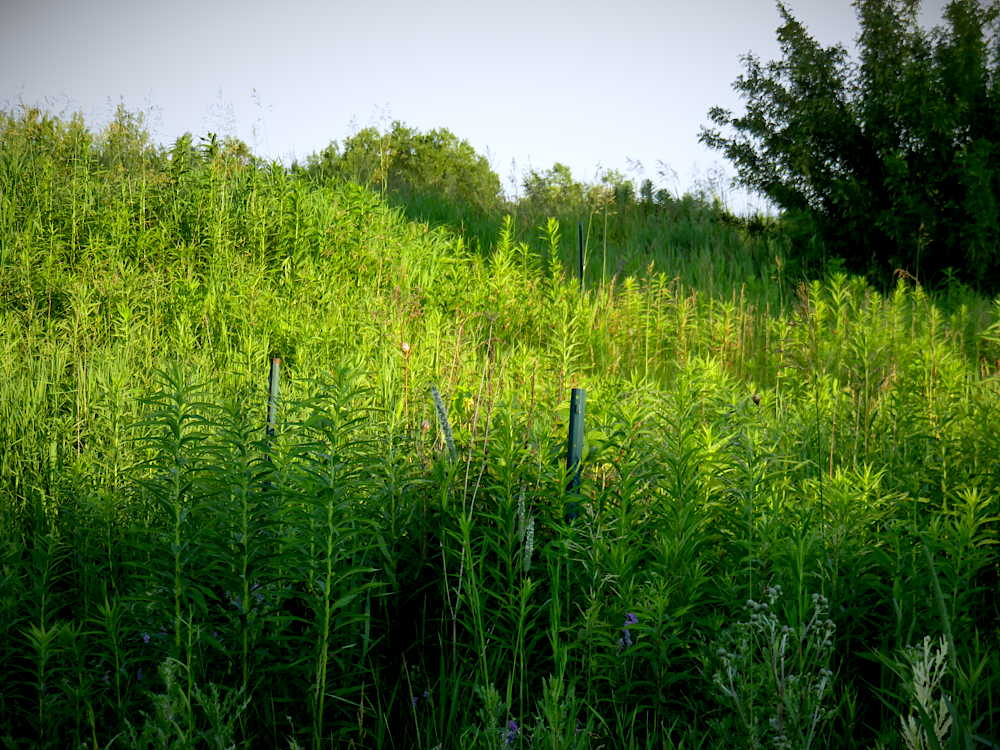
A field of goldenrod and tall grass—what the garden would look like, left to its own devices. It’s Day 4 of the first official heat wave of the season, coming to an end. I’m headed to the veg plot, a couple hundred feet slightly up and to the left, to turn on the electric fence for the night. Earlier in the afternoon, it probably hit around 34°C, which isn’t quite up to the crazy new highs we’ve been getting in recent years. Still, it was exhausting because of the thick, oppressive humidity, so spent much of the day indoors with a fan. Uncomfortable, but here at least, not as scary as the scrolling list of warnings and advice on the weather app made it seem, mixed with equally dire details of a possible sudden, severe thunderstorm. All the weather alerts get kind of annoying when most aren’t as bad as the extremes they describe, but I guess they’re overall useful, especially in cities. We’re being looked out for! And the heat is supposed to end overnight. As the sun goes down, it’s already quite cool and relaxing and the mosquitoes aren’t even bad!
grass
Boldly low-tech grass clearing method
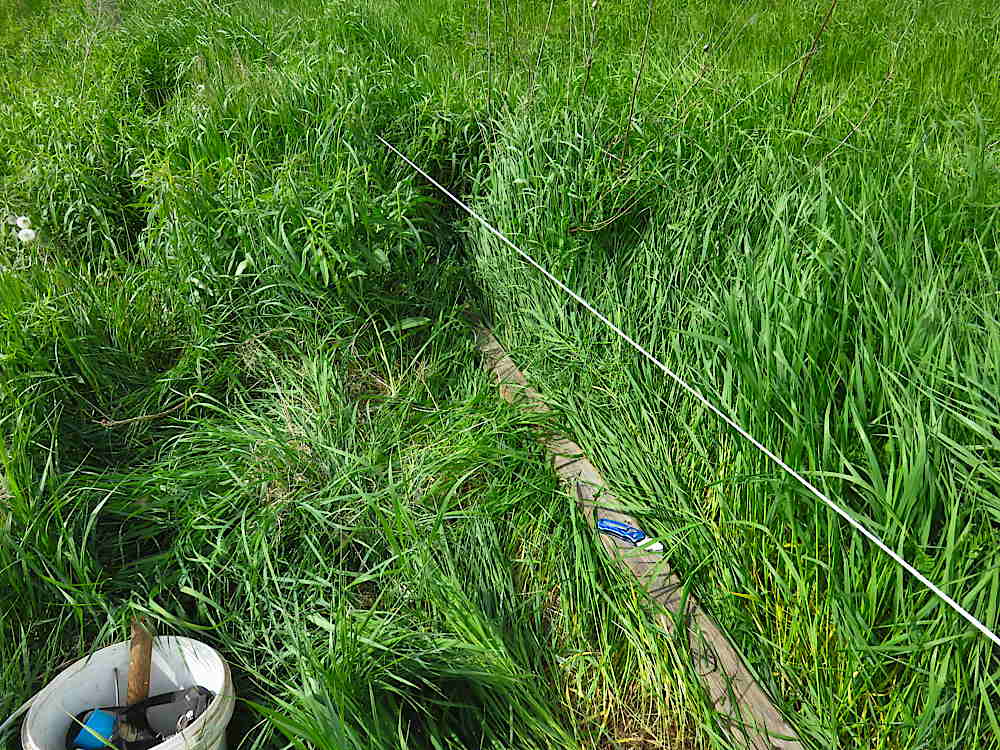
An experimental procedure, effectiveness so far unknown. In some spots, sections of tall grass are swallowing the single strand of electric fence that has so far protected the veggie patch from deer. To keep a nicely unpleasant jolt running smoothly, the grass must be cleared! I’ve used various methods in the past. There’s been the 48″ deck mower on the tiny tractor. Running over the strip under the fence line with the same tiny tractor. Or the handy string trimmer, aka weed whacker, that spits out microplastic particles as the nylon cutting line wears down. And the low tech large garden shears. This year, I’m doing things as manually as possible. If I had a scythe… Since I don’t, and the garden shears haven’t been at all as quick and efficient as I’d hoped, I had a new idea. Lay down a plank under the line—here it’s a 2x4x8—to bend the grass, slide it over a bit so the strip of bent bottoms under the plank is exposed, and slice through with a utility knife, using the plank like a ruler. It went pretty quickly, with only 60-70′ (18-21m) in total of sections to do. And the grass is gone! Whether this really works we’ll find out in how long it takes to grow back. Hopefully, the cut grass will dry into a mulch that helps block future growth. I’m modestly optimistic—the minimum expectation for me to try it at all. Stay tuned!
Front yard farming!
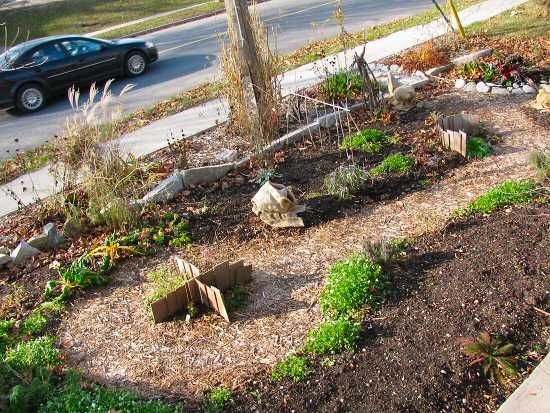
Often heard about, never before seen first-hand, this is front-yard tiny farming in action—late fall edition. I’m at the home of Andrew and Sue and Margo, in a town of 70,000, leaning on the front porch rail on a residential street lined with single homes on small lots. Typical front lawns all along. Except here, where the grass is gone, replaced by an eclectic collection of veggies and herbs. Beets, carrots, tomatoes, corn and several other crops are already gone for the season. Still up and struggling along in the cold, there’s colorful Swiss chard in a couple of spots, parsley and sage, and a few other things that need a closer look to ID. Andrew also mentioned native edibles, like ostrich fern (fiddleheads), wild ginger and wild leek. And more. The keyhole path set-up comes from permaculture methods: minimum path for maximum access to the growing area. It’s a front-yard revolution! After a season or two of sidewalk-side veggie abundance for all to see, I wonder if this alternate land use will start to spread up and down the street! Urban agriculture. Pretty cool!
Potato digging party
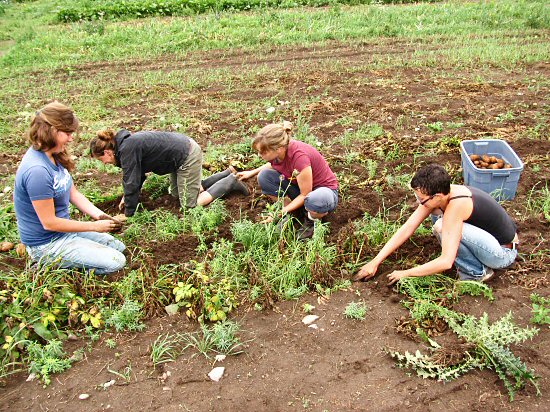
It’ll be hard to top THIS one for extremely labor-intensive tiny farming involving lots of peeps! Here, Libby, Lynn, Andie, and Mel hand-dig potatoes for tomorrow’s farmers’ market. The taters happen to be Gold Rush russets, and they’re in fine form, with a little wireworm damage (surface blemishes or tiny holes) to only a few. We’re right at the end of the first (of three) potato areas of this year, 600′ (183 m), evenly divided between Penta, Chieftan and Gold Rush.
So, what’s with all these people, digging together in a cluster, with just one bin? A little inefficient, pehaps? Well, not really. When there’s a lot of folks happy to mix it up with the dirt, tackling a single task all together can work out! We only needed about 70 lbs of each variety (that blue bin full). With the moist-but-not-mucky soil, pulling plants and scrabbling around was quick and easy. BIG POTATOES helped. Working close together wasn’t a problem because we had so little area to cover. Each bin got filled in maybe 15 minutes. Satisfying!
In the photo, you can also see how relatively good shape we’re in with weeds. The bit of grass growing back is in separate clumps, all the runners haven’t started to reach out and hook up. Further up is a section of more heavily overgrown onions. But that’s actually doing well as well: the onions were thoroughly weeded twice, and hoed a couple more times, so what you see is mainly grass from the last three weeks (without much shading out from the onion plants, everything else grows fast!).
Anyhow, when we tackle the main potato patch, around 2,000′ (609 m), methods will change. But we’ll still be digging in the dirt…!
Spot the tiny farm!
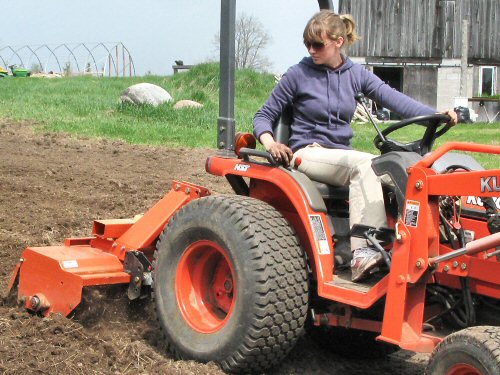
What’s in a photo? Depends what you’re looking for! Take this pic of Andie, rototilling today with the Kubota. Pretty straightforward: woman, machine, field. BUT, can you spot practically EVERY main part of a really tiny farm (at least, of this one), represented right here?
It’s mostly hand work, but there’s some gear: Of course, we have the Kubota compact tractor, flagship of an motley assortment of gear specifically suited to tiny farming. It’s rugged, very much a diesel TRACTOR, but small, and designed more for the big estate crowd than agriculture. Around here, though, it’s the workhorse machine, a people multiplier with its bucket and essential 48″ rototiller. As far as I know, rototillers aren’t core gear on tractor farms, but it’s our ONLY field implement so far, a huge labor-saver over walking up and down with the walking rototiller, or digging by hand. And the turf tires seem to work just fine.
New people diving in: And then there’s Andie, doing (tiny) tractor work within the first few hours of her entire market garden experience. (It’s cool that she’s already looking over her right shoulder, it’s a classic tractor farming pose—except maybe not with GPS?) She also has DIRTY HANDS on the wheel, from checking out the tilling results, and they’ll stay dirty as she moves off the tractor in a few minutes, on to hands and knees to plant onions.
A big shed (aka barn): A barn of some sort is the main, sooner-or-later essential, working structure that separates clear land from a working tiny farm. Really, a basic barn is just a big, all-purpose shed (this one, 20’x32′, is pretty tiny, just four walls), for getting things out of the weather. You use it to store harvests and gear, and to work out of the wind and rain (and of course, we have winter). With rough carpentry, you remodel and reconfigure it to fit: an extra hook here, new door there, closed off room in a corner, whatever you need!
Lots of work, all day long: Elsewhere in the pic, less obvious but clear signs of tiny, labor-intensive veggie growing. In front of the barn, tables of seedlings are hardening off. They’re brought out in the morning, taken in at night, back and forth, back and forth. That’s because the greenhouse (hoophouse frame on the left) isn’t finished yet. And THAT’s because there is just SO MUCH TO DO ALL AT ONCE. Like, mow the grass for mulch, before it gets outta control. And get a new battery for the John Deere riding mower (on the top left), so it can haul around the trailer loaded with whatever we need to get LOTS MORE STUFF done. It all weaves into one big picture of tiny, simple, interdependent tasks that go on and on and on, all day long…
It can get a little intense, but it’s also really fun, if you don’t get all grim and serious about it and try to tie in the state of the entire planet (try to stop following the news!). You get to pretty much see where you’re going. Meet people in a really interesting way. Eat well. Sleep well. Kinda…simple! I think that’s a pretty good start…
Grass vs moldboard
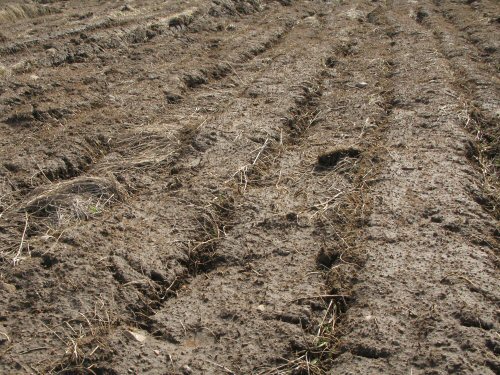
The hay fields were plowed late November, the sod sliced and flipped over by the moldboard, burying the grass so it gets no sun and exposing the severed roots to winterkill. A quick, bold, chemical-free first step in preparing a large clearing for crops. In the couple of garden sections I’ve started like this, it’s been quite effective, but given the slightest break, the grass is ready to come back…
Moldboard plowing—peeling back the land—is usually big-tractor work these days. It takes a lot of energy. If you happen to of soil as a complex living web, an intricately choreographed dance of life taking place mainly in the top 6″ (15cm) or so—sounds good to me!—one look tells you that moldboarding is pretty intense and destructive. Done excessively, with big, modern machines, it is a proven soil killer, encouraging erosion and other unhelpful things. For the tiny farm, this is a one-time-only deal, to start off a new garden area. It’s just the beginning…