Morning carnage

Weed tree, trash tree, table-eating tree, time to step back!

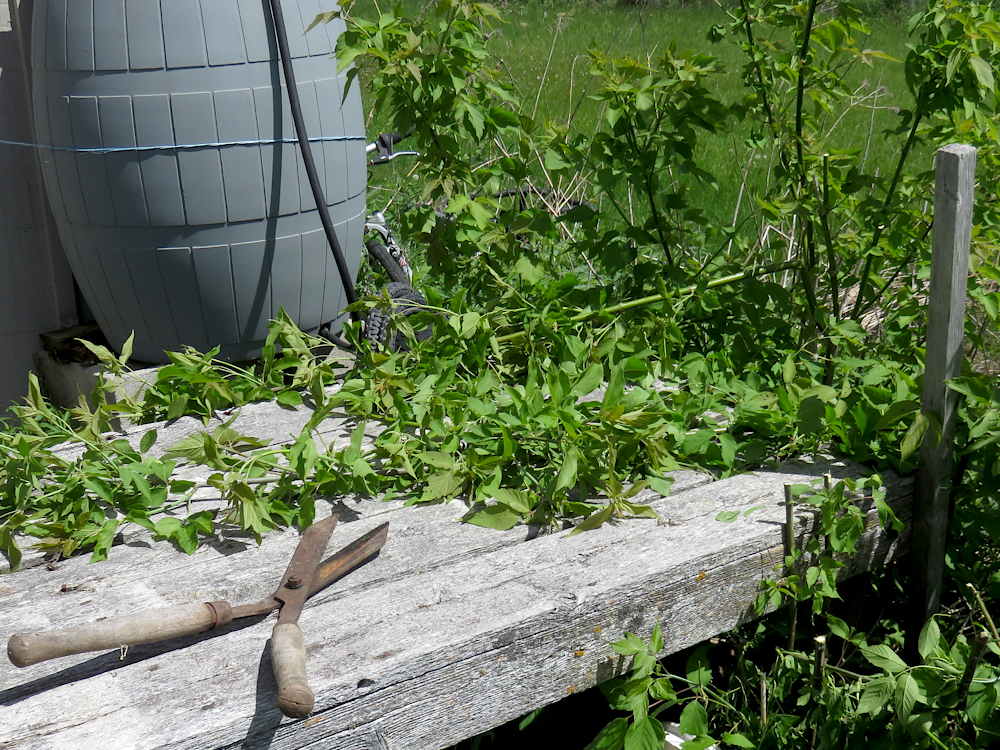
Cutting back the invading box elder from the work table, using antique garden shears, the best tool I have at hand, seems kind of brutal, but this is tiny farming. The whole idea is to direct some space, some land, to your liking. It is kind of militaristic in nature, there’s no getting away from that! Take over, suppress what you don’t want, install what you do, and hunker down to maintain position. I’m kidding, of course, actually thinking about farming and gardening in those stark terms is stressful, not useful or fun. IMHO, you layer on your story to suit the situation, and do what you have to do.

The garden shears only work well on the pencil-thick still-green upper stems, but that’ll do for now. Loppers—lopping shears, with long leveraging handles—would be perfect here, the tool for the job, though at the base this tree is probably a little past even them. So then, a pruning saw. I have neither, so a real saw, a sharp pocket knife, and some bending and twisting may be involved for a decent cutback. Or, much as I don’t want to invest in a box elder battle, I’ll get ahold of a pruning saw. I wonder how much the roots can expand, year after year, without any leaves to feed them…
Thin white lines

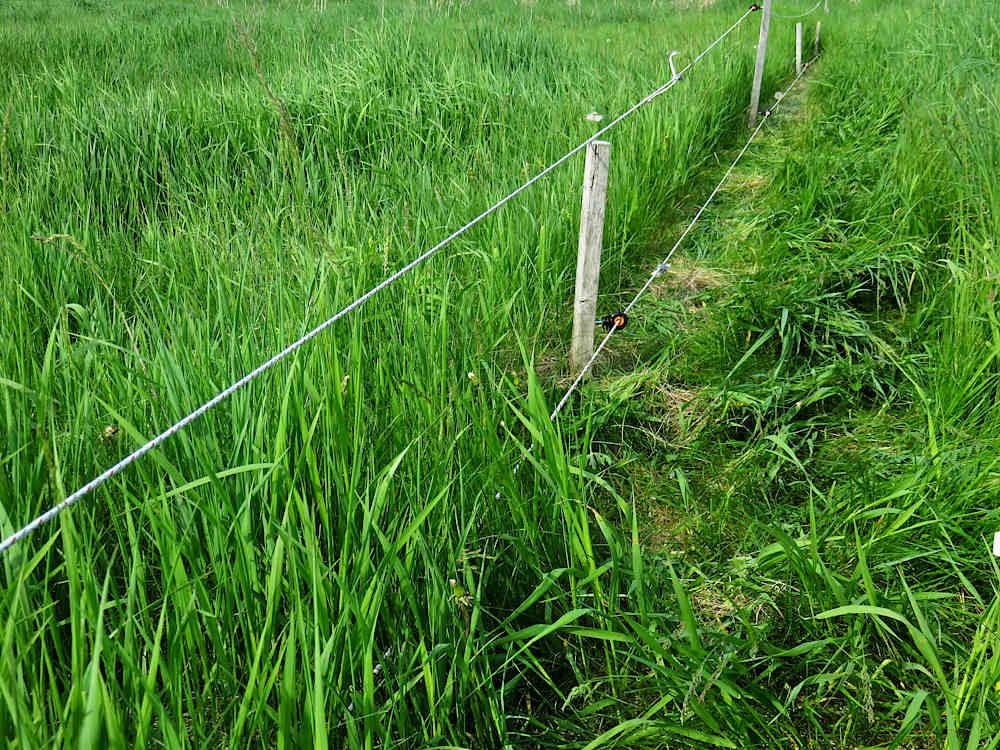
Electric fence lines for deer and for groundhogs

Two lines of electric fence rope, one for deer, one for groundhogs, running through the so-very-healthy grass, perfectly illustrates the nature of the war on weeds. Maybe I should use less militaristic terms, but that’s what comes naturally—guess it’s my cultural upbringing. And it does feel like a battle. On the ground, face to face, against a well-adapted indigenous…opponent. Spraying herbicides would be like an impersonal aerial war, bombing from on high. In this tiny farming, it’s hand pulling and snipping, and using the pulled weeds as mulch to hopefully smother reinforcements that are ready to spring up. Here, letting the grass swamp the fence lines would be bad for the system, draining the battery and reducing the strength of the all-important ZAP!

Spinach in the field

Yay, spinach! Seeing direct seeded crops germinate is one of the most satisfying things in the field. Here, it’s spinach, Reflect variety, seeded a few days ago, coming up nicely. In general, seeds do germinate, that’s a good starting point. But there are lots of variables, and the unpredictable weather extremes that have become the new normal don’t help. Is the seed new this year, or has it been around for a year or more? What conditions does the particular veg like: ground always wet until germination, soil temperature not too low or too high, seed not too deep or too shallow, and so on. It sounds more complicated than it is, only because, as a tiny farmer, you have little control over any of it. You lay seed down at a reasonable depth, water it in, watch, hope for the best, and prepare to reseed if things don’t go your way!

Looking tiny by comparison, you can also see redroot pigweed seedlings popping up. They’re easy to handle if weeded early. Otherwise, a no-joke garden invader!

Weed ID-ing in the Digital Age

Weed ID app photo

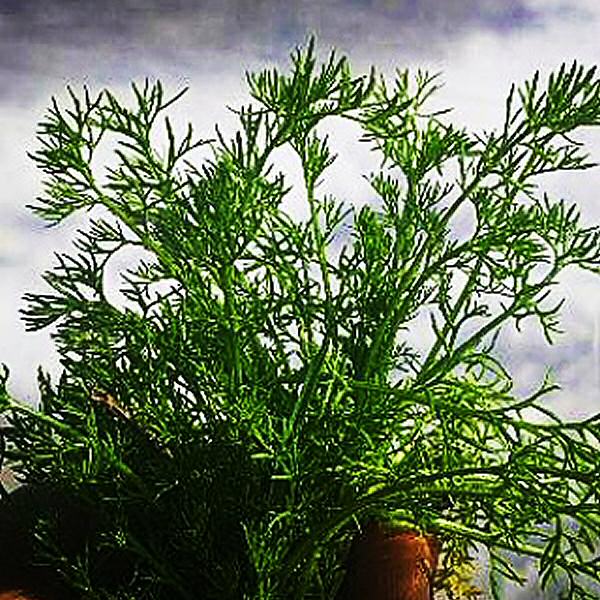
Wormwood of some sort, this weed from the greenhouse, according to our best guess from a selection of possibilities offered up by the smart smartphone plant identification app I’ve been playing with/trying out. There are several such apps for Android: this one’s called Like That Garden—”See a plant, take a photo, and find out what it is – instantly!” It got the highest ratings, and is free, so I grabbed it.

Like the advertising says, it’s that simple to use. With the app, you take a snapshot of the mystery plant that’s saved as a low rez image (above) and sent off into the ether where it’s checked against a vast plant photo database, several possibilities soon return, with multiple images for each, and you pick the one most likely (I suppose in some cases, only one choice comes back, but so far, that hasn’t happened). The technology is all about advanced image recognition and visual searches, very…digital. Trying it out on a few plants, it’s worked quite well.

While this app is doing fine, I have a great (effective) weed book as well. Is the app a novelty toy, or a serious tiny farming tool? Or will the smartphone be accidentally dropped in a puddle and destroyed before we get a chance to decide? Only time will tell…