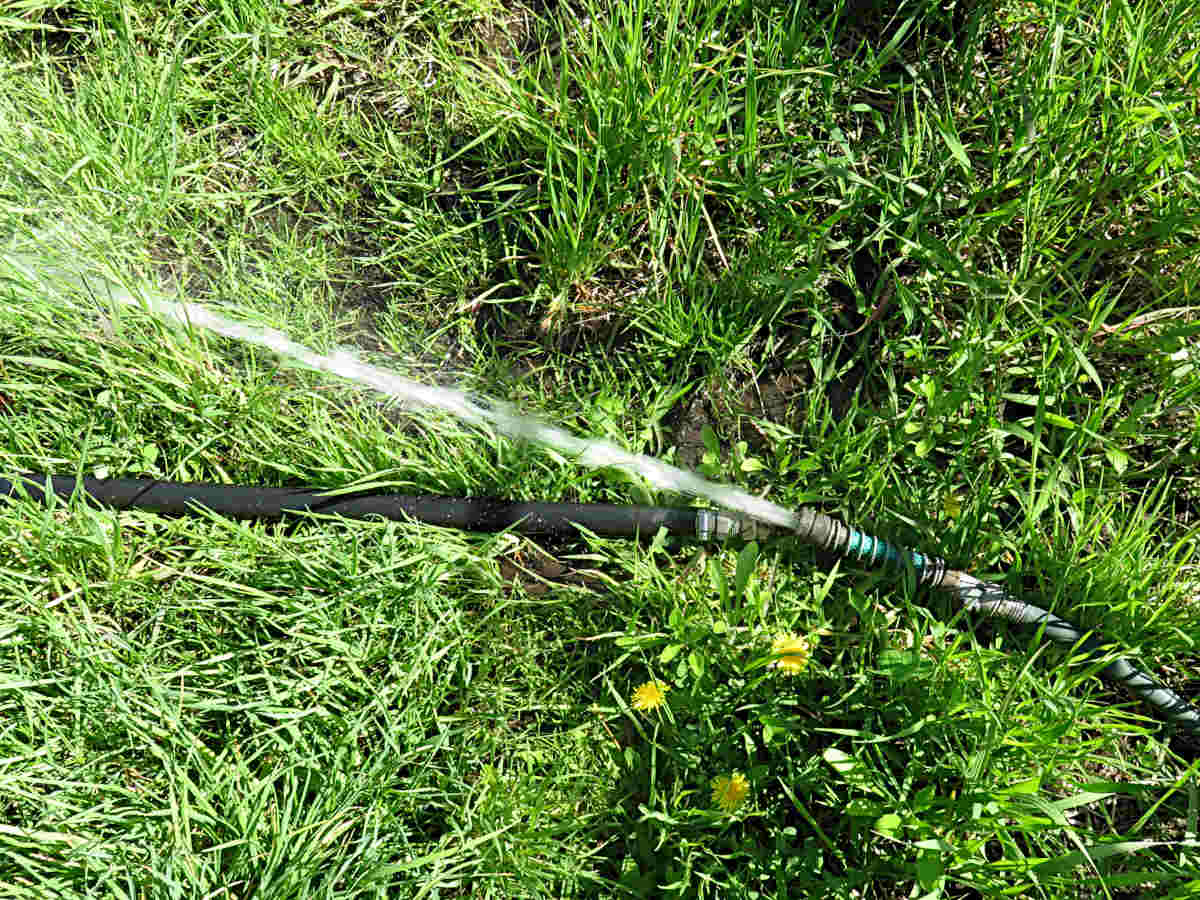
Gushing is good!

A gushing water hose—nothing more normal and mundane wherever electricity for pressurized pumping, and of course WATER, are in plentiful supply. This tiny farm is in such a place, yet the gushing hose signals something much happier, an elevated event, because it’s proof positive that the dug well that irrigates the field is back in action once again after another frozen winter.

Priming the pump is usually a mid-May thing, when freezing is over. The operation is simple enough: slowly pour a couple of gallons of water into the pump so it backfills the pipe that goes into the well, turn on the pump, and wait for it to catch. It may take two or three top-ups and retries. When water gushes, the pump is primed for the season! It’s not foolproof, though, the pipe could’ve gotten hopeless clogged, or the well-used and dilapidated pump and tank could decide to give up a seal or conk out entirely. Then the simple would likely become costly repairs or replacement. But not this time!

Details! If the irrigation fittings look small, they are indeed. I’ve seen photos of irrigation set-ups on big farms that are full scale waterworks, orderly grids of giant pipes. Here, the setup is a 1″ plastic pipe that snakes above-ground out into the field—it’s the disconnected part on the left. The pipe can be this small because it’s only meant for low-pressure drip irrigation, hand watering by hose, or a few sprinklers at a time: not every day, all crops, all the time. Also, a dug well like the one here doesn’t have an endless water supply, you don’t want to get ahead of its reservoir size and replenishment rate. Finally, the longer the pipe, the lower the pressure the closer you get to the end. Here there’s about 400′ of it, and you can notice the pressure difference at each of the taps spaced along it. It’s not geared to intense large-scale production, instead, a low cost way to connect a fairly distant water source to a thirsty veggie plot when there’s the need!
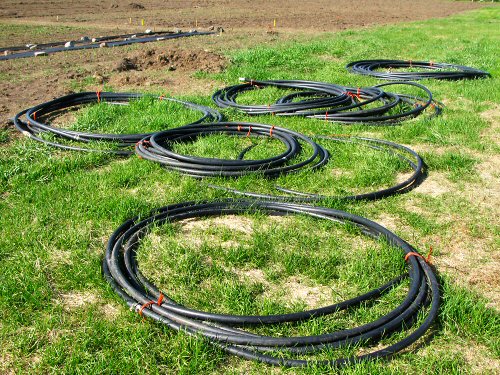
Water pipe

Irrigation pipe

A bonus this spring has been the steady rain, not too frequent, like, once a week or so, and somewhere around 1″ (2.5cm) each time. Perfect! Still, today, in the middle of a hot, sunny stretch, thoughts turned to water (not that it was ever far from mind). Out came the coils of 1″ water pipe. In our barebones spot irrigation system, there’s 1″ pipe and a bit of 2-1/2″ pipe, endless 5/8″ garden hose and 50′ sections of soaker hose, the gas-powered irrigation pump, and even 55-gallon barrels and watering cans. Not to mention, piles shut-off valves, quick connectors, and various hose fittings. For now, all that I’m looking to set up is one central line running from the well pump at the house, right down the length of the side-by-side fields, where it can feed the garden hoses. So, uncoiling we go…

Bringing in the pump

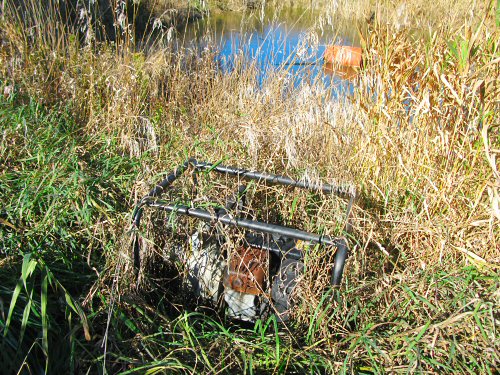
The trusty 6hp irrigation pump was dutifully hauled out to the pond in May, and never seen and barely thought of since. Besides priming it when it was first set out, it had zero use this year. That’s what happens when you get many inches of rain a month, every month, for an entire season. I could’ve brought it in a lot earlier to save it from some weather beating, but today was the day (and it’s a pretty rugged, all-weather pump). So, into the Kubota compact tractor’s loader bucket, and back to the drive shed. Test run for a while, drain the water, and it’s away for the winter!

More carrots…

A good stretch in the field today. Harvested a bushel and a half of carrots (huge Danvers Half Long, enough to last through the winter) and a bushel of beets, a mix of red, golden and the Chioggia striped. Mulched another garlic bed, leaving just one uncovered. Did some clean-up with the compact tractor, moving empty barrels, turning crop remains into one end of the compost windrow. Took a trip down to the pond: it’s unfrozen, with only a layer of ice on top…

The pond is as full as it gets. Normal level is several feet lower, after the winter runoff evaporates, usually sometime in June. The barrel is a float that keeps the end of the uptake hose that leads to the pump suspended above the bottom.