
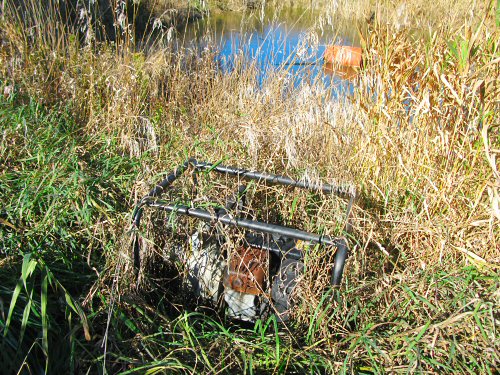
The trusty 6hp irrigation pump was dutifully hauled out to the pond in May, and never seen and barely thought of since. Besides priming it when it was first set out, it had zero use this year. That’s what happens when you get many inches of rain a month, every month, for an entire season. I could’ve brought it in a lot earlier to save it from some weather beating, but today was the day (and it’s a pretty rugged, all-weather pump). So, into the Kubota compact tractor’s loader bucket, and back to the drive shed. Test run for a while, drain the water, and it’s away for the winter!
pond

Summer days
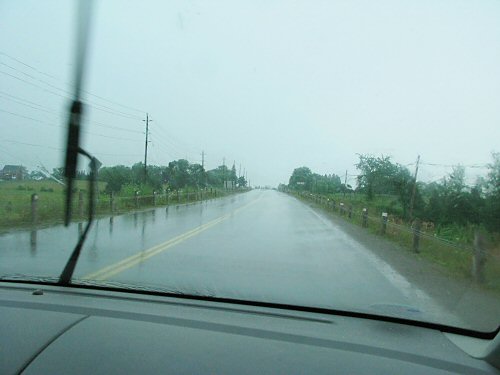
For a the better part of most days for the last couple of months, this, the return view from dropping off Monday CSA shares, has been the Weather. Cloud and rain. There are occasional sunny days. I haven’t been keeping accurate count, but that can’t be far off. We’ve several times enjoyed 2″ (5cm) of rain in a week. I haven’t thought about hoses in weeks, except when moving them out of the way to mow down prolifically multiplying weeds on the garden paths. On the way to the Saturday farmers’ market, I barely glance at the pond to check the level (the pond is out of the way down near the highway, most easily seen when driving by). This summer, water has not been a problem!
Tangling with hoses
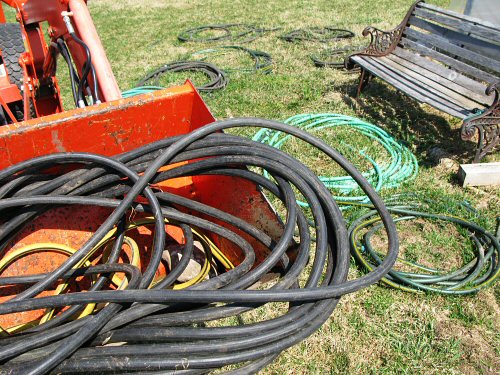
In smaller gardens (tinier farms!), hoses are generally a fact of life. In spring, it’s time to uncoil them all, check the fittings, and get set to deliver water largely by hand.
On BIG veggie farms, “hoses” are usually big pipes (3″/7.5cm and up), part of full-blown irrigation systems that suck up and spew MILLIONS of liters of water a season. Here on this tiny farm, we’re way closer to the garden hose end of the scale.
Our irrigation system is a work in progress. Drip tape is the ultimate goal, but there are obstacles to work around, like the limited water available from the barn well, and the distance to and lack of electricity at the spring-fed pond. Right now, watering is about regular 5/8″ hoses, fed by a 1″ plastic pipe that runs from the barn well to the pond located WAY at the other end of the field, with taps at 100′ intervals.
Actual watering is done with a combination of soaker hoses, sprinklers when there’s no wind, and various hand nozzles for watering in newly seeded beds. Quick connectors are a major convenience when hooking up the various combos of multiple hoses and other attachments. I try to find a balance between not too many hoses, because you can’t leave them lying around, and not so few that you’re moving the same rig all over the plot.
Accidentally tilling hoses that were left snaking around instead of being promptly put away has turned into a not absolutely rare occurrence, and a time-waster (untangling and splicing takes more than a minute). Just put away that 300′ of hose plus 500′ of soaker hose when you’re done! ;)
Spot irrigation with hoses on two acres is a bit tedious, but like everything else, you do get used to it, it’s part of the routine, and it gets the job done, which is satisfying in the end…
That’s the state of the watering art around here as we head into a new season, and I’m promising myself advances on the drip side of things. Of course, it could happen to rain all the time, about an inch (2.5cm) once a week would be fine, and then hoses would largely vanish from the garden landscape. That’s not at all that likely (and when it’s a really rainy year, you wish for hot, sunny hose weather), but…YOU NEVER KNOW!
More carrots…
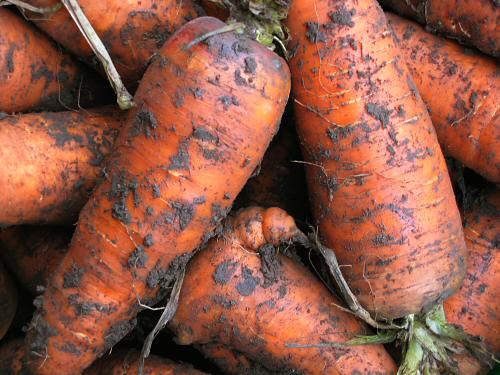
A good stretch in the field today. Harvested a bushel and a half of carrots (huge Danvers Half Long, enough to last through the winter) and a bushel of beets, a mix of red, golden and the Chioggia striped. Mulched another garlic bed, leaving just one uncovered. Did some clean-up with the compact tractor, moving empty barrels, turning crop remains into one end of the compost windrow. Took a trip down to the pond: it’s unfrozen, with only a layer of ice on top…
The pond is as full as it gets. Normal level is several feet lower, after the winter runoff evaporates, usually sometime in June. The barrel is a float that keeps the end of the uptake hose that leads to the pump suspended above the bottom.
At last, rain!
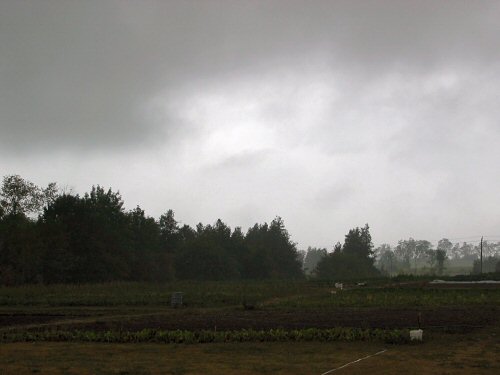
Gloomy, overcast, a typical rainy day…and it actually rained! A couple of heavy downpours and a few gentler extended falls added up to a satisfying full inch (25mm) over a few hours. This is great timing for the second planting of summer squash, which is just starting to produce heavily, and for, well, everything else! Even the pond filled up nicely. It’s too late to make up for nearly three months of near zero rainfall, calculating that effect is best left to the quieter late fall and winter months, when the lessons of the season are reviewed and new year plans get firmed up. Right now, it’s all forward looking, week to week, harvest to harvest. Any decent rain is excellent!
Pond and pump
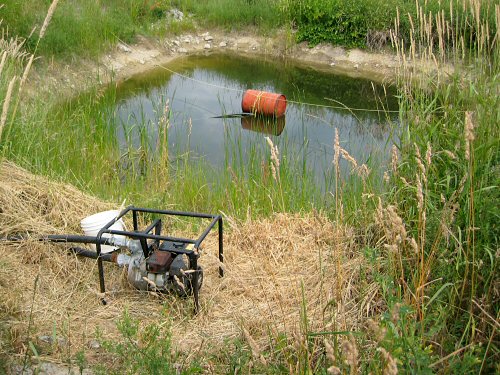
With only a little over an inch (25mm) of rain for most of June, and a near constant breeze on top of sun and heat to help dry things out quicker, we’ve had to hit the pond. Full irrigation here is a time-consuming process, involving dragging around and repositioning a network of hoses, soaker hoses, and sprinklers, and making trips every couple of hours to refill the pump set-up by the pond (see also “Pond and barrel”). The pond was dug out a couple of years ago, is ground-fed, drops level at an alarming rate (it starts the season full to the top of the photo), and replenishes slowly. If you look closely at the perimeter, the darker strip just above the water shows the level drop just for today. Still, it was used quite heavily last year and I’ve yet to see bottom! Meanwhile, I’m visualizing RAIN!
Pond and barrel
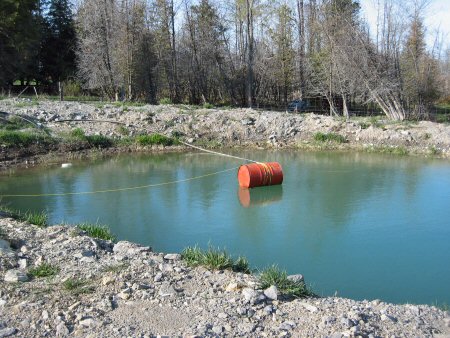
This spring-fed pond was dug out last year from what was only a slightly soggy low end of the field. It holds around 30-40,000 gallons of water for not so rainy days. The barrel acts as a float, holding in position, suspended above the muck on the bottom, a plastic intake pipe that leads to the pump.