
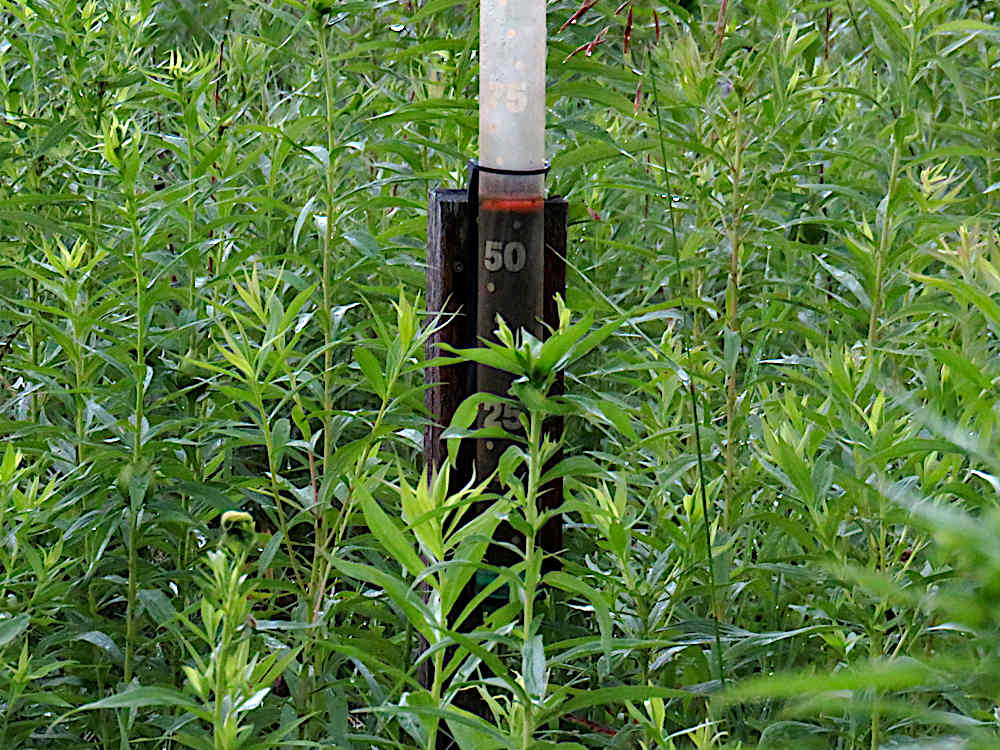
The jumbo rain gauge really can be seen from 50′ (15 m) away. That plus a decent zoom on my camera meant I didn’t have to wade into tall wet goldenrod to see how much today’s thunder and rain added up to. Two inches at least, accounting for the little that hadn’t been emptied out from a sprinkling last night. Erratic weather means some nice patches as well as extremes. After our second mini-heatwave, it’s been just beautiful. Sunny, low to mid-20s, with breezes and no humidity. And now, some rain. Well, a lot of rain. Still, weird for being old days normal, and great! Another week like this in the forecast. And then, what’s next?!
rain
The puddle returns!
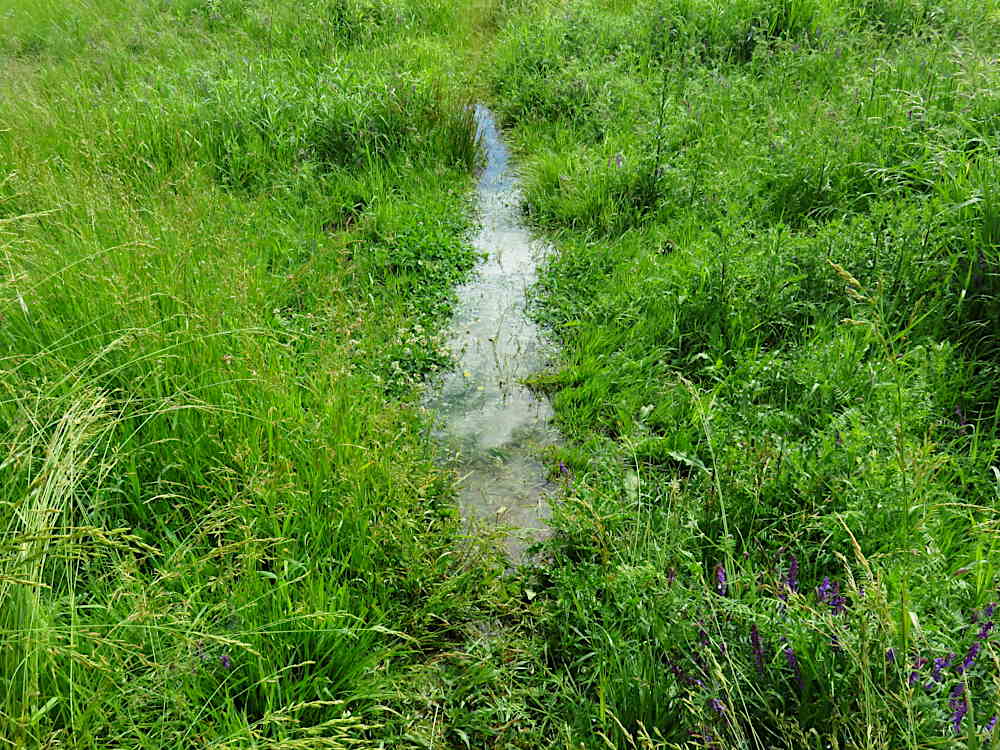
After a pretty impressive inch and a half (3.75 cm) of overnight rain, my water table indicator puddle is back. Not usual this far into June, but there has been a lot of falling water recently. You can see the water in the tamped down route of my path to the veg field, but it also extends into the grass on both sides. A mini-Everglades. If the veggies were planted right here, it would be a problem: plants breathe through their roots, so they’d be spluttering for air, in danger of drowning! Luckily, the veg patch starts not far off, but up a gentle slope, so, pretty much high and drier. With the clouds and rain of this May extending into June, and a few days of a heat wave-ish break, the weather pattern of the last 20 years holds true—there is no pattern!
Mud on the leaves
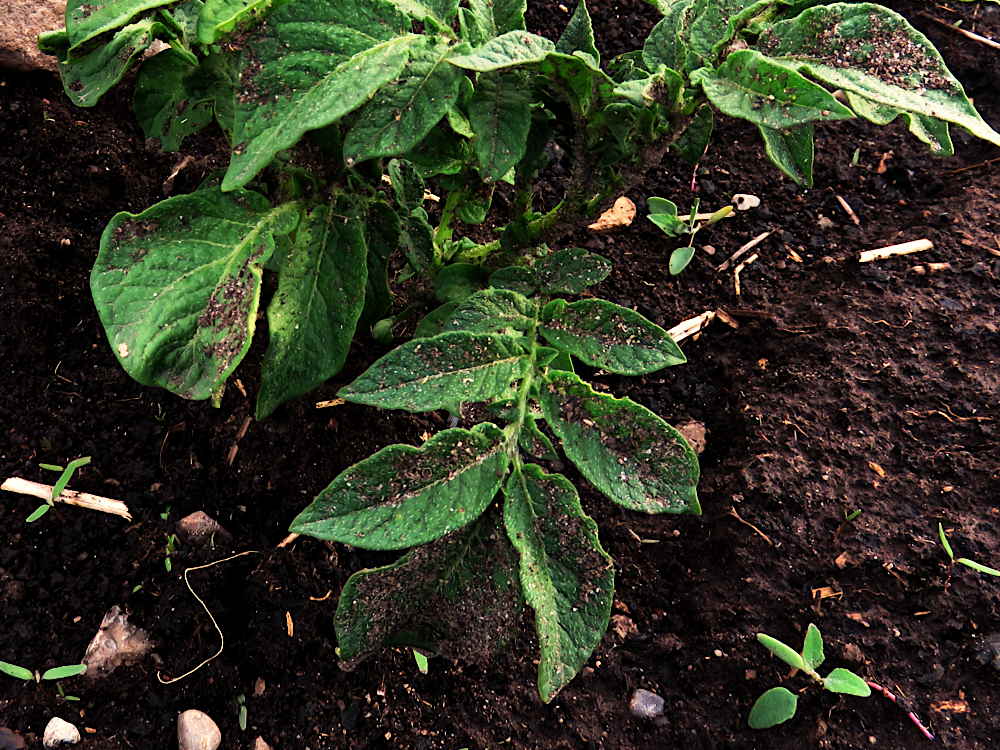
[From yesterday] Unless someone went wild with a hose, mud on the leaves is a sure sign of heavy, pelting rain. It came down this afternoon while I was on a supply run to town, hidden away in a giant box store, completely disconnected from big weather events (that is, until the power went out, which was its own little adventure in a dimly lit cavern). Back in the field, taking stock, the veggie plot was nicely watered in, the rain gauge read a decent half inch (1.25 cm), and no plant problems, just mud-splatter.
These potato plants do a good job of illustrating the ability of pounding rain to throw up a startling amount of dirt. Still, it’s really only of particular veg garden interest if you have to harvest in quantity. Grabbing some salad greens for dinner, a quick mud rinse and into the salad spinner, no problem. On the other hand, harvesting quantities of lettuce, baby salad greens, beets, radish, and carrots with tops, anything with leaves low to the ground right after a deluge becomes instant extra rinsing work. Which adds up! Of course, rain is manna from heaven for growing stuff. We can’t ever wish rain away, at least not around here (well, not most years). Harvest mud is just one of those things to take in stride…
The tree at the end of the field
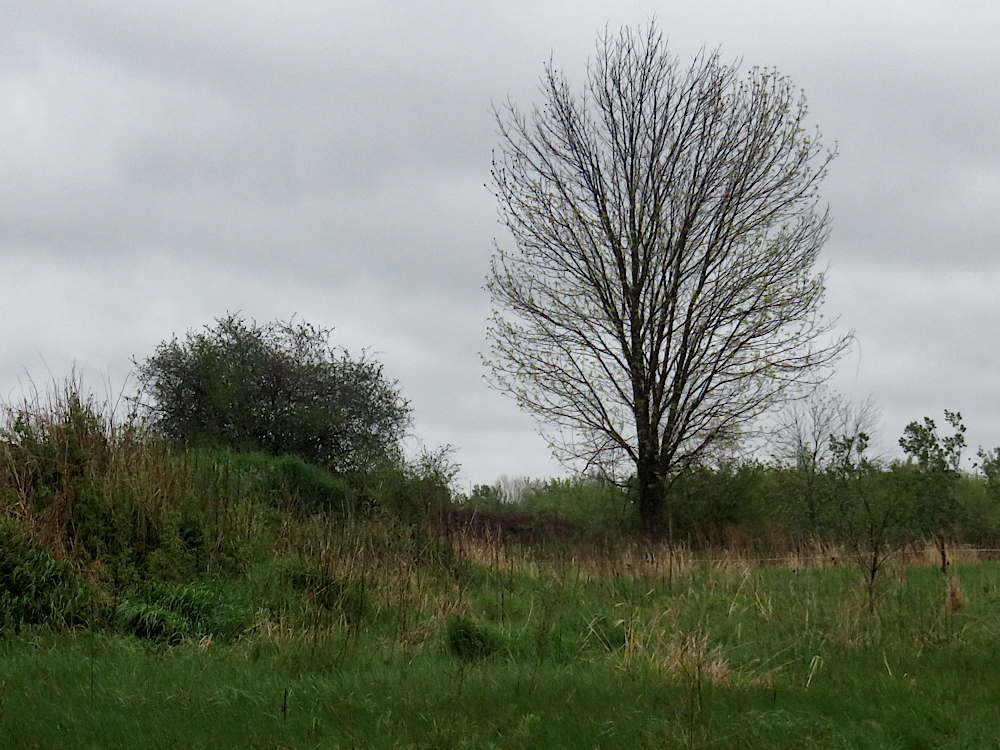
The sun’s almost set but the howling wind and bursts of heavy rain aren’t slowing down. It’s pretty wild out there, with ankle-deep marshy wet patches hidden in the grass. Stepped out for a last look around, and the tree at the end of the field caught my eye as it usually does. It stands in the middle of a large pasture, far from the woods, at the point where the main veggie beds end. It seems quite independent, holding back on the leaves when the other trees are already green, exactly the same shape year round, with leaves or without. Lots of big trees, sheltered in the surrounding forest, were snapped like twigs in the big wind and ice storms of the last four-five years, but this guy remains unbothered. I’m glad because it’s a central part of the tiny farming scenery here these last many years. Would be sad to see it snapped!
The water is high
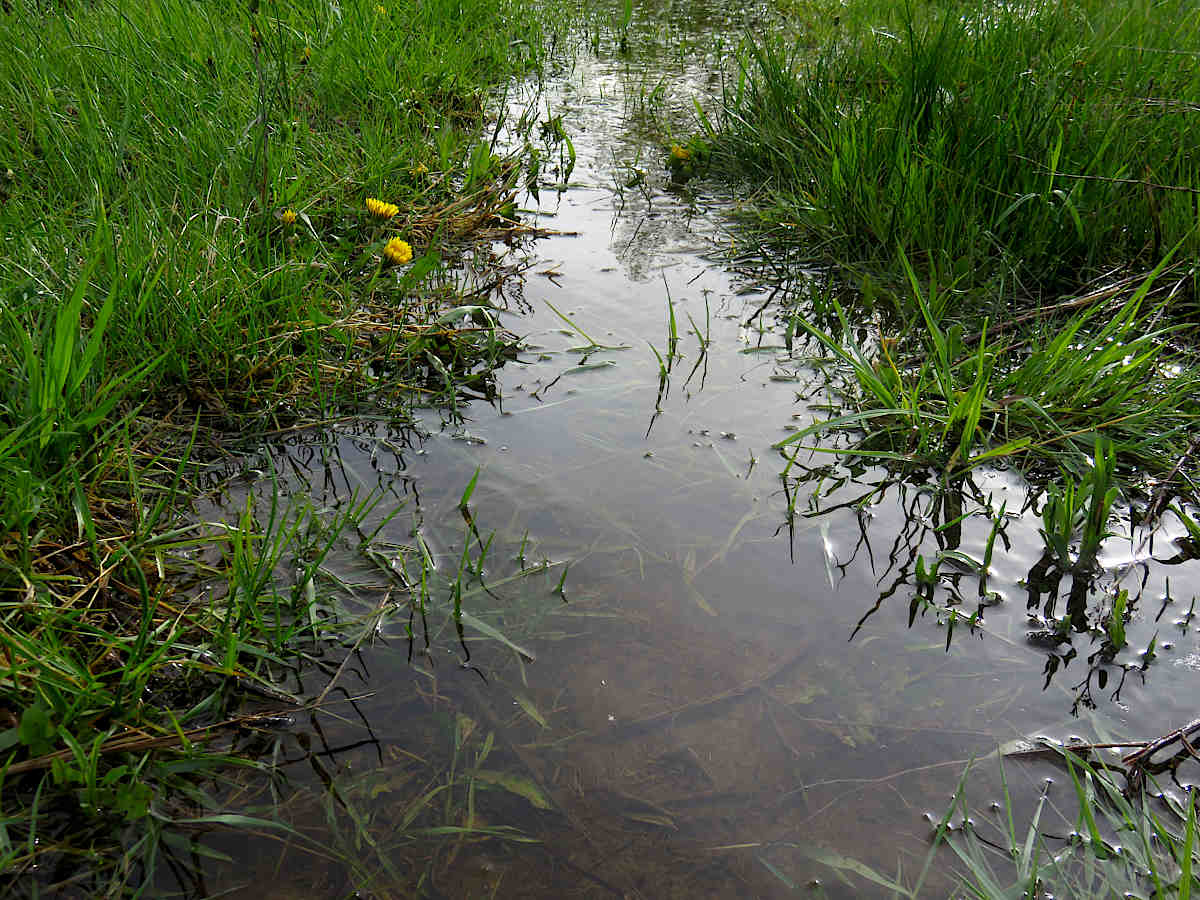
If you live in a big North American city—the kind of cities I’m familiar with—the average ground is asphalt and concrete, and water table is not a household term. If on the other hand you rely on a well, or a smaller town water processing plant, or you grow things at some scale, water table is a big deal. You know the term whether or not you understand it beyond the basic idea of either abundant water or water shortage, and drought.
The puddle zone in the photo, in a particularly low-lying area of the field that my path to the veg garden cuts through, is my own local water table indicator. Earlier in spring, with snow melt-off and the ground still frozen quite far down, it starts out as a shallow pond, to be sloshed through in rubber boots. As the ground unfreezes and the water seeps off, down goes the puddle pond, until it disappears leaving dry ground. This is the water table level, like an underground lake or ocean that’s everywhere, except unlike when it breaks out in an open lake, here the water is running through soil. The lower the table gets, the drier the ground and the less water there is around. When you see a river dramatically drop in a droughty summer, that’s the water table, going down!
This year, the puddle has been dry for a couple of weeks, but after nearly two inches (5 cm) of recent rain, it’s back! Nearly a whole day later, it’s still pretty big, which means, lots of water right at the surface. At this point in the year, its main meaning to me is that lower spots in the field will still get a little flooded, so don’t plant there for a bit! Later on, since there’s no open water near the garden field, if we haven’t had rain for a long while, I’ll start checking the level in the dug well—lower down the string!
Snow fights rain
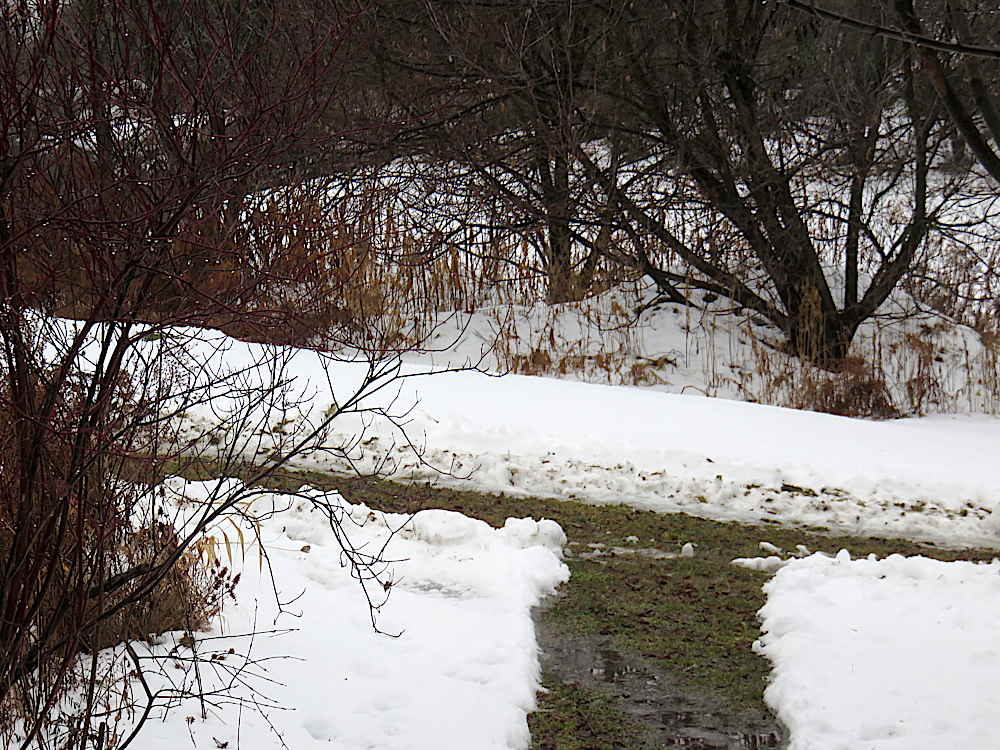
Snow fought the rain, and so far, the snow won. A rainy day in December around here doesn’t leave the prettiest picture. The paths through the snow are down to a mucky couple of inches on top of the frozen ground. But it looks like the rest of the whiteness will be sticking around for now.
Clouds within clouds
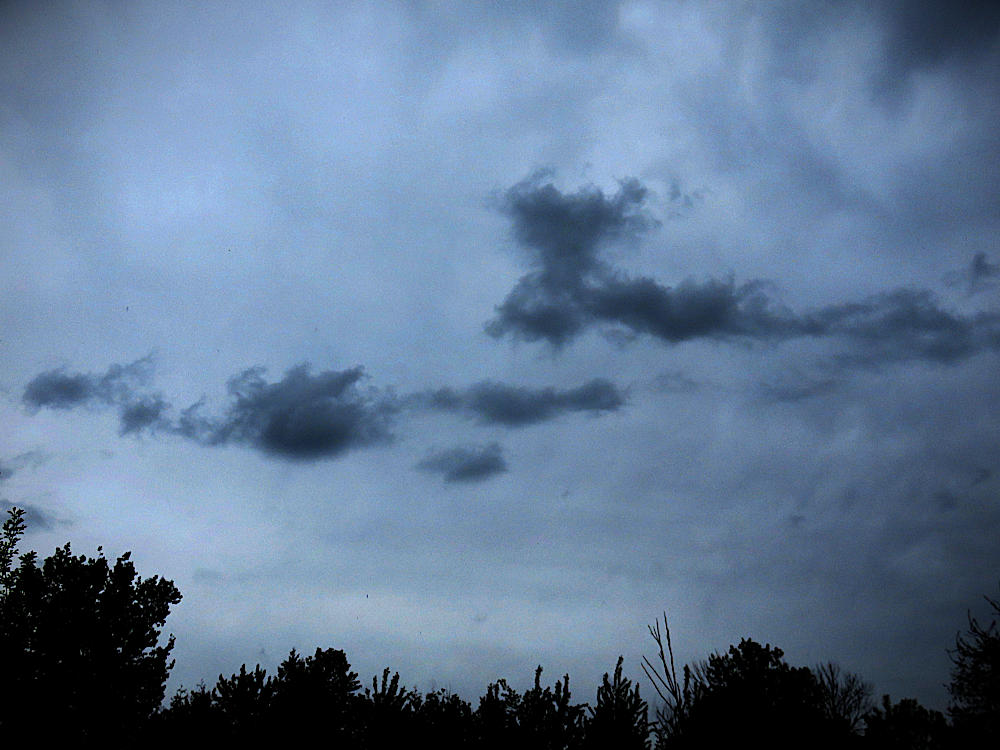
Not to exaggerate this mainly cloudy stretch, it’s just that when I look up lately, something like this is what I usually see. To be fair, in the last 10 or so mainly cloudy days, there’ve been decent sunny breaks, a few hours at a time here and there. Plus, pleasing bits of rain, enough to keep the seedings wet. And temperature’s been good: not too hot, not too cold, and mild overnight. So, no real garden complaints. This photo kinda captures the whole cloudy-rainy situation. Clouds!